Cyanobacterial bloom at Ash River Harbor near Voyageurs National Park
Cyanobacterial bloom at Ash River Harbor near Voyageurs National ParkCyanobacterial bloom in Kabetogama Lake with fall leaves in the background


Official websites use .gov
A .gov website belongs to an official government organization in the United States.

Secure .gov websites use HTTPS
A lock () or https:// means you’ve safely connected to the .gov website. Share sensitive information only on official, secure websites.


Cyanobacterial bloom in Kabetogama Lake with fall leaves in the background
Cyanobacterial bloom in Kabetogama Lake with fall leaves in the background

Algal bloom near the Ash River boat dock, a public access point for boating and fishing on Kabetogama Lake. Microcystin has been detected at this location and at nearby Sullivan Bay at concentrations exceeding recreational guidelines.
Algal bloom near the Ash River boat dock, a public access point for boating and fishing on Kabetogama Lake. Microcystin has been detected at this location and at nearby Sullivan Bay at concentrations exceeding recreational guidelines.

An algal bloom near the Ash River Visitor Center at Kabetogama Lake, where visitors enjoy picnics and trails year-round.
An algal bloom near the Ash River Visitor Center at Kabetogama Lake, where visitors enjoy picnics and trails year-round.

Eosin-nigrosin staining of spermatozoa from common carp (Cyprinus carpio) testes collected from the Lake Mead National Recreation Area, Nevada
Eosin-nigrosin staining of spermatozoa from common carp (Cyprinus carpio) testes collected from the Lake Mead National Recreation Area, Nevada
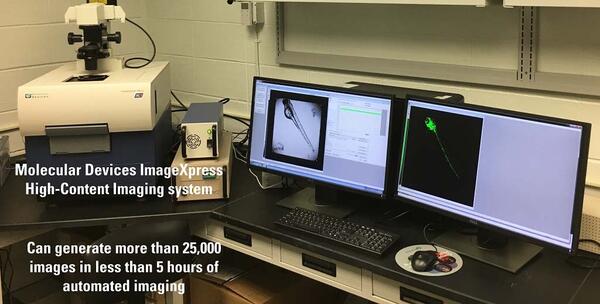
Molecular Devices ImageXpress† High-Content Imaging System that can generate more than 25,000 images in less than 5 hours of automated image acquisition.
Molecular Devices ImageXpress† High-Content Imaging System that can generate more than 25,000 images in less than 5 hours of automated image acquisition.

Keith A. Loftin, USGS, is the lead scientist for algal and cyanobacterial toxins
Keith A. Loftin, USGS, is the lead scientist for algal and cyanobacterial toxins
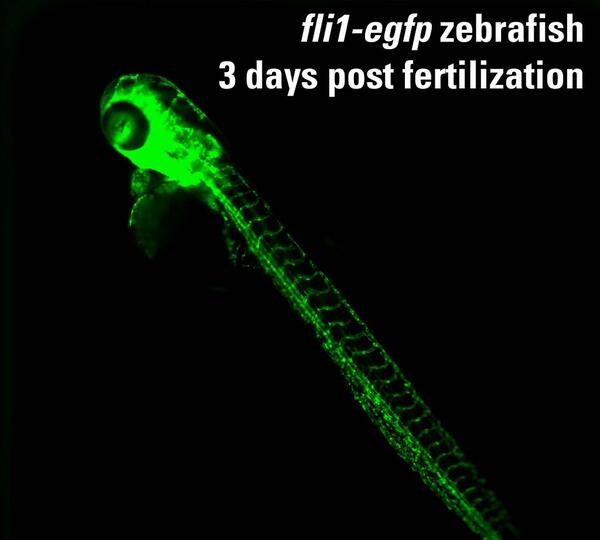
Using the 384-well plate format, a single zebrafish embryo is tested in each well. This is an example of a 72 hour post fertilization fli1:egfp zebrafish (3 millimeters long) imaged under a fluorescein isothiocyanate (FITC) filter.
Using the 384-well plate format, a single zebrafish embryo is tested in each well. This is an example of a 72 hour post fertilization fli1:egfp zebrafish (3 millimeters long) imaged under a fluorescein isothiocyanate (FITC) filter.

U.S. Geological Survey (USGS) scientist working on data analysis of cyanotoxins in water samples
U.S. Geological Survey (USGS) scientist working on data analysis of cyanotoxins in water samples

Microscopic video imaging is used for computerized analysis of sperm motility parameters
Microscopic video imaging is used for computerized analysis of sperm motility parameters

A USGS scientist prepares a sample to test the effect of antibiotics on denitrifying bacteria within a glove box. A glove box allows scientists to work with samples in an anaerobic (no oxygen) atmosphere, the conditions under which denitrification occurs.
A USGS scientist prepares a sample to test the effect of antibiotics on denitrifying bacteria within a glove box. A glove box allows scientists to work with samples in an anaerobic (no oxygen) atmosphere, the conditions under which denitrification occurs.
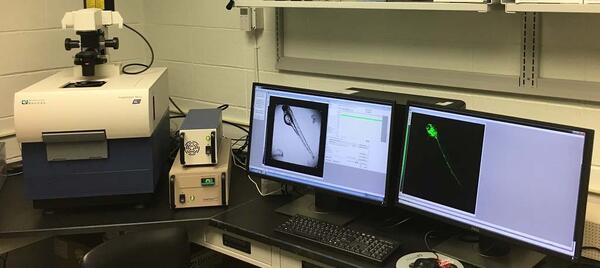
Molecular Devices ImageXpress† High-Content Imaging System
Molecular Devices ImageXpress† High-Content Imaging System

USGS scientists evaluating the nebulizer assembly in a mixed mode ionization source of a triple quadrupole mass spectrometer used to measure individual cyanotoxins
USGS scientists evaluating the nebulizer assembly in a mixed mode ionization source of a triple quadrupole mass spectrometer used to measure individual cyanotoxins

Tablet-enabled field forms have been developed to help coordinate field efforts, collect site information, GPS coordinates, photos, and control data collection.
Tablet-enabled field forms have been developed to help coordinate field efforts, collect site information, GPS coordinates, photos, and control data collection.

Between 2009 and 2018, scientists conducted a national scale assessment of mercury accumulation in the National Park System using dragonfly larvae as biosentinels (species that accumulate a pollutant in their tissues as an index of exposure to other organisms without significant adverse effects to the biosentinel) through a citizen science network called the Dragonf
Between 2009 and 2018, scientists conducted a national scale assessment of mercury accumulation in the National Park System using dragonfly larvae as biosentinels (species that accumulate a pollutant in their tissues as an index of exposure to other organisms without significant adverse effects to the biosentinel) through a citizen science network called the Dragonf

Cover of the 2018 publication, "California’s Fourth Climate Change Assessment: Statewide Summary Report."
Cover of the 2018 publication, "California’s Fourth Climate Change Assessment: Statewide Summary Report."

This image shows citizen scientists along with National Park Service personnel identifying invertebrates as part of the Dragonfly Mercury Project.
This image shows citizen scientists along with National Park Service personnel identifying invertebrates as part of the Dragonfly Mercury Project.

After 100 years of restricted tidal activity to support agricultural use and salt harvesting, the tidal marshes around San Francisco Bay, like this one at Bair Island, are steadily rebuilding, returning to a stunning mosaic of marsh, mudflat, and channels.
After 100 years of restricted tidal activity to support agricultural use and salt harvesting, the tidal marshes around San Francisco Bay, like this one at Bair Island, are steadily rebuilding, returning to a stunning mosaic of marsh, mudflat, and channels.

Citizen scientists after a day of collecting dragonfly larvae for the Dragonfly Mercury Project.
Citizen scientists after a day of collecting dragonfly larvae for the Dragonfly Mercury Project.

A U.S.
High-Content Screening Laboratory -- Columbia, Missouri
High-Content Screening Laboratory -- Columbia, Missouri
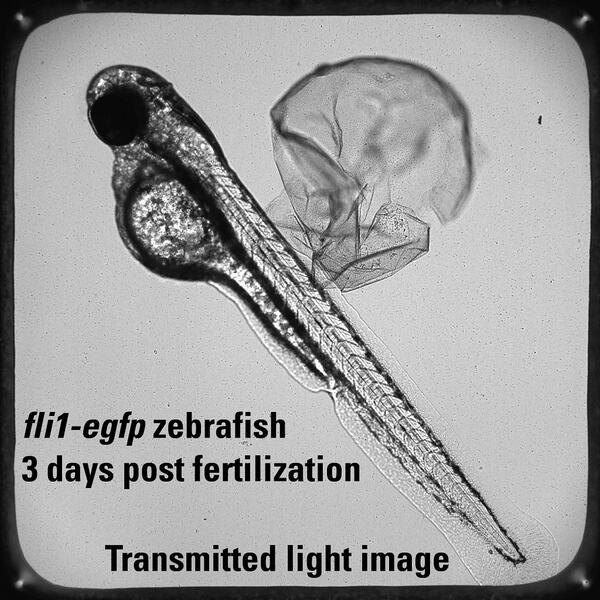
This is an example of a 72 hour post fertilization fli1:egfp zebrafish (3 millimeters long) imaged under transmitted light. The same imaging system with was used.
This is an example of a 72 hour post fertilization fli1:egfp zebrafish (3 millimeters long) imaged under transmitted light. The same imaging system with was used.