



Integrated Science Teams
Biologists, ecologists, toxicologists, hydrologists, chemists, and geographers work together in the field and laboratories across the United States
Biologists, ecologists, toxicologists, hydrologists, chemists, and geographers work together in the field and laboratories across the United States
Questions We Answer
Examples of how specialized teams of scientists answer high priority environmental health science questions.
Examples of how specialized teams of scientists answer high priority environmental health science questions.
Featured Science Activities
Science activities are summarized in a series of feature articles
Science activities are summarized in a series of feature articles
Contaminant Biology
Science Centers and scientists supported by Contaminant Biology develop and apply advanced laboratory methods, field investigations, and modeling capabilities to understand toxicity and effects of environmental contaminant and pathogen exposure.
Featured Science Activities
Featured Science Activities

Our Featured Science Articles highlight Environmental Health Program science activities.
GeoHEALTH-USGS
GeoHEALTH-USGS

The GeoHEALTH–USGS Newsletter—published since 2004—provides information on USGS science activities pertinent to safeguarding the health of fish, wildlife, domesticated animals, and people from environmental exposures to contaminants and pathogens.
News
Our Research on a Tire Chemical and its Impact on Fish Featured in LakeLine Magazine
Our Research on a Tire Chemical and its Impact on Fish Featured in LakeLine Magazine
GeoHEALTH - USGS Newsletter - Issue September 2025
GeoHEALTH - USGS Newsletter - Issue September 2025
GeoHEALTH - USGS Newsletter - Issue August 2025
GeoHEALTH - USGS Newsletter - Issue August 2025
Publications
Per- and polyfluoroalkyl substances in waters associated with oil and gas development in the Denver Basin Per- and polyfluoroalkyl substances in waters associated with oil and gas development in the Denver Basin
Use of per- and polyfluoroalkyl substances (PFAS) in the petroleum industry could be a cause for concern due to the large volumes of produced water (PW) generated during oil and gas extraction, the reuse of these wastes in water-stressed regions, and adverse health outcomes related to PFAS exposures. However, PW PFAS characterization is nearly absent in the literature, and hydraulic...
Pathways for potential exposure to onshore oil and gas wastewater: What we need to know to protect human health Pathways for potential exposure to onshore oil and gas wastewater: What we need to know to protect human health
Produced water is a chemically complex waste stream generated during oil and gas development. Roughly four trillion liters were generated onshore in the United States in 2021 (ALL Consulting, 2022, https://www.gwpc.org/wp-content/uploads/2021/09/2021_Produced_Water_Volumes.pdf). Efforts are underway to expand historic uses of produced water to offset freshwater needs in water-stressed...
Anaerobic biodegradation of perfluorooctane sulfonate (PFOS) and microbial community composition in soil amended with a dechlorinating culture and chlorinated solvents Anaerobic biodegradation of perfluorooctane sulfonate (PFOS) and microbial community composition in soil amended with a dechlorinating culture and chlorinated solvents
Perfluorooctane sulfonate (PFOS), one of the most frequently detected per- and polyfluoroalkyl substances (PFAS) occurring in soil, surface water, and groundwater near sites contaminated with aqueous film-forming foam (AFFF), has proven to be recalcitrant to many destructive remedies, including chemical oxidation. We investigated the potential to utilize microbially mediated reduction
Science

2026 Environmental Health Program Highlights
The USGS’s environmental health research in 2026 advanced national priorities focused on strengthening America’s energy future, supporting responsible mineral development, continuing scientific integrity, and improving environmental resilience. The studies highlighted below, show how USGS scientists in the Environmental Health (EH) Program delivered actionable, trusted science through improved...
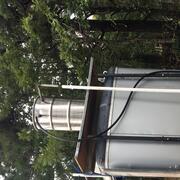
Not All PFAS Are Alike: Fish Responses Reveal The Importance Of Real-World Mixtures
A USGS study demonstrates the importance of monitoring not just the amount of PFAS in groundwater, but the PFAS mixture present. Building on two decades of experience conducting mobile laboratory experiments, USGS researchers applied this approach at a contaminated fire training area to evaluate how fish respond to complex PFAS mixtures, providing important scientific evidence that can improve how...
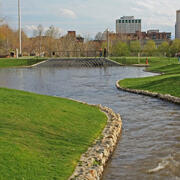
A Decade of Data Reveals Imidacloprid (a common insecticide) is Increasing in American Rivers
Imidacloprid, a commonly used insecticide in both agricultural and urban settings, is reaching rivers and streams across the country, where it can potentially harm the aquatic insects and other organisms that support healthy freshwater ecosystems. A decade‑long USGS study found this insecticide in nearly half of all samples, often at levels above chronic health benchmarks and present throughout...