The team of USGS scientists collected stream water samples before and after rainfall events for this study. In this photo a USGS scientist is taking measurements of field parameters (dissolved oxygen, water temperature, specific conductance, and pH) from New York Branch, Iowa, at low flow (baseflow) conditions.
Images
The team of USGS scientists collected stream water samples before and after rainfall events for this study. In this photo a USGS scientist is taking measurements of field parameters (dissolved oxygen, water temperature, specific conductance, and pH) from New York Branch, Iowa, at low flow (baseflow) conditions.
Strongly discolored stream water following a manure spill
Strongly discolored stream water following a manure spillView of stream water following a manure spill, which has strongly discolored the water.
Strongly discolored stream water following a manure spill
Strongly discolored stream water following a manure spillView of stream water following a manure spill, which has strongly discolored the water.
Upper Workings of Pennsylvania Mine in Headwaters of Peru CreeK, CO
Upper Workings of Pennsylvania Mine in Headwaters of Peru CreeK, COUpper workings of the Pennsylvania Mine in the headwaters of Peru Creek, Colorado.
Upper Workings of Pennsylvania Mine in Headwaters of Peru CreeK, CO
Upper Workings of Pennsylvania Mine in Headwaters of Peru CreeK, COUpper workings of the Pennsylvania Mine in the headwaters of Peru Creek, Colorado.
Mountain Sheep Spring, Arizona, is one of the 37 springs north of the Grand Canyon near areas of breccia-pipe uranium mining that U.S. Geological Survey (USGS) scientists studied.
This cyanobacterium has radiating filaments and basal heterocysts. Green is Sytox Green (a DNA stain that is excluded from live cells).
Schmutz Spring, Arizona, is one of the 37 springs north of the Grand Canyon near areas of breccia-pipe uranium mining that U.S. Geological Survey (USGS) scientists studied.
Pigeon Canyon in northern Arizona is just north of the Grand Canyon
Pigeon Canyon in northern Arizona is just north of the Grand CanyonPigeon Canyon in northern Arizona is just north of the Grand Canyon. Here, Pigeon Spring emerges in Pigeon Canyon just before it merges with Snake Gulch in northern Arizona.
Pigeon Canyon in northern Arizona is just north of the Grand Canyon
Pigeon Canyon in northern Arizona is just north of the Grand CanyonPigeon Canyon in northern Arizona is just north of the Grand Canyon. Here, Pigeon Spring emerges in Pigeon Canyon just before it merges with Snake Gulch in northern Arizona.
USGS Scientists Installing Passive Sediment Samplers near Hancock, WI
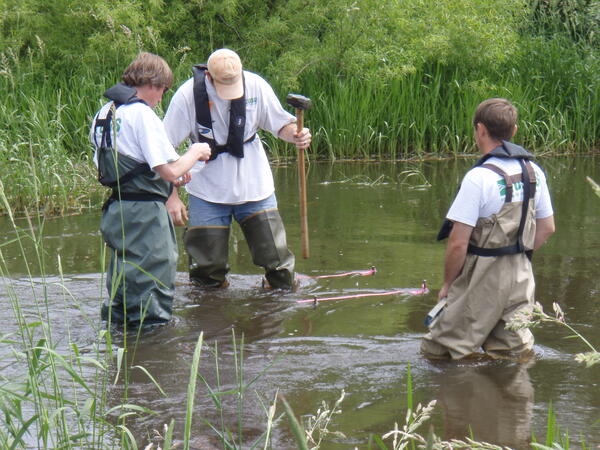
USGS Scientists Installing Passive Sediment Samplers near Hancock, WIUSGS scientists installing passive sediment samplers in an irrigation ditch near Hancock, Wisconsin. The samplers are designed to collect suspended sediment from streams over a 3-week period.
USGS Scientists Installing Passive Sediment Samplers near Hancock, WI
USGS Scientists Installing Passive Sediment Samplers near Hancock, WIUSGS scientists installing passive sediment samplers in an irrigation ditch near Hancock, Wisconsin. The samplers are designed to collect suspended sediment from streams over a 3-week period.
USGS scientist collecting water samples from an amphibian monitoring
USGS scientist collecting water samples from an amphibian monitoringUSGS scientist collecting water samples from an amphibian monitoring site in Livermore, California.
USGS scientist collecting water samples from an amphibian monitoring
USGS scientist collecting water samples from an amphibian monitoringUSGS scientist collecting water samples from an amphibian monitoring site in Livermore, California.
USGS scientist collecting water samples for pesticide analysis at Woodward Resevoir Pond near Oakdale, California.
Scanning electron microscopy (SEM) image of diatoms with zinc oxide
Scanning electron microscopy (SEM) image of diatoms with zinc oxideScanning electron microscopy (SEM) image of diatoms with zinc oxide (ZnO) nanoparticles. U.S. Geological Survey (USGS) scientists are studying the linkages between contaminant bioavailability and toxicity, especially in aquatic organisms exposed to metals and metallo-nanomaterials through solution and diet.
Scanning electron microscopy (SEM) image of diatoms with zinc oxide
Scanning electron microscopy (SEM) image of diatoms with zinc oxideScanning electron microscopy (SEM) image of diatoms with zinc oxide (ZnO) nanoparticles. U.S. Geological Survey (USGS) scientists are studying the linkages between contaminant bioavailability and toxicity, especially in aquatic organisms exposed to metals and metallo-nanomaterials through solution and diet.
This photo shows a snow plow and road salt application truck that is used to clear snow and ice from roadways for improving traffic and pedestrian safety. The use of salt to deice pavement can be harmful to aquatic life in urban streams. The USGS is involved in studies that focus on the influence of winter runoff on aquatic ecosystems.
USGS scientists processing samples of combined sewer overflow water
USGS scientists processing samples of combined sewer overflow waterUSGS scientists processing samples of combined sewer overflow water collected after a storm. The samples were analyzed for selected wastewater-related chemicals.
USGS scientists processing samples of combined sewer overflow water
USGS scientists processing samples of combined sewer overflow waterUSGS scientists processing samples of combined sewer overflow water collected after a storm. The samples were analyzed for selected wastewater-related chemicals.
Dissecting a Fish to Determine Possible Endocrine Disruption Effects
Dissecting a Fish to Determine Possible Endocrine Disruption EffectsUSGS scientist dissecting a fish to determine possible effects from exposure to endocrine disrupting contaminants.
Dissecting a Fish to Determine Possible Endocrine Disruption Effects
Dissecting a Fish to Determine Possible Endocrine Disruption EffectsUSGS scientist dissecting a fish to determine possible effects from exposure to endocrine disrupting contaminants.
Equipment for an Bioaugmentation Experiment at the Naval Air Warfare Center (NAWC) Research Site, West Trenton, New Jersey
Equipment for an Bioaugmentation Experiment at the Naval Air Warfare Center (NAWC) Research Site, West Trenton, New JerseyThe set up and equipment used for the bioaugmentation experiment at a fractured-rock contamination site. The site is contaminated with trichloroethene (TCE). The bladders contain the solutions that were injected into the subsurface. The injection well is right in front of the blue barrel.
Equipment for an Bioaugmentation Experiment at the Naval Air Warfare Center (NAWC) Research Site, West Trenton, New Jersey
Equipment for an Bioaugmentation Experiment at the Naval Air Warfare Center (NAWC) Research Site, West Trenton, New JerseyThe set up and equipment used for the bioaugmentation experiment at a fractured-rock contamination site. The site is contaminated with trichloroethene (TCE). The bladders contain the solutions that were injected into the subsurface. The injection well is right in front of the blue barrel.
USGS scientist dissecting a summer flounder. Science Feature that the image was used on was Pesticides Common in California Estuary
U.S. Geological Survey (USGS) scientist Dr. Diann J. Prosser examining a ruddy shelduck in China. Dr. Diann J. Prosser was awarded the Presidential Early Career Awards for Scientists and Engineers (PECASE).
Deposit of Iron-cemented Stream Gravel (Ferricrete)
Deposit of Iron-cemented Stream Gravel (Ferricrete)Deposit of iron-cemented stream gravel (ferricrete) with embedded wood fragments that can be age dated using radiocarbon to determine the age of the ferricrete deposit. Knowing the age of the ferricretes helps scientists determine if the associated enrichment of metals in streams occurred before or after mining in the watershed started.
Deposit of Iron-cemented Stream Gravel (Ferricrete)
Deposit of Iron-cemented Stream Gravel (Ferricrete)Deposit of iron-cemented stream gravel (ferricrete) with embedded wood fragments that can be age dated using radiocarbon to determine the age of the ferricrete deposit. Knowing the age of the ferricretes helps scientists determine if the associated enrichment of metals in streams occurred before or after mining in the watershed started.
Mineral Creek watershed in southwestern Colorado has natural and mining-related sources of contamination. In the background of this photo is a large naturally occurring seep that discharges acidic, metal-rich water to a tributary of Mineral Creek.
Scientists collecting samples of runoff from a test plot
Scientists collecting samples of runoff from a test plotScientists collecting samples of runoff from a test plot during a simulated rainfall event. The field received an application of biosolids, and the runoff samples were analyzed for organic chemicals that are commonly used in our everyday lives.
Scientists collecting samples of runoff from a test plot
Scientists collecting samples of runoff from a test plotScientists collecting samples of runoff from a test plot during a simulated rainfall event. The field received an application of biosolids, and the runoff samples were analyzed for organic chemicals that are commonly used in our everyday lives.
A USGS researcher uses an ASTM-approved vacuum to collect house dust for analysis.