



Contaminants of Concern
Contaminants of Concern
Filter Total Items: 77

U.S. Geological Survey Develops Per- and Polyfluoroalkyl Substances (PFAS) Sampling Guide
USGS scientist’s published a Per- and Polyfluoroalkyl Substances (PFAS) sampling guide for personnel involved with Natural Resource Damage Assessment and Restoration (NRDAR) activities. This guide introduces individuals involved in NRDAR efforts and other investigators to key concepts and considerations when sampling different environmental media for PFAS.

Organic Geochemistry Research Core Technology Team
About the Research The Organic Geochemistry Research Laboratory Core Technology Team (CTT) as part of the Environmental Health Program works to develop targeted and non-targeted analytical methods for the identification and quantitation of chemicals that can impact the health of humans and other organisms, and uses bioassays to screen for receptor inhibition.

Spatiotemporal conditions of vegetation and invasive plant species on mine lands.
To support the Department of Interior's bureaus, states, and local communities, we are developing 1) a document highlighting remote sensing approaches that can be leveraged for site prioritization, recovery design, and long-term assessments of recovery trends, and 2) data products of vegetation conditions, change, recovery potential, and risk of exotic plant invasion on mine lands. We will...

6PPDQ
6PPD-quinone is a compound used to make tires more durable and is also linked to toxicity for Coho Salmon and other aquatic species.

USGS Scientists Develop an Interactive Mapping Tool to Visualize PFAS in Tap Water
A new interactive dashboard is available to visualize PFAS measurements for 716 tap water samples collected at select sites across the nation between 2016 and 2021 from private and public supplies.

Unique Approach to Measure Per- and Polyfluoroalkyl Substances Uptake in Fish, Mussels, and Passive Samplers
Per- and polyfluoroalkyl substances (PFAS) uptake and bioconcentration by fish and mussels ─ housed in mobile laboratories at a legacy fire-training area contaminated by aqueous film-forming foams ─ varied by species, sex, and compound. PFAS in passive samplers deployed at the same time mimicked uptake by fish but not mussels indicating that passive samplers might prove useful as screening tools...

Per-and Polyfluoroalkyl Substances (PFAS) Integrated Science Team
Increasing scientific and public awareness of the widespread distribution of per- and poly-fluoroalkyl substances (PFAS) in U.S. drinking-water supplies, aquatic and terrestrial ecosystems, wildlife, and humans has raised many public health and resource management questions that U.S. Geological Survey's (USGS) science can inform. The USGS Environmental Health Program's PFAS Integrated Science Team...

U.S. Geological Survey Per- and Polyfluoroalkyl Substances Science Strategy Identifies Science Gaps and Opportunities
USGS recently (2022) released a strategic vision document that identifies science gaps and opportunities for per- and polyfluoroalkyl substances (PFAS) monitoring, assessment, and research activities (sampling protocols and analytical methods, environmental sources and source apportionment, environmental occurrence, environmental fate and transport, human and wildlife exposure routes...

Study Provides a Data Resource for Per- and Polyfluoroalkyl Substances in Streams Within Iowa Agricultural Watersheds
Per- and poly fl uoroalkyl substances (PFAS) were detected in streams within agricultural areas (an often-unmeasured landscape) across Iowa. The data from this study provide one resource to understand the extent of PFAS concentrations in water resources from diverse landscapes throughout the United States.

Large Fraction of Unidentified Organofluorine in a Coastal Watershed has Implications for River to Marine Ecosystems
A group of scientists investigated per- and polyfluoroalkyl substances (PFAS) in watersheds on Cape Cod and identified a unique signature for aqueous film forming foams (AFFF) from legacy firefighting and fire training. A combination of statistical modeling and laboratory measurements indicates that unidentified organofluorine constitutes a large fraction of PFAS in the river systems that...
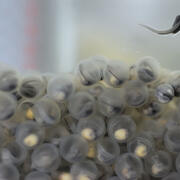
Do Trace Metal Concentrations in the Upper Columbia River Affect Early Life Stage White Sturgeon?
To understand if contaminants are associated with white sturgeon population declines, U.S. Geological Survey scientists reviewed the life history, physiology, and behavior of white sturgeon, along with recent toxicological studies and existing trace metal data for locations in the Columbia River. The analysis indicated that the highest concentrations of copper and other metals in the Columbia...

Ecotoxicology and Ecological Risks of Per‐ and Polyfluoroalkyl Substances
Ecotoxicology and ecological risks of per- and polyfluoroalkyl substances are summarized to highlight critical gaps and uncertainties, and to provide potential approaches to fill those gaps, including the development of targeted monitoring programs and cross-disciplinary approaches.