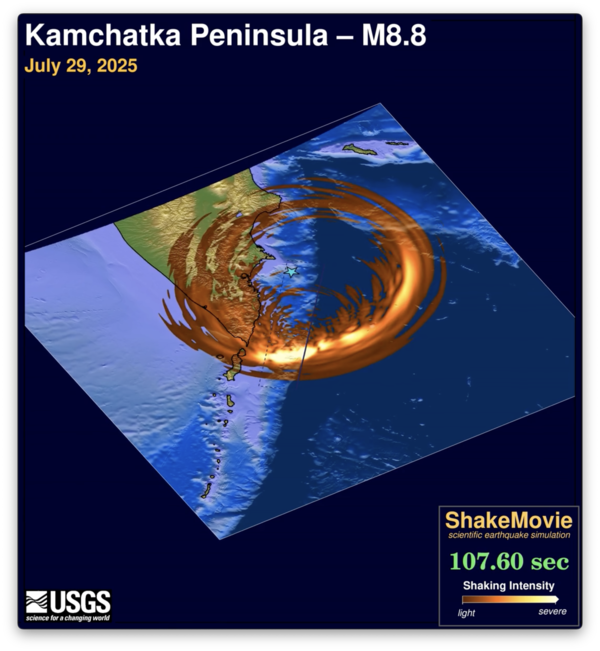
Shakemovie animation showing seismic waves emanating from the magnitude 8.8 Kamchatka Peninsula earthquake.
Videos
Earthquake Hazards Program videos.
Shakemovie animation showing seismic waves emanating from the magnitude 8.8 Kamchatka Peninsula earthquake.
Computer simulation of shaking during the April 14, 2025 M5.2 Julian, CA earthquake. As the waves propagate away from the epicenter they interact with different geologic materials, which can slow down and amplify the shaking.
man in front of a graphic for PAGER
USGS PAGER during the Magnitude 7.7 2025 Mandalay, Burma (Myanmar) Earthquake
USGS PAGER during the Magnitude 7.7 2025 Mandalay, Burma (Myanmar) EarthquakeDr. William Yeck is a seismologist with the USGS National Earthquake Information Center. He explains the importance of PAGER during the magnitude 7.7 2025 Mandalay, Burma (Myanmar) Earthquake.
USGS PAGER during the Magnitude 7.7 2025 Mandalay, Burma (Myanmar) Earthquake
USGS PAGER during the Magnitude 7.7 2025 Mandalay, Burma (Myanmar) EarthquakeDr. William Yeck is a seismologist with the USGS National Earthquake Information Center. He explains the importance of PAGER during the magnitude 7.7 2025 Mandalay, Burma (Myanmar) Earthquake.
Ammonia or ammonium? What’s the difference? In water, ammonia (NH3) and ammonium (NH4+) exist together in an equilibrium that depends on pH and temperature. As the temperature or pH rise, ammonia (NH3) becomes more abundant. This is important because ammonia is more toxic than ammonium.
USGS Scientist, Bob deGroot, briefly explains what happened during the magnitude 7.0 earthquake that occurred offshore of Mendocino, CA, on December 5, 2024.
The event occurred in an area called the Triple Junction, where the Pacific, Juan de Fuca, and North American tectonic plates meet.
USGS Scientist, Bob deGroot, briefly explains what happened during the magnitude 7.0 earthquake that occurred offshore of Mendocino, CA, on December 5, 2024.
The event occurred in an area called the Triple Junction, where the Pacific, Juan de Fuca, and North American tectonic plates meet.
USGS Scientist, Bob deGroot, briefly explains what happened during the magnitude 7.0 earthquake that occurred offshore of Mendocino, CA, on December 5, 2024.
The event occurred in an area called the Triple Junction, where the Pacific, Juan de Fuca, and North American tectonic plates meet.
USGS Scientist, Bob deGroot, briefly explains what happened during the magnitude 7.0 earthquake that occurred offshore of Mendocino, CA, on December 5, 2024.
The event occurred in an area called the Triple Junction, where the Pacific, Juan de Fuca, and North American tectonic plates meet.
ShakeMovie Animation: 1989 M6.9 Loma Prieta Earthquake
ShakeMovie Animation: 1989 M6.9 Loma Prieta EarthquakeThe 1989 Loma Prieta earthquake, measuring magnitude 6.9, was the strongest to hit the San Francisco Bay Area since the Great San Francisco earthquake of 1906. Although it provided extensive data on ground shaking, the available observations don’t fully capture all the quake's important features.
ShakeMovie Animation: 1989 M6.9 Loma Prieta Earthquake
ShakeMovie Animation: 1989 M6.9 Loma Prieta EarthquakeThe 1989 Loma Prieta earthquake, measuring magnitude 6.9, was the strongest to hit the San Francisco Bay Area since the Great San Francisco earthquake of 1906. Although it provided extensive data on ground shaking, the available observations don’t fully capture all the quake's important features.
At the USGS National Earthquake Information Center (NEIC), our team locates and researches earthquakes to provide information on how to reduce risk from earthquakes.
Ever wonder what it is like to work as a USGS intern? Dive into these intern stories of how students are making science their superpower while studying earthquakes!
ShakeMovie of 2019 M6.4 Ridgecrest Sequence Earthquake
ShakeMovie of 2019 M6.4 Ridgecrest Sequence EarthquakeThis ShakeMovie depicts a computer-generated simulation of the July 4, 2019 M6.4 Ridgecrest, CA earthquake, and is based on a mathematical model of the earthquake faulting process and 3D wave propagation.
ShakeMovie of 2019 M6.4 Ridgecrest Sequence Earthquake
ShakeMovie of 2019 M6.4 Ridgecrest Sequence EarthquakeThis ShakeMovie depicts a computer-generated simulation of the July 4, 2019 M6.4 Ridgecrest, CA earthquake, and is based on a mathematical model of the earthquake faulting process and 3D wave propagation.
screen capture of M7.1 Ridgecrest video (zoomed out)
ShakeMovie of 2019 M7.1 Ridgecrest Sequence Earthquake
ShakeMovie of 2019 M7.1 Ridgecrest Sequence EarthquakeThis ShakeMovie depicts a computer-generated simulation of the July 5, 2019 M7.1 Ridgecrest, CA earthquake, and is based on a mathematical model of the earthquake faulting process and 3D wave propagation.
ShakeMovie of 2019 M7.1 Ridgecrest Sequence Earthquake
ShakeMovie of 2019 M7.1 Ridgecrest Sequence EarthquakeThis ShakeMovie depicts a computer-generated simulation of the July 5, 2019 M7.1 Ridgecrest, CA earthquake, and is based on a mathematical model of the earthquake faulting process and 3D wave propagation.
screen capture of M7.1 Ridgecrest video
ShakeMovie of 2019 M7.1 Ridgecrest Sequence Earthquake, Near-Fault View
ShakeMovie of 2019 M7.1 Ridgecrest Sequence Earthquake, Near-Fault ViewThis ShakeMovie depicts a computer-generated simulation of the July 5, 2019 M7.1 Ridgecrest, CA earthquake, and is based on a mathematical model of the earthquake faulting process and 3D wave propagation.
ShakeMovie of 2019 M7.1 Ridgecrest Sequence Earthquake, Near-Fault View
ShakeMovie of 2019 M7.1 Ridgecrest Sequence Earthquake, Near-Fault ViewThis ShakeMovie depicts a computer-generated simulation of the July 5, 2019 M7.1 Ridgecrest, CA earthquake, and is based on a mathematical model of the earthquake faulting process and 3D wave propagation.
thumbnail turkey earthquake press conference
Earthquake Activity in Turkey and Syria [Press Briefing]
Earthquake Activity in Turkey and Syria [Press Briefing]On February 6, around 4:15 a.m. local time, a magnitude 7.8 earthquake struck south-central Turkey near the Turkey/Syria border.
Earthquake Activity in Turkey and Syria [Press Briefing]
Earthquake Activity in Turkey and Syria [Press Briefing]On February 6, around 4:15 a.m. local time, a magnitude 7.8 earthquake struck south-central Turkey near the Turkey/Syria border.
Mapping the Ground Failure—Puerto Rico Post-Dec 28, 2019 Quake
Mapping the Ground Failure—Puerto Rico Post-Dec 28, 2019 QuakeMy name is Kate Allstadt. I’m a research geophysicist with the U.S.
Mapping the Ground Failure—Puerto Rico Post-Dec 28, 2019 Quake
Mapping the Ground Failure—Puerto Rico Post-Dec 28, 2019 QuakeMy name is Kate Allstadt. I’m a research geophysicist with the U.S.
Initial Observations of Cypress Structure Collapse, Oakland, CA 1989
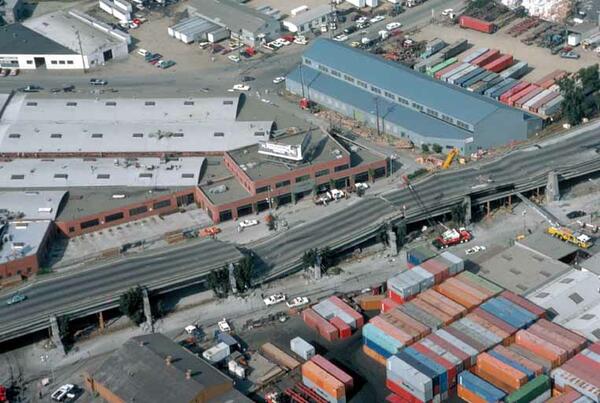
Initial Observations of Cypress Structure Collapse, Oakland, CA 1989Retrospective interview with USGS Geophysicist Susan Hough about the collapse of the Nimitz Freeway (known as the Cypress Structure) in Oakland, CA, during the October 17, 1989 Loma Prieta Earthquake and how the first responders reacted to the event.
Initial Observations of Cypress Structure Collapse, Oakland, CA 1989
Initial Observations of Cypress Structure Collapse, Oakland, CA 1989Retrospective interview with USGS Geophysicist Susan Hough about the collapse of the Nimitz Freeway (known as the Cypress Structure) in Oakland, CA, during the October 17, 1989 Loma Prieta Earthquake and how the first responders reacted to the event.
Sight Response and Cypress Structure Collapse, Oakland, CA 1989
Sight Response and Cypress Structure Collapse, Oakland, CA 1989Retrospective interview with USGS Geophysicist Susan Hough about her early earthquake work during the 1989 Loma Prieta earthquake. The interview covers how the Cypress Structure collapse in Oakland, CA, served as a site response study for seismic research.
Sight Response and Cypress Structure Collapse, Oakland, CA 1989
Sight Response and Cypress Structure Collapse, Oakland, CA 1989Retrospective interview with USGS Geophysicist Susan Hough about her early earthquake work during the 1989 Loma Prieta earthquake. The interview covers how the Cypress Structure collapse in Oakland, CA, served as a site response study for seismic research.
On October 17, 1989, at 5:04 pm a magnitude M6.9 earthquake struck near Loma Prieta, California. It was a tragic reminder of the destructive power of earthquakes. However, it was also a watershed moment in seismic research. 30 years later, we revisit the earthquake through the eyes of the scientists who experienced it. And studied it. These are their stories.
On October 17, 1989, at 5:04 pm a magnitude M6.9 earthquake struck near Loma Prieta, California. It was a tragic reminder of the destructive power of earthquakes. However, it was also a watershed moment in seismic research. 30 years later, we revisit the earthquake through the eyes of the scientists who experienced it. And studied it.
On October 17, 1989, at 5:04 pm a magnitude M6.9 earthquake struck near Loma Prieta, California. It was a tragic reminder of the destructive power of earthquakes. However, it was also a watershed moment in seismic research. 30 years later, we revisit the earthquake through the eyes of the scientists who experienced it. And studied it. These are their stories.