



FAQs
Have questions? The answer is probably here!
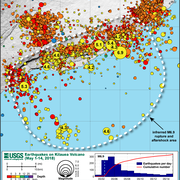
Foreshocks, aftershocks - what's the difference? Foreshocks, aftershocks - what's the difference?
"Foreshock" and "aftershock" are relative terms. Foreshocks are earthquakes that precede larger earthquakes in the same location. An earthquake cannot be identified as a foreshock until after a larger earthquake in the same area occurs. Aftershocks are smaller earthquakes that occur in the same general area during the days to years following a larger event or "mainshock." They occur within 1-2...
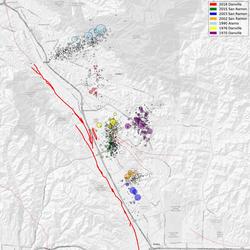
What is the difference between aftershocks and swarms? What is the difference between aftershocks and swarms?
Aftershocks are a sequence of earthquakes that happen after a larger mainshock on a fault. Aftershocks occur near the fault zone where the mainshock rupture occurred and are part of the "readjustment process” after the main slip on the fault. Aftershocks become less frequent with time, although they can continue for days, weeks, months, or even years for a very large mainshock. A swarm, on the...
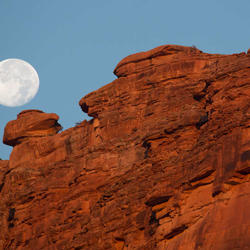
Can the position of the moon or the planets affect seismicity? Are there more earthquakes in the morning/in the evening/at a certain time of the month? Can the position of the moon or the planets affect seismicity? Are there more earthquakes in the morning/in the evening/at a certain time of the month?
Earthquakes are equally as likely to occur in the morning or the evening. Many studies in the past have shown no significant correlations between the rate of earthquake occurrence and the semi-diurnal tides when using large earthquake catalogs. Several recent studies, however, have found a correlation between earth tides (caused by the position of the moon relative to the earth) and some types of...
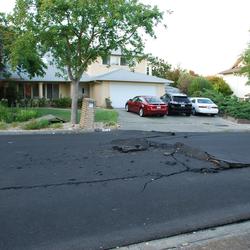
What is surface faulting or surface rupture in an earthquake? What is surface faulting or surface rupture in an earthquake?
Surface rupture occurs when movement on a fault deep within the earth breaks through to the surface. NOT ALL earthquakes result in surface rupture.

At what depth do earthquakes occur? What is the significance of the depth? At what depth do earthquakes occur? What is the significance of the depth?
Earthquakes occur in the crust or upper mantle, which ranges from the earth's surface to about 800 kilometers deep (about 500 miles). The strength of shaking from an earthquake diminishes with increasing distance from the earthquake's source, so the strength of shaking at the surface from an earthquake that occurs at 500 km deep is considerably less than if the same earthquake had occurred at 20...
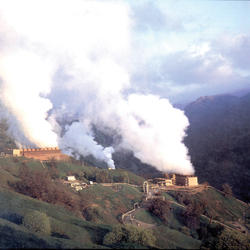
Why are there so many earthquakes in the Geysers area in Northern California? Why are there so many earthquakes in the Geysers area in Northern California?
The Geysers Geothermal Field is located in a tectonically active region of Northern California. The major seismic hazards in the region are from large earthquakes occurring along regional faults that are located miles away from the geothermal field, such as the San Andreas and Healdsburg-Rodgers Creek faults. However, activities associated with the withdrawal of steam for producing electric power...

Do earthquakes occur in Antarctica? Do earthquakes occur in Antarctica?
Earthquakes do occur in Antarctica, but not very often. There have been some big earthquakes--including one magnitude 8.1--in the Balleny Islands (between Antarctica and New Zealand). The boundary between the Scotia Plate and the Antarctic Plate just grazes the north tip of the Antarctic Peninsula (look "northwest" from the Pole toward South America). There is also a hint of a line of seismicity...

What is a hotspot and how do you know it's there? What is a hotspot and how do you know it's there?
Most volcanic eruptions occur near the boundaries of tectonic plates, but there are some exceptions. In the interior of some tectonic plates, magma has been erupting from a relatively fixed spot below the plate for millions of years. As the plate continuously moves across that spot, a trail of progressively older volcanic deposits is left at the surface. The Hawaiian Islands are a good example of...
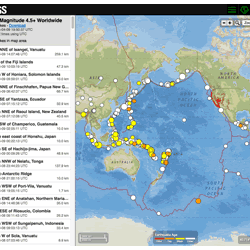
Where can I find current earthquake lists and maps for the world or for a specific area? Where can I find current earthquake lists and maps for the world or for a specific area?
The Earthquake Hazards Program Latest Earthquakes Map displays earthquakes in near-realtime and up to the past 30 days of earthquakes. The interface includes three panels: a list of earthquakes, a map, and a settings/options panel. You can pan and zoom the map to view specific areas. Click on an event on the list or map for additional information and a link to the event page with all the details...

Did I feel an earthquake? Can I report feeling an earthquake? Did I feel an earthquake? Can I report feeling an earthquake?
Report an earthquake experience or related observation through the Did You Feel It? citizen science webpage. The best way to do this is to click on the earthquake that you think you felt on one of the lists on the Earthquakes webpage, and then select the "Tell Us!" link. If you don't see the earthquake you think you felt, use the green "Report an Unknown Event" button on our Did You Feel It? page...

What is UTC, and why do you report earthquakes in UTC? What is UTC, and why do you report earthquakes in UTC?
UTC stands for Coordinated Universal Time, and for this purpose is the same as GMT (Greenwich Mean Time). Since the USGS and other seismic network agencies record earthquakes around the globe in all the various time zones, using a single standard time reference is best for record-keeping and exchange of data. The individual event pages with details about each earthquake use UTC for the reference...

Why do so many earthquakes occur at a depth of 10km? Why do so many earthquakes occur at a depth of 10km?
Ten kilometers is a "fixed depth." Sometimes data are too poor to compute a reliable depth for an earthquake. In such cases, the depth is assigned to be 10 km. Why that number? In many areas around the world, reliable depths tend to average 10 km or close to it. For example, if we made a histogram of the reliable depths in such an area, we'd expect to see a peak around 10 km. So if we don't know...