



Not All PFAS Are Alike: Fish Responses Reveal The Importance Of Real-World Mixtures
A USGS study demonstrates the importance of monitoring not just the amount of PFAS in groundwater, but the PFAS mixture present. Building on two decades of experience conducting mobile laboratory experiments, USGS researchers applied this approach at a contaminated fire training area to evaluate how fish respond to complex PFAS mixtures, providing important scientific evidence that can improve how we accurately evaluate environmental risks.
Per- and polyfluoroalkyl substances (PFAS) used in consumer and industrial applications, such as firefighting foams, persist in groundwater and move into nearby surface waters, creating long-term exposure pathways for humans and other aquatic species, including fish. Although the environmental distribution of PFAS is increasingly understood, far less is known about how actual mixtures of different PFAS compounds affect organisms when they encounter the contaminants simultaneously in the field.
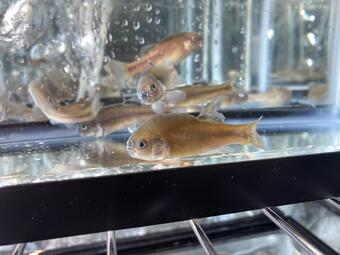
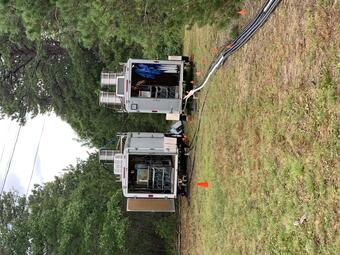
To address this information gap, a team of USGS scientists conducted multiyear mobile laboratory experiments at a contaminated fire training area at Joint Base Cape Cod, Massachusetts. Contaminated groundwater representing distinct PFAS mixtures was pumped from monitoring wells directly into mobile laboratory exposure tanks to preserve authentic water chemistry. Adult male fathead minnows* were exposed to the groundwater PFAS mixtures to determine how different contaminant compositions affected male reproductive biomarkers.
USGS researchers looked at whether the fish survived, how well they could reproduce, and what their tissues looked like under a microscope. They also measured PFAS levels inside the fish to understand how much of the chemicals the fish accumulated. The scientists found that the fish were not affected just by the amount of PFAS in the water, but by the specific mix of PFAS chemicals and how those chemicals built up inside their bodies. Some mixtures appeared to cause more deaths and more problems with reproduction than others, even when the total PFAS concentrations in the water were comparable. When the researchers looked deeper at the fish’s cells, they found changes in important systems such as energy use, hormones, immune function, and stress response. This helped explain why certain PFAS mixtures seemed to harm the fish more than other PFAS mixtures.
This paper highlights the fact that we cannot understand environmental risk just by measuring the total amount of contaminants in water. What really matters is the kind of chemicals in the mixture, how those chemicals move into and build up inside an organism, and how long they stay there. As PFAS contamination continues to affect groundwater, rivers, lakes, fish, and wildlife, this study gives important scientific information to help federal agencies improve how they monitor pollution, evaluate risks, and decide the best ways to clean up contaminated sites. It also highlights why studying real-world mixtures is important: animals are exposed to many chemicals at once, not one chemical at a time. Understanding these real-world exposure conditions can improve protection of ecosystems, public health, and the natural resources on which communities depend.
*Use of Fathead Minnows in Science – Fathead minnows are a common laboratory fish used in aquatic science. They are a standard species for testing water pollution because they are sensitive to chemicals, easy to breed, and can live in many different water conditions. Scientists use them to quickly spot early signs of health problems, especially changes in hormones and reproduction.
Males were used in this study because it was designed to evaluate PFAS impacts on male-specific reproductive endpoints, which provide sensitive and informative measures of PFAS mixture toxicity.
This study was supported by the U.S. Geological Survey Ecosystems Mission Area, through the Environmental Health Program (Contaminant Biology and Toxic Substances Hydrology) in collaboration with the University of Colorado Denver (supported by National Institute of Environmental Health Sciences and the Department of Defense Strategic Environmental Research and Development Program Grants).
A USGS study demonstrates the importance of monitoring not just the amount of PFAS in groundwater, but the PFAS mixture present. Building on two decades of experience conducting mobile laboratory experiments, USGS researchers applied this approach at a contaminated fire training area to evaluate how fish respond to complex PFAS mixtures, providing important scientific evidence that can improve how we accurately evaluate environmental risks.
Per- and polyfluoroalkyl substances (PFAS) used in consumer and industrial applications, such as firefighting foams, persist in groundwater and move into nearby surface waters, creating long-term exposure pathways for humans and other aquatic species, including fish. Although the environmental distribution of PFAS is increasingly understood, far less is known about how actual mixtures of different PFAS compounds affect organisms when they encounter the contaminants simultaneously in the field.
To address this information gap, a team of USGS scientists conducted multiyear mobile laboratory experiments at a contaminated fire training area at Joint Base Cape Cod, Massachusetts. Contaminated groundwater representing distinct PFAS mixtures was pumped from monitoring wells directly into mobile laboratory exposure tanks to preserve authentic water chemistry. Adult male fathead minnows* were exposed to the groundwater PFAS mixtures to determine how different contaminant compositions affected male reproductive biomarkers.
USGS researchers looked at whether the fish survived, how well they could reproduce, and what their tissues looked like under a microscope. They also measured PFAS levels inside the fish to understand how much of the chemicals the fish accumulated. The scientists found that the fish were not affected just by the amount of PFAS in the water, but by the specific mix of PFAS chemicals and how those chemicals built up inside their bodies. Some mixtures appeared to cause more deaths and more problems with reproduction than others, even when the total PFAS concentrations in the water were comparable. When the researchers looked deeper at the fish’s cells, they found changes in important systems such as energy use, hormones, immune function, and stress response. This helped explain why certain PFAS mixtures seemed to harm the fish more than other PFAS mixtures.
This paper highlights the fact that we cannot understand environmental risk just by measuring the total amount of contaminants in water. What really matters is the kind of chemicals in the mixture, how those chemicals move into and build up inside an organism, and how long they stay there. As PFAS contamination continues to affect groundwater, rivers, lakes, fish, and wildlife, this study gives important scientific information to help federal agencies improve how they monitor pollution, evaluate risks, and decide the best ways to clean up contaminated sites. It also highlights why studying real-world mixtures is important: animals are exposed to many chemicals at once, not one chemical at a time. Understanding these real-world exposure conditions can improve protection of ecosystems, public health, and the natural resources on which communities depend.
*Use of Fathead Minnows in Science – Fathead minnows are a common laboratory fish used in aquatic science. They are a standard species for testing water pollution because they are sensitive to chemicals, easy to breed, and can live in many different water conditions. Scientists use them to quickly spot early signs of health problems, especially changes in hormones and reproduction.
Males were used in this study because it was designed to evaluate PFAS impacts on male-specific reproductive endpoints, which provide sensitive and informative measures of PFAS mixture toxicity.
This study was supported by the U.S. Geological Survey Ecosystems Mission Area, through the Environmental Health Program (Contaminant Biology and Toxic Substances Hydrology) in collaboration with the University of Colorado Denver (supported by National Institute of Environmental Health Sciences and the Department of Defense Strategic Environmental Research and Development Program Grants).