



Bioassays
Bioassays
Filter Total Items: 28

Mixtures of Algal Toxins Present Prior to and After Formation of Visible Algal Blooms—Science to Inform the Timing of Algal Toxin Exposure
Cyanobacteria with toxin-producing potential, genes indicating an ability for toxin synthesis, or cyanotoxins were present before and after formation of a visible algal bloom in Kabetogama Lake, a popular recreation area in Voyageurs National Park that lies along the border of Minnesota and Canada. The temporal patterns observed in this study indicate that sampling only when there is a visible...

Refined Model Provides a Screening Tool to Understand Exposure to Contaminants from Incidental Wastewater Reuse
Refinement of the existing national-scale “de facto reuse incidence in our nation’s consumable supply” (DRINCS) model, complemented by field measurements, provides a screening tool to understand human and wildlife exposure to toxicants and pathogens associated with the incidental reuse of treated wastewater in the Shenandoah River watershed. The model results can be accessed in a companion web...

Can There be Unintended Benefits when Wastewater Treatment Infrastructure is Upgraded?
Science from the U.S. Geological Survey (USGS) and other entities has shown that a mixture of natural and synthetic estrogens and other similar chemicals are discharged from wastewater treatment plants (WWTPs) to streams and rivers.
Outdoor Resources Integrated Science Team
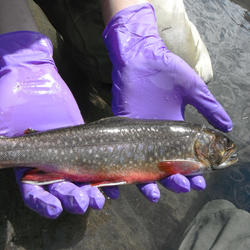
The Outdoor Resources Integrated Science Team studies how contaminants, pathogens, and other environmental stressors affect the health of fish and wildlife that support recreational and cultural traditions, providing practical science that guides responsible land and water use, supports informed stewardship, and helps ensure resilient outdoor resources for all communities.

Endocrine Active Chemical Screening Tests Optimized to Improve Precision, Accuracy, and Timeliness
Scientists optimized existing endocrine active chemical screening tests to improve their precision, accuracy, and ability to screen more samples in a shorter time-frame. The optimization was done to more rapidly obtain results from the bioassays so that research on the risks of endocrine active chemical exposure can proceed more rapidly.

Endocrine Disrupting Compounds in the Chesapeake Bay Watershed Science Team
The Chesapeake Bay is the largest estuary in the United States and provides critical resources to fish, wildlife and people. For more than a decade, recreational fish species have been plagued with skin lesions and intersex conditions (the presence of male and female sex characteristics in the same fish) that biologists attributed to exposures to endocrine disrupting chemicals (EDCs)...

Gestodene Affects Fish Reproductive Behavior in Laboratory Exposure Study
Short-term laboratory exposure of adult fathead minnows to the human contraceptive progestin, gestodene (GES), at environmentally relevant concentrations induced rapid and negative effects on reproductive health and suggests that wild fish may be similarly affected.

Indication of Unconventional Oil and Gas Wastewaters Found in Local Surface Waters
Evidence indicating the presence of wastewaters from unconventional oil and gas (UOG) production was found in surface waters and surficial sediments near an UOG disposal facility in West Virginia.

Assessing Environmental Chemical Mixtures in United States Streams
The U.S. Geological Survey (USGS) and the U.S. Environmental Protection Agency (EPA) are collaborating on a field-based study of chemical mixture composition and environmental effects in stream waters affected by a wide range of human activities and contaminant sources.

Biological Activity of Steroid Hormones in U.S. Streams
Testing of U.S. streams has detected glucocorticoid and androgen biological activity. In a collaborative study between the National Cancer Institute (NCI), Laboratory of Receptor Biology and Gene Expression, the U.S. Geological Survey (USGS), and others, scientists studied the potential for the biological activity in streams of glucocorticoids and androgens hormones—both potential endocrine...

Contaminants Affect Fish and Wildlife in the Chesapeake Bay
“Legacy contaminants” and “contaminants of emerging concern” that persist in the environment are affecting the health of fish and wildlife in the Chesapeake Bay and its watershed. State continue to report impaired water resources due to the persistence and toxicity of some previously banned pollutants. In addition, other contaminants of emerging concern are released to the environment at levels...

Chemical Combo and Intersex Fish Found at Smallmouth Bass Nesting Sites
Chemical contaminants including herbicides, veterinary pharmaceuticals, and biogenic hormones have been detected at fish nesting sites in the Potomac River watershed where endocrine disruption in smallmouth bass ( Micropterus dolomieu) was also observed. Although these contaminants are known to originate from a variety of human and animal-waste sources, results of a recent U.S. Geological Survey (...