Repeat oblique photographs of Gulkana glaciers in Alaska.
Repeat oblique photographs of Gulkana glaciers in Alaska.Repeat oblique photographs of Gulkana glaciers in Alaska. 1967, Unknown USGS photographer. 2016, L. Sass, USGS.


Official websites use .gov
A .gov website belongs to an official government organization in the United States.

Secure .gov websites use HTTPS
A lock () or https:// means you’ve safely connected to the .gov website. Share sensitive information only on official, secure websites.

Browse images from a wide range of science topics covered by USGS.

Repeat oblique photographs of Gulkana glaciers in Alaska. 1967, Unknown USGS photographer. 2016, L. Sass, USGS.
Repeat oblique photographs of Gulkana glaciers in Alaska. 1967, Unknown USGS photographer. 2016, L. Sass, USGS.
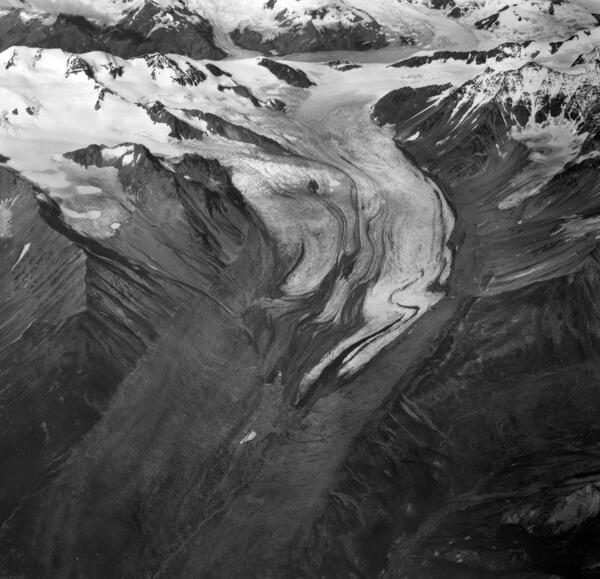
Gulkana Glacier. Ice flowing from four tributaries unites to form the main glacier. Irregular and folded medial moraines suggest that this glacier surges, but no recent advances have been observed. In recent decades the glacier has been shrinking rapidly; note the large barren area in front of the terminus recently exposed by the melting ice.
Gulkana Glacier. Ice flowing from four tributaries unites to form the main glacier. Irregular and folded medial moraines suggest that this glacier surges, but no recent advances have been observed. In recent decades the glacier has been shrinking rapidly; note the large barren area in front of the terminus recently exposed by the melting ice.

Repeat oblique photographs of Wolverine glacier in Alaska. 1966 image by unknown USGS photographer; 2015 image by L. Sass, USGS.
Repeat oblique photographs of Wolverine glacier in Alaska. 1966 image by unknown USGS photographer; 2015 image by L. Sass, USGS.
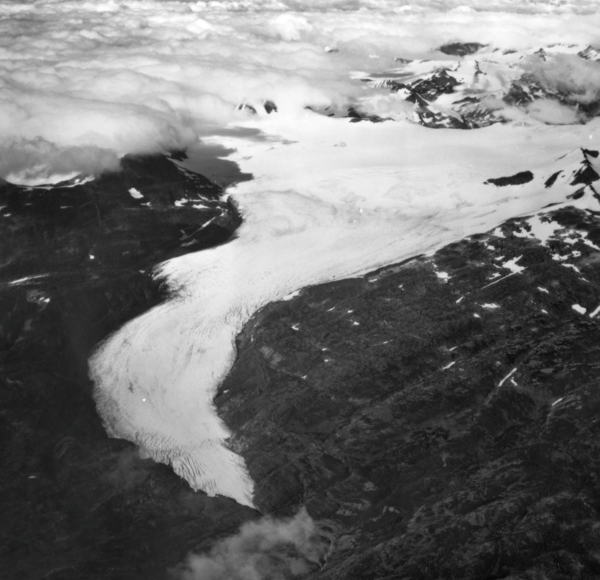
Wolverine Glacier. The glacier heads in a broad basin but terminates in a narrow gorge. Crevasses indicate this glacier is flowing quite rapidly. Relatively little retreat in recent decades is demonstrated by the narrow areas of recently exposed bedrock along the margins of the ice. Seward district, Alaska Gulf region, Alaska. September 3, 1966.
Wolverine Glacier. The glacier heads in a broad basin but terminates in a narrow gorge. Crevasses indicate this glacier is flowing quite rapidly. Relatively little retreat in recent decades is demonstrated by the narrow areas of recently exposed bedrock along the margins of the ice. Seward district, Alaska Gulf region, Alaska. September 3, 1966.

Photograph taken in 1964 of the main part of the Chenega village site in Alaska. Pilings in the ground mark the former locations of homes swept away by tsunami waves. The schoolhouse on high ground was undamaged.
Photograph taken in 1964 of the main part of the Chenega village site in Alaska. Pilings in the ground mark the former locations of homes swept away by tsunami waves. The schoolhouse on high ground was undamaged.
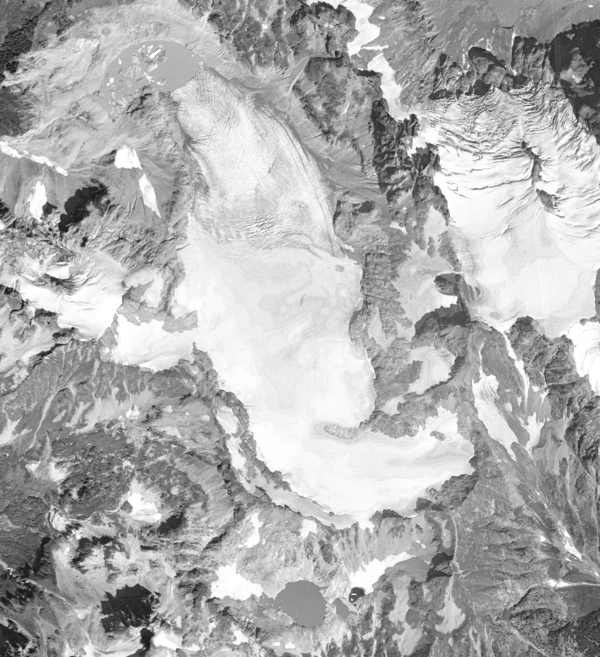
Aerial photograph of South Cascade Glacier, WA taken August 13th, 1958.
Aerial photograph of South Cascade Glacier, WA taken August 13th, 1958.
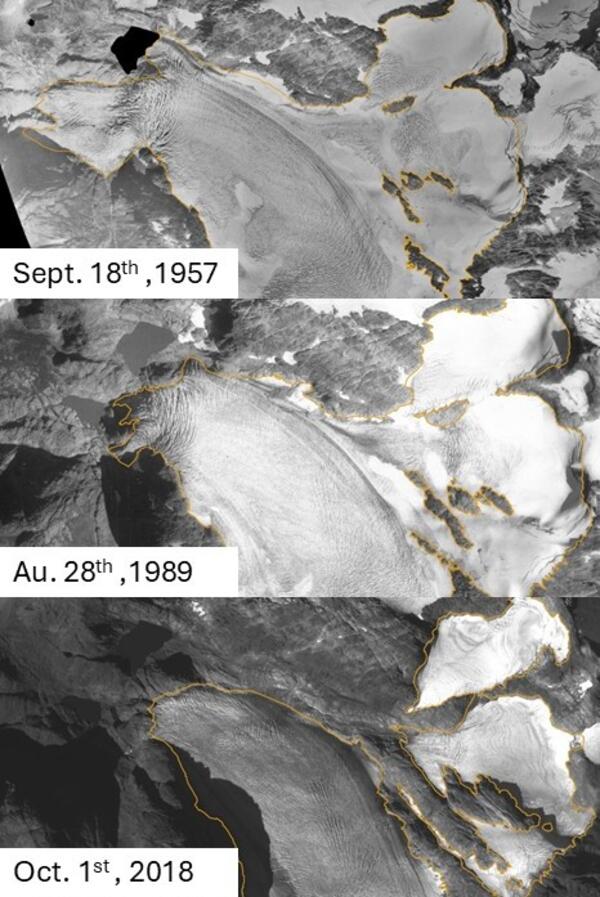
Time series imagery (1957, 1989, 2018) shows the progressive disconnection of tributary branches from Lemon Creek Glacier. In each panel, the glacier extent is outlined in orange. Over time, thinning and retreat isolate formerly connected accumulation areas, reducing ice flux into the main trunk.
Time series imagery (1957, 1989, 2018) shows the progressive disconnection of tributary branches from Lemon Creek Glacier. In each panel, the glacier extent is outlined in orange. Over time, thinning and retreat isolate formerly connected accumulation areas, reducing ice flux into the main trunk.

This, the first of two repeat photographs, documents significant changes that have occurred during the nine years between photographs A and B. Although Muir Glacier has retreated more than 3 kilometers and thinned more than 100 meters, exposing Muir Inlet, it remains connected with tributary Riggs Glacier. White Thunder Ridge remains devoid of vegetation.
This, the first of two repeat photographs, documents significant changes that have occurred during the nine years between photographs A and B. Although Muir Glacier has retreated more than 3 kilometers and thinned more than 100 meters, exposing Muir Inlet, it remains connected with tributary Riggs Glacier. White Thunder Ridge remains devoid of vegetation.

This northeast-looking photograph, on the southeastern side of White Thunder Ridge ,shows the lower reaches of Muir Glacier, then a large tidewater calving valley glacier, and its tributary Riggs Glacier. The séracs in the lower right-hand corner of the photograph mark Muir Glacier’s terminus. The ice thickness is more than 700 meters.
This northeast-looking photograph, on the southeastern side of White Thunder Ridge ,shows the lower reaches of Muir Glacier, then a large tidewater calving valley glacier, and its tributary Riggs Glacier. The séracs in the lower right-hand corner of the photograph mark Muir Glacier’s terminus. The ice thickness is more than 700 meters.

Volcanic ash drifts around houses at Katmai after the June 1912 eruption of Novarupta Volcano. Church in the distant background. August 13, 1912.
Volcanic ash drifts around houses at Katmai after the June 1912 eruption of Novarupta Volcano. Church in the distant background. August 13, 1912.

Geologists examine cores on Sitkinak Island, Alaska.
Geologists examine cores on Sitkinak Island, Alaska.

Base camp, Sitkinak Island.

Geologists examine an exposure of a tidal marsh bank on Sitkinak Island, Alaska. The bank exposes interbedded peat and silt that records sudden vertical land movements associated with megathrust fault slip during large earthquakes.
Geologists examine an exposure of a tidal marsh bank on Sitkinak Island, Alaska. The bank exposes interbedded peat and silt that records sudden vertical land movements associated with megathrust fault slip during large earthquakes.

A tidal marsh bank exposed during low tide on Sitkinak Island, Alaska. The bank reveals ledges of alternating peat and silt. Abrupt uplift and subsidence during large megathrust earthquakes is interpreted to be the cause of the alternating layers.
A tidal marsh bank exposed during low tide on Sitkinak Island, Alaska. The bank reveals ledges of alternating peat and silt. Abrupt uplift and subsidence during large megathrust earthquakes is interpreted to be the cause of the alternating layers.
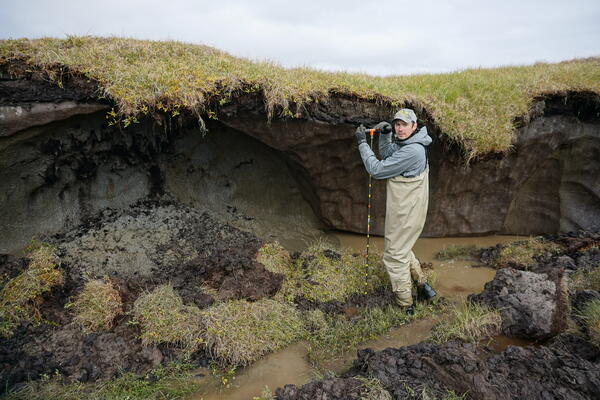
Allen Bondurant measuring depth to permafrost along a thermokarst lake shore
Allen Bondurant measuring depth to permafrost along a thermokarst lake shore

An Alaska Volcano Observatory Monitoring station with Peulik Volcano behind. This is the main repeater for the Peulik monitoring network located on Whale Mountain, Beecharaof National Wildlife Refuge.
An Alaska Volcano Observatory Monitoring station with Peulik Volcano behind. This is the main repeater for the Peulik monitoring network located on Whale Mountain, Beecharaof National Wildlife Refuge.

Northslope of Alaska in May

Exposures of sedimentary rocks in the western Brooks Range, Alaska were evaluated for their contents of metals and phosphate and for their petroleum maturation histories to determine the potential for undiscovered resources in the southern National Petroleum Reserve Alaska.
Exposures of sedimentary rocks in the western Brooks Range, Alaska were evaluated for their contents of metals and phosphate and for their petroleum maturation histories to determine the potential for undiscovered resources in the southern National Petroleum Reserve Alaska.

Eagle was our put-in point for our first synoptic cruise down the Yukon River.
Eagle was our put-in point for our first synoptic cruise down the Yukon River.

USGS ecologist Kevin Lafferty visits the Exit Glacier in Alaska.
USGS ecologist Kevin Lafferty visits the Exit Glacier in Alaska.

Geologists extract a hand-driven core from 2-3 m depth on Sitkinak Island, Alaska. The cores contain peat with interbedded sand layers that record inundation of the coast by prehistoric tsunamis. (l-r: Peter Haeussler, USGS; Andrew Kemp, Tufts University; Alan Nelson, USGS)
Geologists extract a hand-driven core from 2-3 m depth on Sitkinak Island, Alaska. The cores contain peat with interbedded sand layers that record inundation of the coast by prehistoric tsunamis. (l-r: Peter Haeussler, USGS; Andrew Kemp, Tufts University; Alan Nelson, USGS)