



Evan Grant, Ph.D.
Evan Grant the principle investigator of the US Geological Survey’s Amphibian Research and Monitoring Initiative (ARMI), northeast region.
Evan's research focuses on questions relating to amphibian populations, specifically with respect to their landscape-scale ecology. Evan also uses decision science to aid resource managers.
Education:
- PhD, 2009, University of Maryland College Park, Program of Marine, Estuarine and Environmental Sciences and Department of Entomology
- BS, 2001, Cornell University, Natural Resources, with Distinction in Research
Science and Products
Filter Total Items: 21
EESC Makes an Impact: Reducing Management Costs and Increasing Efficiency
Decision analysis is widely used in business applications to improve cost saving and increase efficiency under uncertainty. Scientists at the U.S. Geological Survey Eastern Ecological Science Center (EESC) include world-renowned experts who use data, mathematics, statistics, and computer science to help frame and solve decision problems to support U.S. national security, public health, wildlife...

Collaborative Project to Understand Red-backed Salamander Population Dynamics and Adaptation
In 2013, the Salamander Population and Adaptation Research Network started as a partnership between researchers at Penn State University and the USGS Northeast Amphibian and Research Monitoring Initiative with the intention of creating a research network to address adaptation and population dynamics across multiple scales. Our goals are to understand impacts of land use and weather conditions on...

Monitoring Vernal Pool Amphibians in the Northeast
In 2004, the Northeast Amphibian Research Monitoring Initiative (NE ARMI) in collaboration with National Park Service and US Fish and Wildlife Service initiated a region-wide study on the distribution of vernal pools and estimate the proportion of pools that were occupied by pool-associated amphibians (specifically, wood frogs, Lithobates sylvaticus, and spotted salamanders, Ambystoma maculatum).

Assessing amphibian communities in the National Capital Region
The National Capital Region Network (NCRN) has identified amphibians as a priority taxonomic group for its Inventory and Monitoring program. Amphibian monitoring was initiated in 2005, and is currently concentrated in Antietam National Battlefield (ANTI), Catoctin Mountain Park (CATO), Chesapeake and Ohio Canal National Historical Park (CHOH), George Washington Memorial Parkway (GWMP), Harpers...

Northeast Amphibian Research and Monitoring Initiative
The U.S. Geological Survey’s Eastern Ecological Science Center is home to the Northeast Amphibian Research and Monitoring Initiative (NEARMI), one of 7 ARMI regions across the United States. NEARMI works on public lands in thirteen states from Maine to Virginia, including many National Parks and National Wildlife Refuges.

Disease Decision Analysis and Research
The Disease Decision Analysis and Research group is a multi-disciplinary team based out of the Eastern Ecological Science Center whose strengths are in ecology, decision sciences and quantitative modeling.

COVID-19 Pathways and Wildlife Dynamics
Below are the USGS 2020 Coronavirus Aid, Relief and Economic Security Act (CARES Act) research projects related to COVID-19 pathways and wildlife dynamics. Select tabs above for related items.

Decision Science Support for SARS-CoV-2 Risk to North American Bats
The Eastern Ecological Science Center is working closely with federal, state, and tribal partners to help inform decisions that reduce the risk of SARS-CoV-2 transmission from humans to North American wildlife, including bats.

Decision science support for Chronic Wasting Disease
Eastern Ecological Science Center adds the decision analytical skill set to the existing body of USGS expertise on Chronic Wasting Disease (CWD), in support of our sister DOI agencies.

Vernal Pool Inundation Models
This website provides an application for exploring modeling results from a U.S. Geological Survey (USGS) project titled Mapping Climate Change Resistant Vernal Pools in the Northeastern U.S. The purpose of this project was to improve understanding of the factors that control inundation patterns in vernal pools of the northeastern United States, so as to identify pools that might function as...

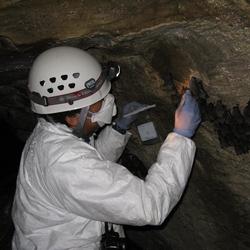
Modeling the response of cave hibernating Myotis species to white-nose syndrome mitigation tactics
Bat Research Research collaboration: Robin Russell (NWHC), Tonie Rocke (NWHC), Wayne Thogmartin (UMESC), Evan Grant (EESC) White-nose syndrome is a fungal disease devastating cave-hibernating bat species ( Myotis spp.) in the eastern United States. Several mitigation tactics have been proposed to alleviate the effects of white-nose syndrome on bats including probiotics and vaccination. Questions...

A generic web application to visualize and understand movements of tagged animals
The goal of this project was to maximize the value of expensive animal tagging data. We developed an interactive web application to help scientists understand patterns in their own tagging datasets and to help scientists, funders and agencies communicate tagging data to decision-makers and to the general public. Interactive visualizations have emerged recently as a valuable tool for...
Science and Products
Filter Total Items: 21
EESC Makes an Impact: Reducing Management Costs and Increasing Efficiency
Decision analysis is widely used in business applications to improve cost saving and increase efficiency under uncertainty. Scientists at the U.S. Geological Survey Eastern Ecological Science Center (EESC) include world-renowned experts who use data, mathematics, statistics, and computer science to help frame and solve decision problems to support U.S. national security, public health, wildlife...
Collaborative Project to Understand Red-backed Salamander Population Dynamics and Adaptation
In 2013, the Salamander Population and Adaptation Research Network started as a partnership between researchers at Penn State University and the USGS Northeast Amphibian and Research Monitoring Initiative with the intention of creating a research network to address adaptation and population dynamics across multiple scales. Our goals are to understand impacts of land use and weather conditions on...
Monitoring Vernal Pool Amphibians in the Northeast
In 2004, the Northeast Amphibian Research Monitoring Initiative (NE ARMI) in collaboration with National Park Service and US Fish and Wildlife Service initiated a region-wide study on the distribution of vernal pools and estimate the proportion of pools that were occupied by pool-associated amphibians (specifically, wood frogs, Lithobates sylvaticus, and spotted salamanders, Ambystoma maculatum).
Assessing amphibian communities in the National Capital Region
The National Capital Region Network (NCRN) has identified amphibians as a priority taxonomic group for its Inventory and Monitoring program. Amphibian monitoring was initiated in 2005, and is currently concentrated in Antietam National Battlefield (ANTI), Catoctin Mountain Park (CATO), Chesapeake and Ohio Canal National Historical Park (CHOH), George Washington Memorial Parkway (GWMP), Harpers...
Northeast Amphibian Research and Monitoring Initiative
The U.S. Geological Survey’s Eastern Ecological Science Center is home to the Northeast Amphibian Research and Monitoring Initiative (NEARMI), one of 7 ARMI regions across the United States. NEARMI works on public lands in thirteen states from Maine to Virginia, including many National Parks and National Wildlife Refuges.
Disease Decision Analysis and Research
The Disease Decision Analysis and Research group is a multi-disciplinary team based out of the Eastern Ecological Science Center whose strengths are in ecology, decision sciences and quantitative modeling.
COVID-19 Pathways and Wildlife Dynamics
Below are the USGS 2020 Coronavirus Aid, Relief and Economic Security Act (CARES Act) research projects related to COVID-19 pathways and wildlife dynamics. Select tabs above for related items.
Decision Science Support for SARS-CoV-2 Risk to North American Bats
The Eastern Ecological Science Center is working closely with federal, state, and tribal partners to help inform decisions that reduce the risk of SARS-CoV-2 transmission from humans to North American wildlife, including bats.
Decision science support for Chronic Wasting Disease
Eastern Ecological Science Center adds the decision analytical skill set to the existing body of USGS expertise on Chronic Wasting Disease (CWD), in support of our sister DOI agencies.
Vernal Pool Inundation Models
This website provides an application for exploring modeling results from a U.S. Geological Survey (USGS) project titled Mapping Climate Change Resistant Vernal Pools in the Northeastern U.S. The purpose of this project was to improve understanding of the factors that control inundation patterns in vernal pools of the northeastern United States, so as to identify pools that might function as...
Modeling the response of cave hibernating Myotis species to white-nose syndrome mitigation tactics
Bat Research Research collaboration: Robin Russell (NWHC), Tonie Rocke (NWHC), Wayne Thogmartin (UMESC), Evan Grant (EESC) White-nose syndrome is a fungal disease devastating cave-hibernating bat species ( Myotis spp.) in the eastern United States. Several mitigation tactics have been proposed to alleviate the effects of white-nose syndrome on bats including probiotics and vaccination. Questions...
A generic web application to visualize and understand movements of tagged animals
The goal of this project was to maximize the value of expensive animal tagging data. We developed an interactive web application to help scientists understand patterns in their own tagging datasets and to help scientists, funders and agencies communicate tagging data to decision-makers and to the general public. Interactive visualizations have emerged recently as a valuable tool for...