
Frederick D. Day-Lewis (Former Employee)
Science and Products
Hydrogeophysics Core Technology Team
About the Research. The Hydrogeophysics Core Technology Team (CTT) as part of the Environmental Health Program specializes in locating and quantifying exchanges of groundwater and surface water, along with characterizing geologic structure and mapping hydrologic connectivity across varied landscapes.
Fiber-Optic Distributed Temperature Sensing Technology for Surface-Water and Groundwater Studies
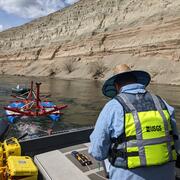
Fiber-optic distributed temperature sensing (FO-DTS) technology can be used for characterizing estuary-aquifer and stream-aquifer interaction and for identifying transmissive fractures in bedrock boreholes.
Geophysics for USGS Groundwater/Surface Water Exchange Studies
Locating and quantifying exchanges of groundwater and surface water, along with characterizing geologic structure, is essential to water-resource managers and hydrologists for the development of effective water-resource policy, protection, and management. The USGS conducts applied research to evaluate the use of new or emerging hydrogeophysical tools and methods to improve our understanding of...
Optimized Enhanced Bioremediation through 4D Geophysical Monitoring and Autonomous Data Collection, Processing, and Analysis
The USGS Office of Ground Water, Branch of Geophysics (OGW BG) is collaborating on an applied research project to evaluate the use of new hydrogeophysical tools to remotely monitor and visualize subsurface bioremediation amendment emplacement and transport in near real-time. The project, funded by the U.S. Department of Defense Environmental Security Technology Certification Program, could provide...
Fiber-Optic Distributed Temperature Sensing in Waquoit Bay, Massachusetts
In 2006 the USGS Office of Groundwater, Branch of Geophysics (OGW BG) conducted a technology demonstration and evaluation project in Waquoit Bay, East Falmouth, Massachusetts, to evaluate the use of fiber-optic distributed temperature sensing (FO-DTS). In this project, the USGS used FO-DTS to investigate aquifer-estuary interaction by monitoring submarine groundwater discharge in Waquoit Bay. OGW...
Filter Total Items: 13
RDAVT RDAVT
RDAVT.r is an R Shiny-based app used to estimate immobile porosity, mobile porosity, and the mass transfer rate coefficient in dual-domain porosity media. The app allows for interactive fitting of the fluid versus bulk conductivity hysteresis curve from electrical tracer experiments using a semi-analytic graphical approach.
Data release for tempest1d: Recursive Estimation of Vertical Groundwater/Surface-Water Exchange using Heat Tracing Data release for tempest1d: Recursive Estimation of Vertical Groundwater/Surface-Water Exchange using Heat Tracing
This data release provides a recursive-estimation framework to infer groundwater/surface-water exchange based on temperature time series collected at different vertical depths below the sediment/water interface. A heat-transport problem was formulated as a state-space model (SSM), in which the spatial derivatives in the convection/conduction equation are approximated using finite...
GW/SW-MST: A Groundwater/Surface-Water Method Selection Tool GW/SW-MST: A Groundwater/Surface-Water Method Selection Tool
The Groundwater/Surface-Water Method Selection Tool (GW/SW-MST) is a spreadsheet-based tool to help practitioners identify methods for use in groundwater/surface-water (GW/SW) exchange and hyporheic studies. GW/SW exchange and hyporheic processes are topics receiving increasing attention from the hydrologic community. Hydraulic, chemical, temperature, geophysical, and remote sensing...
Selected borehole geophysical logs from three contaminant sites in California, Wisconsin, and New Jersey Selected borehole geophysical logs from three contaminant sites in California, Wisconsin, and New Jersey
Borehole geophysical logs were collected to characterize bedrock aquifers at three contamination sites located in California, Wisconsin, and New Jersey. The data were collected by the U.S. Geological Survey (USGS) and the University of Guelph from 2014 to 2015 as part of the U.S. Department of Defense Strategic Environmental Research and Development Program (SERDP) and Environmental...
Algorithms for model parameter estimation, state estimation, and forecasting applied to a State-Space model coupled with the Kalman Filter for one-dimensional vertical infiltration to fractured rock aquifers Algorithms for model parameter estimation, state estimation, and forecasting applied to a State-Space model coupled with the Kalman Filter for one-dimensional vertical infiltration to fractured rock aquifers
The algorithms and input data included in this data release are used to interpret time-series data (water- table altitude, precipitation, and potential evapotranspiration) over an observation period to estimate model parameters of a State-Space (SS) model of vertical infiltration to a fractured-rock aquifer. The SS model is coupled with a Kalman Filter (KF) to estimate system states...
DTSGUI DTSGUI
DTSGUI is a public-domain software tool to import, manage, parse/cull, georeference, analyze and visualize fiber-optic distributed temperature sensor (FO-DTS) data. Visualization can efficiently be accomplished in the form of heat maps of temperature (as color) versus distance and time, and in map view plots of georeferenced data on land-surface orthoimagery. The code is written in...
Filter Total Items: 94
Benefits and cautions in data assimilation strategies: An example of modeling groundwater recharge Benefits and cautions in data assimilation strategies: An example of modeling groundwater recharge
Assimilating recent observations improves model outcomes for real-time assessments of groundwater processes. This is demonstrated in estimating time-varying recharge to a shallow fractured-rock aquifer in response to precipitation. Results from estimating the time-varying water-table altitude (h) and recharge, and their error covariances, are compared for forecasting, filtering, and...
Authors
Allen M. Shapiro, Frederick Day-Lewis
Field evaluation of semi-automated moisture estimation from geophysics using machine learning Field evaluation of semi-automated moisture estimation from geophysics using machine learning
Geophysical methods can provide three-dimensional (3D), spatially continuous estimates of soil moisture. However, point-to-point comparisons of geophysical properties to measure soil moisture data are frequently unsatisfactory, resulting in geophysics being used for qualitative purposes only. This is because (1) geophysics requires models that relate geophysical signals to soil moisture...
Authors
Neil Terry, F.D. Day-Lewis, John W. Lane, Carole D. Johnson, Dale Werkema
Electrical imaging for hydrogeology Electrical imaging for hydrogeology
Geophysical methods offer hydrogeologists unprecedented access to understanding subsurface parameters and processes. In this book, we outline the theory and application of electrical imaging methods, which inject current into the ground and measure the resultant potentials. These data are sensitive to rock type, grain size, porosity, pore fluid electrical conductivity, saturation, and...
Authors
Kamini Singha, Timothy C. Johnson, Frederick Day-Lewis, Lee D. Slater
Application of recursive estimation to heat tracing for groundwater/surface-water exchange Application of recursive estimation to heat tracing for groundwater/surface-water exchange
We present and demonstrate a recursive-estimation framework to infer groundwater/surface-water exchange based on temperature time series collected at different vertical depths below the sediment/water interface. We formulate the heat-transport problem as a state-space model (SSM), in which the spatial derivatives in the convection/conduction equation are approximated using finite...
Authors
W. Anderson McAliley, Frederick Day-Lewis, David M. Rey, Martin A. Briggs, Allen M. Shapiro, Dale Werkema
Incorporating snowmelt into daily estimates of recharge using a state-space model of infiltration Incorporating snowmelt into daily estimates of recharge using a state-space model of infiltration
A state-space model (SSM) of infiltration estimates daily groundwater recharge using time-series of groundwater-level altitude and meteorological inputs (liquid precipitation, snowmelt, and evapotranspiration). The model includes diffuse and preferential flow through the unsaturated zone, where preferential flow is a function of liquid precipitation and snowmelt rates and a threshold...
Authors
Allen M. Shapiro, Frederick Day-Lewis, William M. Kappel, John Williams
Reframing groundwater hydrology as a data-driven science Reframing groundwater hydrology as a data-driven science
No abstract available.
Authors
Allen M. Shapiro, F.D. Day-Lewis
RDAVT RDAVT
RDAVT.r is an R Shiny-based app used to estimate immobile porosity, mobile porosity, and the mass transfer rate coefficient in dual-domain porosity media. The app allows for interactive fitting of the fluid versus bulk conductivity hysteresis curve from electrical tracer experiments using a semi-analytic graphical approach.
GW/SW-MST: A Groundwater/Surface-Water Method Selection Tool GW/SW-MST: A Groundwater/Surface-Water Method Selection Tool
The Groundwater/Surface-Water Method Selection Tool (GW/SW-MST) is a spreadsheet-based tool to help practitioners identify methods for use in groundwater/surface-water (GW/SW) exchange and hyporheic studies. GW/SW exchange and hyporheic processes are topics receiving increasing attention from the hydrologic community. Hydraulic, chemical, temperature, geophysical, and remote sensing...
DTSGUI DTSGUI
DTSGUI is a public-domain software tool to import, manage, parse/cull, georeference, analyze and visualize fiber-optic distributed temperature sensor (FO-DTS) data. Visualization can efficiently be accomplished in the form of heat maps of temperature (as color) versus distance and time, and in map view plots of georeferenced data on land-surface orthoimagery. The code is written in...
FLASH-R (Flow-Log Analysis of Single Holes) FLASH-R (Flow-Log Analysis of Single Holes)
FLASH-R (Flow-Log Analysis of Single Holes) is an R app for the analysis of borehole vertical flow logs to estimate fracture (or layer) transmissivities and far-field hydraulic heads. This app is a new version of the FLASH spreadsheet tool by Day-Lewis et al. (2011) . The program is written in R, an open-source environment. All previous features have been retained and new features...
FLASH-R: Flow-Log Analysis of Single Holes FLASH-R: Flow-Log Analysis of Single Holes
FLASH-R (Flow-Log Analysis of Single Holes) is an R app for the analysis of borehole vertical flow logs to estimate fracture (or layer) transmissivities and far-field hydraulic heads.
DTSGUI DTSGUI
DTSGUI is a USGS software tool to import, manage, parse/cull, georeference, analyze and visualize fiber-optic distributed temperature sensor data.
Science and Products
Hydrogeophysics Core Technology Team
About the Research. The Hydrogeophysics Core Technology Team (CTT) as part of the Environmental Health Program specializes in locating and quantifying exchanges of groundwater and surface water, along with characterizing geologic structure and mapping hydrologic connectivity across varied landscapes.
Fiber-Optic Distributed Temperature Sensing Technology for Surface-Water and Groundwater Studies
Fiber-optic distributed temperature sensing (FO-DTS) technology can be used for characterizing estuary-aquifer and stream-aquifer interaction and for identifying transmissive fractures in bedrock boreholes.
Geophysics for USGS Groundwater/Surface Water Exchange Studies
Locating and quantifying exchanges of groundwater and surface water, along with characterizing geologic structure, is essential to water-resource managers and hydrologists for the development of effective water-resource policy, protection, and management. The USGS conducts applied research to evaluate the use of new or emerging hydrogeophysical tools and methods to improve our understanding of...
Optimized Enhanced Bioremediation through 4D Geophysical Monitoring and Autonomous Data Collection, Processing, and Analysis
The USGS Office of Ground Water, Branch of Geophysics (OGW BG) is collaborating on an applied research project to evaluate the use of new hydrogeophysical tools to remotely monitor and visualize subsurface bioremediation amendment emplacement and transport in near real-time. The project, funded by the U.S. Department of Defense Environmental Security Technology Certification Program, could provide...
Fiber-Optic Distributed Temperature Sensing in Waquoit Bay, Massachusetts
In 2006 the USGS Office of Groundwater, Branch of Geophysics (OGW BG) conducted a technology demonstration and evaluation project in Waquoit Bay, East Falmouth, Massachusetts, to evaluate the use of fiber-optic distributed temperature sensing (FO-DTS). In this project, the USGS used FO-DTS to investigate aquifer-estuary interaction by monitoring submarine groundwater discharge in Waquoit Bay. OGW...
Filter Total Items: 13
RDAVT RDAVT
RDAVT.r is an R Shiny-based app used to estimate immobile porosity, mobile porosity, and the mass transfer rate coefficient in dual-domain porosity media. The app allows for interactive fitting of the fluid versus bulk conductivity hysteresis curve from electrical tracer experiments using a semi-analytic graphical approach.
Data release for tempest1d: Recursive Estimation of Vertical Groundwater/Surface-Water Exchange using Heat Tracing Data release for tempest1d: Recursive Estimation of Vertical Groundwater/Surface-Water Exchange using Heat Tracing
This data release provides a recursive-estimation framework to infer groundwater/surface-water exchange based on temperature time series collected at different vertical depths below the sediment/water interface. A heat-transport problem was formulated as a state-space model (SSM), in which the spatial derivatives in the convection/conduction equation are approximated using finite...
GW/SW-MST: A Groundwater/Surface-Water Method Selection Tool GW/SW-MST: A Groundwater/Surface-Water Method Selection Tool
The Groundwater/Surface-Water Method Selection Tool (GW/SW-MST) is a spreadsheet-based tool to help practitioners identify methods for use in groundwater/surface-water (GW/SW) exchange and hyporheic studies. GW/SW exchange and hyporheic processes are topics receiving increasing attention from the hydrologic community. Hydraulic, chemical, temperature, geophysical, and remote sensing...
Selected borehole geophysical logs from three contaminant sites in California, Wisconsin, and New Jersey Selected borehole geophysical logs from three contaminant sites in California, Wisconsin, and New Jersey
Borehole geophysical logs were collected to characterize bedrock aquifers at three contamination sites located in California, Wisconsin, and New Jersey. The data were collected by the U.S. Geological Survey (USGS) and the University of Guelph from 2014 to 2015 as part of the U.S. Department of Defense Strategic Environmental Research and Development Program (SERDP) and Environmental...
Algorithms for model parameter estimation, state estimation, and forecasting applied to a State-Space model coupled with the Kalman Filter for one-dimensional vertical infiltration to fractured rock aquifers Algorithms for model parameter estimation, state estimation, and forecasting applied to a State-Space model coupled with the Kalman Filter for one-dimensional vertical infiltration to fractured rock aquifers
The algorithms and input data included in this data release are used to interpret time-series data (water- table altitude, precipitation, and potential evapotranspiration) over an observation period to estimate model parameters of a State-Space (SS) model of vertical infiltration to a fractured-rock aquifer. The SS model is coupled with a Kalman Filter (KF) to estimate system states...
DTSGUI DTSGUI
DTSGUI is a public-domain software tool to import, manage, parse/cull, georeference, analyze and visualize fiber-optic distributed temperature sensor (FO-DTS) data. Visualization can efficiently be accomplished in the form of heat maps of temperature (as color) versus distance and time, and in map view plots of georeferenced data on land-surface orthoimagery. The code is written in...
Filter Total Items: 94
Benefits and cautions in data assimilation strategies: An example of modeling groundwater recharge Benefits and cautions in data assimilation strategies: An example of modeling groundwater recharge
Assimilating recent observations improves model outcomes for real-time assessments of groundwater processes. This is demonstrated in estimating time-varying recharge to a shallow fractured-rock aquifer in response to precipitation. Results from estimating the time-varying water-table altitude (h) and recharge, and their error covariances, are compared for forecasting, filtering, and...
Authors
Allen M. Shapiro, Frederick Day-Lewis
Field evaluation of semi-automated moisture estimation from geophysics using machine learning Field evaluation of semi-automated moisture estimation from geophysics using machine learning
Geophysical methods can provide three-dimensional (3D), spatially continuous estimates of soil moisture. However, point-to-point comparisons of geophysical properties to measure soil moisture data are frequently unsatisfactory, resulting in geophysics being used for qualitative purposes only. This is because (1) geophysics requires models that relate geophysical signals to soil moisture...
Authors
Neil Terry, F.D. Day-Lewis, John W. Lane, Carole D. Johnson, Dale Werkema
Electrical imaging for hydrogeology Electrical imaging for hydrogeology
Geophysical methods offer hydrogeologists unprecedented access to understanding subsurface parameters and processes. In this book, we outline the theory and application of electrical imaging methods, which inject current into the ground and measure the resultant potentials. These data are sensitive to rock type, grain size, porosity, pore fluid electrical conductivity, saturation, and...
Authors
Kamini Singha, Timothy C. Johnson, Frederick Day-Lewis, Lee D. Slater
Application of recursive estimation to heat tracing for groundwater/surface-water exchange Application of recursive estimation to heat tracing for groundwater/surface-water exchange
We present and demonstrate a recursive-estimation framework to infer groundwater/surface-water exchange based on temperature time series collected at different vertical depths below the sediment/water interface. We formulate the heat-transport problem as a state-space model (SSM), in which the spatial derivatives in the convection/conduction equation are approximated using finite...
Authors
W. Anderson McAliley, Frederick Day-Lewis, David M. Rey, Martin A. Briggs, Allen M. Shapiro, Dale Werkema
Incorporating snowmelt into daily estimates of recharge using a state-space model of infiltration Incorporating snowmelt into daily estimates of recharge using a state-space model of infiltration
A state-space model (SSM) of infiltration estimates daily groundwater recharge using time-series of groundwater-level altitude and meteorological inputs (liquid precipitation, snowmelt, and evapotranspiration). The model includes diffuse and preferential flow through the unsaturated zone, where preferential flow is a function of liquid precipitation and snowmelt rates and a threshold...
Authors
Allen M. Shapiro, Frederick Day-Lewis, William M. Kappel, John Williams
Reframing groundwater hydrology as a data-driven science Reframing groundwater hydrology as a data-driven science
No abstract available.
Authors
Allen M. Shapiro, F.D. Day-Lewis
RDAVT RDAVT
RDAVT.r is an R Shiny-based app used to estimate immobile porosity, mobile porosity, and the mass transfer rate coefficient in dual-domain porosity media. The app allows for interactive fitting of the fluid versus bulk conductivity hysteresis curve from electrical tracer experiments using a semi-analytic graphical approach.
GW/SW-MST: A Groundwater/Surface-Water Method Selection Tool GW/SW-MST: A Groundwater/Surface-Water Method Selection Tool
The Groundwater/Surface-Water Method Selection Tool (GW/SW-MST) is a spreadsheet-based tool to help practitioners identify methods for use in groundwater/surface-water (GW/SW) exchange and hyporheic studies. GW/SW exchange and hyporheic processes are topics receiving increasing attention from the hydrologic community. Hydraulic, chemical, temperature, geophysical, and remote sensing...
DTSGUI DTSGUI
DTSGUI is a public-domain software tool to import, manage, parse/cull, georeference, analyze and visualize fiber-optic distributed temperature sensor (FO-DTS) data. Visualization can efficiently be accomplished in the form of heat maps of temperature (as color) versus distance and time, and in map view plots of georeferenced data on land-surface orthoimagery. The code is written in...
FLASH-R (Flow-Log Analysis of Single Holes) FLASH-R (Flow-Log Analysis of Single Holes)
FLASH-R (Flow-Log Analysis of Single Holes) is an R app for the analysis of borehole vertical flow logs to estimate fracture (or layer) transmissivities and far-field hydraulic heads. This app is a new version of the FLASH spreadsheet tool by Day-Lewis et al. (2011) . The program is written in R, an open-source environment. All previous features have been retained and new features...
FLASH-R: Flow-Log Analysis of Single Holes FLASH-R: Flow-Log Analysis of Single Holes
FLASH-R (Flow-Log Analysis of Single Holes) is an R app for the analysis of borehole vertical flow logs to estimate fracture (or layer) transmissivities and far-field hydraulic heads.
DTSGUI DTSGUI
DTSGUI is a USGS software tool to import, manage, parse/cull, georeference, analyze and visualize fiber-optic distributed temperature sensor data.