
Habitat change from wildfire and forest restoration treatments can influence habitat conditions for mule deer, elk, mountain lions, and black bears in New Mexico.
James Cain, III, PhD (Former Employee)
Science and Products
Biological Feasibility of Introducing Bighorn Sheep to the Jicarilla Apache Nation
The biological feasibility of introducing Rocky Mountain bighorn sheep (Ovis canadensis canadensis) to the Dulce area of the Jicarilla Apache Nation (JAN) depends on the availability and condition of potential habitat and the potential for disease risk, as pneumonia is the largest current threat to wild sheep populations. USGS researchers at the New Mexico Cooperative Fish and Wildlife Research...
Webinar: Foraging Decisions and Populations Dynamics: Ungulates under a Warmer Climate
View this webinar to learn how scientists are exploring the impacts of climate change on ungulates in the Southwest.
Evaluating Adaptations of Desert Bighorn Sheep to Climate Change in the Southwestern U.S.
In the southwestern U.S., climate change is expected to increase the frequency of extreme droughts and cause an overall decrease in precipitation and increase in temperatures. These changes could impact a wide range of species in the region, even those adapted to living in arid environments. It’s possible that some species may be able to adapt to changing conditions by migrating to new...
The Impacts of Drought on Fish and Wildlife in the Southwestern U.S.
Species that inhabit the arid Southwest are adapted to living in hot, dry environments. Yet the increasing frequency and severity of drought in the region may create conditions that even these hardy species can’t survive. This project examined the impacts of drought in the southwestern U.S. on four of the region’s iconic species: desert bighorn sheep, American pronghorn, scaled quail...
The Effects of Drought on Southwestern Pronghorns
The antelope-like pronghorn is the fastest land animal in North America and has the longest land migration in the continental U.S—in fact, the species has been dubbed “the true marathoners of the American West”. While pronghorns are numerous in parts of their range, such as Wyoming and northern Colorado, they are endangered in others, such as the Sonoran Desert. In the arid Southwest...
The Effects of Drought on Desert Bighorn Sheep
Native to the southwestern U.S. and northwestern Mexico, the desert bighorn sheep is known for its ability to adapt to harsh, arid environments. However, this does not mean the species is immune to the effects of drought. In fact, the fragmented and isolated distribution of the desert mountain ranges that they inhabit means that they can’t follow distant rain storms without traversing...
Ungulate Migrations of the Western United States, Volume 5 Ungulate Migrations of the Western United States, Volume 5
This is the data archive for the publication Ungulate Migrations of the Western United States, Volume 5 and includes the collection of GIS map files that are mapped and described in the report. These map files are meant to provide a common spatial representation of the mapped migrations and seasonal ranges. This data release provides the means for ungulate migrations to be mapped and...
Ungulate Migrations of the Western United States, Volume 4 Ungulate Migrations of the Western United States, Volume 4
This is the data archive for the publication Ungulate Migrations of the Western United States, Volume 4 and includes the collection of GIS map files that are mapped and described in the report. These map files are meant to provide a common spatial representation of the mapped migrations and seasonal ranges. This data release provides the means for ungulate migrations to be mapped and...
Ungulate Migrations of the Western United States, Volume 3 Ungulate Migrations of the Western United States, Volume 3
This is the data archive for the publication Ungulate Migrations of the Western United States, Volume 3 (Kauffman et al. 2022) and includes the collection of GIS map files that are mapped and described in the report. These map files are meant to provide a common spatial representation of the mapped migrations. This data release provides the means for ungulate migrations to be mapped and...
Genetic structure of American black bear populations in the American Southwest and northern Mexico, 1994-2014 Genetic structure of American black bear populations in the American Southwest and northern Mexico, 1994-2014
Microsatellite genotypes for American black bears collected by Gould et al. 2002 and used to assess the genetic structure of American black bear populations in the American Southwest and northern Mexico. Genotypes are for Ursus americanus individuals.
Detections of burros from helicopter aerial surveys in the southwestern US, 2016-2018 Detections of burros from helicopter aerial surveys in the southwestern US, 2016-2018
Feral burros (Equus asinus) and horses (E. ferus caballus) inhabiting public land in the western United States are intended to be managed at population levels established to promote a thriving, natural ecological balance. Like many large ungulate populations, management agencies employ aerial surveys to obtain estimates of horse and burro population sizes. Double-observer sightability...
Ungulate Migrations of the Western United States, Volume 2 Ungulate Migrations of the Western United States, Volume 2
This is the data archive for the publication Ungulate Migrations of the Western United States, Volume 2 (Kauffman et al. 2022) and includes the collection of GIS map files that are mapped and described in the report. These map files are meant to provide a common spatial representation of the mapped migrations. This data release provides the means for ungulate migrations to be mapped and...
Habitat change from wildfire and forest restoration treatments can influence habitat conditions for mule deer, elk, mountain lions, and black bears in New Mexico.
Filter Total Items: 68
Spatiotemporal risk avoidance varies seasonally, relative to risk intensity, in a reestablishing predator–prey system Spatiotemporal risk avoidance varies seasonally, relative to risk intensity, in a reestablishing predator–prey system
Predation establishes risk, which can indirectly influence prey behavior and ecology. We evaluated the influence of Mexican gray wolves (Canis lupus baileyi) on habitat selection and spatiotemporal predator avoidance strategies of elk (Cervus canadensis). We fit 866 adult female elk with GPS collars across areas of varying wolf densities within the Mexican wolf experimental population...
Authors
Cara J. Thompson, Nicole M. Tatman, Zachary J. Farley, Scott T. Boyle, Allison R. Greenleaf, James W. Cain
Serological assessment of pathogen exposure among desert bighorn sheep in southwestern Arizona Serological assessment of pathogen exposure among desert bighorn sheep in southwestern Arizona
Bighorn sheep (Ovis canadensis) are influenced by infectious diseases. Although Mycoplasma ovipneumoniae has been the main focus of bighorn sheep managers since early 2010, other pathogens may also influence bighorn sheep populations. We sampled desert bighorn sheep (Ovis canadensis mexicana) captured for a study on the Cabeza Prieta National Wildlife Refuge in southwestern Arizona, USA...
Authors
Colton J. Padilla, James W. Cain, Matthew E. Gompper, Paul R. Krausman, JIM Devos
Feeding habits of sympatric aoudad (Ammotragus lervia) and desert bighorn sheep (Ovis canadensis mexicana) in West Texas Feeding habits of sympatric aoudad (Ammotragus lervia) and desert bighorn sheep (Ovis canadensis mexicana) in West Texas
Aoudad (Ammotragus lervia), native to northern Africa, were introduced as exotic game animals to the Chihuahuan Desert in West Texas, USA, and have become invasive. Aoudad and bighorn sheep (Ovis canadensis mexicana) are adapted to rugged terrain in arid climates, and both persist in desert regions with low primary productivity and limited perennial water availability, which suggests...
Authors
Grace L. Parikh, Jose L. Etchart, Ryan O’Shaughnessy, Louis A. Harveson, James W. Cain
Predicting pup-rearing habitat for Mexican wolves Predicting pup-rearing habitat for Mexican wolves
Population monitoring is essential to document recovery efforts for threatened and endangered species. Mexican wolves (Canis lupus baileyi) are an endangered subspecies of gray wolves that historically occupied large portions of the American Southwest and Mexico. Recently, the Mexican wolf population in the United States has been growing rapidly and traditional approaches for population...
Authors
Sarah B. Bassing, John K. Oakleaf, James W. Cain, Allison R. Greenleaf, Colby M. Gardner, David Edward Ausband
Ungulate migrations of the Western United States, volume 5 Ungulate migrations of the Western United States, volume 5
Many ungulates migrate between distinct summer and winter ranges to take advantage of spatially and temporally variable food sources and avoid threats such as predators and deep snow. In 2018, the U.S. Department of the Interior established Secretarial Order 3362, which provided Federal support to expand existing research efforts to study ungulate populations and conserve their...
Authors
Matthew Kauffman, Blake Lowrey, Jennifer L. McKee, Travis Allen, Chloe Beaupre, Jeffrey L. Beck, Scott Bergen, Justin Binfet, Shelly Blair, James W. Cain, Peyton Carl, Todd Cornish, Michelle Cowardin, Rachel Curtis, Melia DeVivo, Jennifer Diamond, Katie Dugger, Orrin Duvuvuei, C.J. Ellingwood, Darby Finely, Jessica Fort, Eric Freeman, Ian Freeman, Jeff Gagnon, Emily Gelzer, Jacob Gray, Evan Greenspan, Curtis Hendricks, Valerie Hinojoza-Rood, Matthew Jeffress, Carolyn A. Kyle, Zack Lockyer, Cody McKee, Jerod Merkle, Jerrod Merrell, Matthew Mumma, Jake Powell, Craig Reddell, Adele K. Reinking, Robert Ritson, Sierra Robatcek, Benjamin S. Robb, Brianna M. Russo, Hall Sawyer, Cody Schroeder, Elissa Slezak, Scott Sprague, Erik Steiner, Alethea Steingisser, Tom Stephenson, Nicole Tatman, Kaitlyn L. Taylor, Don Whittaker, Travis Zaffarano
Effects of Mycoplasma ovipneumoniae, abundance, and environmental conditions on bighorn sheep lamb:ewe ratios and adult survival in New Mexico Effects of Mycoplasma ovipneumoniae, abundance, and environmental conditions on bighorn sheep lamb:ewe ratios and adult survival in New Mexico
Mycoplasma ovipneumoniae is a primary causative agent responsible for initiating polymicrobial pneumonia in bighorn sheep (Ovis canadensis). Infections of bighorn sheep populations are typically characterized by initial all-age epizootics followed by long-term periods of repressed juvenile (lamb) survival. Populations of bighorn sheep in New Mexico, USA, were thought to be free of this...
Authors
Colton J. Padilla, Caitlin Q. Ruhl, James W. Cain, Matthew E. Gompper
Science and Products
Biological Feasibility of Introducing Bighorn Sheep to the Jicarilla Apache Nation
The biological feasibility of introducing Rocky Mountain bighorn sheep (Ovis canadensis canadensis) to the Dulce area of the Jicarilla Apache Nation (JAN) depends on the availability and condition of potential habitat and the potential for disease risk, as pneumonia is the largest current threat to wild sheep populations. USGS researchers at the New Mexico Cooperative Fish and Wildlife Research...
Webinar: Foraging Decisions and Populations Dynamics: Ungulates under a Warmer Climate
View this webinar to learn how scientists are exploring the impacts of climate change on ungulates in the Southwest.
Evaluating Adaptations of Desert Bighorn Sheep to Climate Change in the Southwestern U.S.
In the southwestern U.S., climate change is expected to increase the frequency of extreme droughts and cause an overall decrease in precipitation and increase in temperatures. These changes could impact a wide range of species in the region, even those adapted to living in arid environments. It’s possible that some species may be able to adapt to changing conditions by migrating to new...
The Impacts of Drought on Fish and Wildlife in the Southwestern U.S.
Species that inhabit the arid Southwest are adapted to living in hot, dry environments. Yet the increasing frequency and severity of drought in the region may create conditions that even these hardy species can’t survive. This project examined the impacts of drought in the southwestern U.S. on four of the region’s iconic species: desert bighorn sheep, American pronghorn, scaled quail...
The Effects of Drought on Southwestern Pronghorns
The antelope-like pronghorn is the fastest land animal in North America and has the longest land migration in the continental U.S—in fact, the species has been dubbed “the true marathoners of the American West”. While pronghorns are numerous in parts of their range, such as Wyoming and northern Colorado, they are endangered in others, such as the Sonoran Desert. In the arid Southwest...
The Effects of Drought on Desert Bighorn Sheep
Native to the southwestern U.S. and northwestern Mexico, the desert bighorn sheep is known for its ability to adapt to harsh, arid environments. However, this does not mean the species is immune to the effects of drought. In fact, the fragmented and isolated distribution of the desert mountain ranges that they inhabit means that they can’t follow distant rain storms without traversing...
Ungulate Migrations of the Western United States, Volume 5 Ungulate Migrations of the Western United States, Volume 5
This is the data archive for the publication Ungulate Migrations of the Western United States, Volume 5 and includes the collection of GIS map files that are mapped and described in the report. These map files are meant to provide a common spatial representation of the mapped migrations and seasonal ranges. This data release provides the means for ungulate migrations to be mapped and...
Ungulate Migrations of the Western United States, Volume 4 Ungulate Migrations of the Western United States, Volume 4
This is the data archive for the publication Ungulate Migrations of the Western United States, Volume 4 and includes the collection of GIS map files that are mapped and described in the report. These map files are meant to provide a common spatial representation of the mapped migrations and seasonal ranges. This data release provides the means for ungulate migrations to be mapped and...
Ungulate Migrations of the Western United States, Volume 3 Ungulate Migrations of the Western United States, Volume 3
This is the data archive for the publication Ungulate Migrations of the Western United States, Volume 3 (Kauffman et al. 2022) and includes the collection of GIS map files that are mapped and described in the report. These map files are meant to provide a common spatial representation of the mapped migrations. This data release provides the means for ungulate migrations to be mapped and...
Genetic structure of American black bear populations in the American Southwest and northern Mexico, 1994-2014 Genetic structure of American black bear populations in the American Southwest and northern Mexico, 1994-2014
Microsatellite genotypes for American black bears collected by Gould et al. 2002 and used to assess the genetic structure of American black bear populations in the American Southwest and northern Mexico. Genotypes are for Ursus americanus individuals.
Detections of burros from helicopter aerial surveys in the southwestern US, 2016-2018 Detections of burros from helicopter aerial surveys in the southwestern US, 2016-2018
Feral burros (Equus asinus) and horses (E. ferus caballus) inhabiting public land in the western United States are intended to be managed at population levels established to promote a thriving, natural ecological balance. Like many large ungulate populations, management agencies employ aerial surveys to obtain estimates of horse and burro population sizes. Double-observer sightability...
Ungulate Migrations of the Western United States, Volume 2 Ungulate Migrations of the Western United States, Volume 2
This is the data archive for the publication Ungulate Migrations of the Western United States, Volume 2 (Kauffman et al. 2022) and includes the collection of GIS map files that are mapped and described in the report. These map files are meant to provide a common spatial representation of the mapped migrations. This data release provides the means for ungulate migrations to be mapped and...
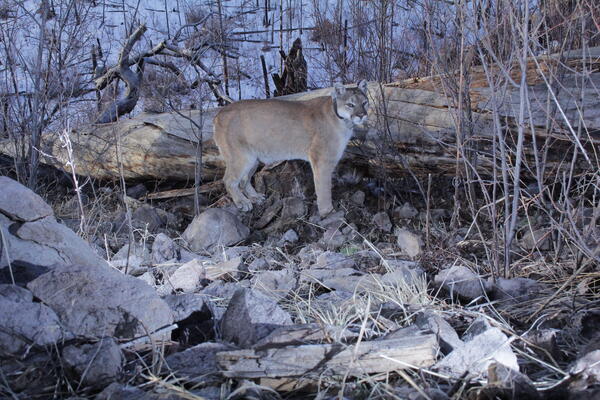
Mountain lion
Habitat change from wildfire and forest restoration treatments can influence habitat conditions for mule deer, elk, mountain lions, and black bears in New Mexico.
Filter Total Items: 68
Spatiotemporal risk avoidance varies seasonally, relative to risk intensity, in a reestablishing predator–prey system Spatiotemporal risk avoidance varies seasonally, relative to risk intensity, in a reestablishing predator–prey system
Predation establishes risk, which can indirectly influence prey behavior and ecology. We evaluated the influence of Mexican gray wolves (Canis lupus baileyi) on habitat selection and spatiotemporal predator avoidance strategies of elk (Cervus canadensis). We fit 866 adult female elk with GPS collars across areas of varying wolf densities within the Mexican wolf experimental population...
Authors
Cara J. Thompson, Nicole M. Tatman, Zachary J. Farley, Scott T. Boyle, Allison R. Greenleaf, James W. Cain
Serological assessment of pathogen exposure among desert bighorn sheep in southwestern Arizona Serological assessment of pathogen exposure among desert bighorn sheep in southwestern Arizona
Bighorn sheep (Ovis canadensis) are influenced by infectious diseases. Although Mycoplasma ovipneumoniae has been the main focus of bighorn sheep managers since early 2010, other pathogens may also influence bighorn sheep populations. We sampled desert bighorn sheep (Ovis canadensis mexicana) captured for a study on the Cabeza Prieta National Wildlife Refuge in southwestern Arizona, USA...
Authors
Colton J. Padilla, James W. Cain, Matthew E. Gompper, Paul R. Krausman, JIM Devos
Feeding habits of sympatric aoudad (Ammotragus lervia) and desert bighorn sheep (Ovis canadensis mexicana) in West Texas Feeding habits of sympatric aoudad (Ammotragus lervia) and desert bighorn sheep (Ovis canadensis mexicana) in West Texas
Aoudad (Ammotragus lervia), native to northern Africa, were introduced as exotic game animals to the Chihuahuan Desert in West Texas, USA, and have become invasive. Aoudad and bighorn sheep (Ovis canadensis mexicana) are adapted to rugged terrain in arid climates, and both persist in desert regions with low primary productivity and limited perennial water availability, which suggests...
Authors
Grace L. Parikh, Jose L. Etchart, Ryan O’Shaughnessy, Louis A. Harveson, James W. Cain
Predicting pup-rearing habitat for Mexican wolves Predicting pup-rearing habitat for Mexican wolves
Population monitoring is essential to document recovery efforts for threatened and endangered species. Mexican wolves (Canis lupus baileyi) are an endangered subspecies of gray wolves that historically occupied large portions of the American Southwest and Mexico. Recently, the Mexican wolf population in the United States has been growing rapidly and traditional approaches for population...
Authors
Sarah B. Bassing, John K. Oakleaf, James W. Cain, Allison R. Greenleaf, Colby M. Gardner, David Edward Ausband
Ungulate migrations of the Western United States, volume 5 Ungulate migrations of the Western United States, volume 5
Many ungulates migrate between distinct summer and winter ranges to take advantage of spatially and temporally variable food sources and avoid threats such as predators and deep snow. In 2018, the U.S. Department of the Interior established Secretarial Order 3362, which provided Federal support to expand existing research efforts to study ungulate populations and conserve their...
Authors
Matthew Kauffman, Blake Lowrey, Jennifer L. McKee, Travis Allen, Chloe Beaupre, Jeffrey L. Beck, Scott Bergen, Justin Binfet, Shelly Blair, James W. Cain, Peyton Carl, Todd Cornish, Michelle Cowardin, Rachel Curtis, Melia DeVivo, Jennifer Diamond, Katie Dugger, Orrin Duvuvuei, C.J. Ellingwood, Darby Finely, Jessica Fort, Eric Freeman, Ian Freeman, Jeff Gagnon, Emily Gelzer, Jacob Gray, Evan Greenspan, Curtis Hendricks, Valerie Hinojoza-Rood, Matthew Jeffress, Carolyn A. Kyle, Zack Lockyer, Cody McKee, Jerod Merkle, Jerrod Merrell, Matthew Mumma, Jake Powell, Craig Reddell, Adele K. Reinking, Robert Ritson, Sierra Robatcek, Benjamin S. Robb, Brianna M. Russo, Hall Sawyer, Cody Schroeder, Elissa Slezak, Scott Sprague, Erik Steiner, Alethea Steingisser, Tom Stephenson, Nicole Tatman, Kaitlyn L. Taylor, Don Whittaker, Travis Zaffarano
Effects of Mycoplasma ovipneumoniae, abundance, and environmental conditions on bighorn sheep lamb:ewe ratios and adult survival in New Mexico Effects of Mycoplasma ovipneumoniae, abundance, and environmental conditions on bighorn sheep lamb:ewe ratios and adult survival in New Mexico
Mycoplasma ovipneumoniae is a primary causative agent responsible for initiating polymicrobial pneumonia in bighorn sheep (Ovis canadensis). Infections of bighorn sheep populations are typically characterized by initial all-age epizootics followed by long-term periods of repressed juvenile (lamb) survival. Populations of bighorn sheep in New Mexico, USA, were thought to be free of this...
Authors
Colton J. Padilla, Caitlin Q. Ruhl, James W. Cain, Matthew E. Gompper