



Vicki S. Blazer, PhD (Former Employee)
Science and Products
Filter Total Items: 21

Healthy Fish and Wildlife: Community Livelihoods, Fishing and Hunting Heritage, Recreation, and Economic Security
Healthy fish and wildlife underpin the economic vitality, food security, recreational enjoyment, and cultural heritage of fishing and hunting in communities across the United States. Fishing and hunting resources scale from the personal recreation of families to multi-billion-dollar industries. Recognizing these critical connections, the U.S. Geological Survey (USGS) works to understand, protect...
By
Ecosystems Mission Area, Contaminant Biology, Environmental Health Program, Toxic Substances Hydrology, California Water Science Center, Central Midwest Water Science Center, Columbia Environmental Research Center, Eastern Ecological Science Center, Forest and Rangeland Ecosystem Science Center, Upper Midwest Environmental Sciences Center, Upper Midwest Water Science Center

Per- and Polyfluoroalkyl Substances (PFAS) found in Smallmouth Bass (Micropterus dolomieu) throughout the mid-Atlantic United States
Per- and polyfluoroalkyl substances (PFAS) are a large group of chemicals that have been recognized as concerns for both human and ecosystem health. There is a need to understand the effects of PFAS on fish health and populations.

PFAS Transport, Exposure, and Effects
The team is determining the movement and behavior of per- and poly-fluoroalkyl substances (PFAS) from their sources in the environment, as they move through exposure pathways in ecosystems including watersheds and aquifers, their incorporation into food webs, and molecular to population scale effects on fish and wildlife. These studies are accomplished at a variety of spatial scales from regional...

USGS Integrates Findings about Endocrine-Disrupting Compounds in the Chesapeake Watershed
Issue: Studies in the Chesapeake Bay Watershed have documented the exposure of fish to toxic contaminants including endocrine-disrupting compounds (EDCs) - compounds which can alter normal hormonal function in organisms. Given the importance of fisheries to the economic and environmental health of the Watershed, observed endocrine disruption and fish kills in the Watershed have raised public and...

Groundwater Discharge is a Pathway for Phytoestrogen and Herbicide Entry to Streams in the Chesapeake Bay Watershed
Groundwater discharge zones are important spawning areas for fish because they provide a thermally stable habitat. Research at three streams in the Chesapeake Bay Watershed with areas of focused groundwater discharge revealed that groundwater also is a source of phytoestrogens and herbicides that could result in fish exposure during sensitive life stages.

Bioaccumulation of Mercury in Fish Varied by Species and Location in the Chesapeake Bay Watershed—Summary of Existing Data and a Roadmap for Integrated Monitoring
Fish mercury data from State monitoring programs and research studies within the Chesapeake Bay were compiled and summarized to provide a comprehensive overview of the variation in fish mercury concentrations among species and habitats within the watershed. These data are put into context with existing health benchmarks for humans, birds, and fish. Scientists also provide a roadmap for an...

New Virus Identified in Melanistic Skin Lesions on Smallmouth Bass from the Chesapeake Bay Watershed
Scientists determined the risk factors associated with smallmouth bass melanistic skin lesions on smallmouth bass in the Susquehanna and Potomac Rivers, in the Chesapeake Bay watershed. A new virus, which appears to be a member of an emerging viral family, the Adomaviridae, was identified in the lesions. Questions remain about the full characterization of the virus and the role of environmental...

Land-use influences on estrogenic-endocrine disruption in fish within the Chesapeake Bay watershed
Issue: Effects of exposure to estrogenic-chemical contaminants have been observed in many fish species worldwide. One effect is described as “intersex” because fish will take on characteristics of the other sex, such as immature eggs forming in male fish. Studies in the Chesapeake Bay watershed have also identified the exposure of fish to endocrine-disrupting compounds. The estrogenic-endocrine...

Point and Non-Point Sources of Endocrine Disrupting Compounds and the Potential Effects on Fish and Frogs in the New Jersey Pinelands
This project, in collaboration with the NJ Pinelands Commission and the USGS NJ Water Center, is evaluating potential effects of endocrine-disrupting chemicals from point and nonpoint sources in the Pinelands Area, a research cluster as part of the Delaware River Watershed Initiative.
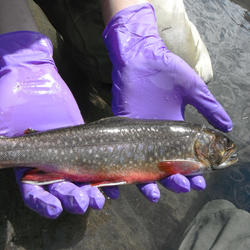
Outdoor Resources Integrated Science Team
The Outdoor Resources Integrated Science Team studies how contaminants, pathogens, and other environmental stressors affect the health of fish and wildlife that support recreational and cultural traditions, providing practical science that guides responsible land and water use, supports informed stewardship, and helps ensure resilient outdoor resources for all communities.

Point and Nonpoint Sources of Endocrine Disrupting Compounds and the Potential effects on Fish and Frogs in the New Jersey Pinelands
Scientists from the NJ WSC, Leetown Science Center and New Jersey Pinelands Commission recently initiated a 4 year study designed to characterize the point and non-point sources of endocrine disrupting compound (EDCs) and their potential effects on fish and frogs in the NJ Pinelands.

Striped bass with mycobacteriosis
Striped bass ( Morone saxatilis) displaying ulcerative skin lesions and chronic wasting, both typical clinical signs of mycobacteriosis, a bacterial disease that is problematic among many types of fishes around the world.
Science and Products
Filter Total Items: 21
Healthy Fish and Wildlife: Community Livelihoods, Fishing and Hunting Heritage, Recreation, and Economic Security
Healthy fish and wildlife underpin the economic vitality, food security, recreational enjoyment, and cultural heritage of fishing and hunting in communities across the United States. Fishing and hunting resources scale from the personal recreation of families to multi-billion-dollar industries. Recognizing these critical connections, the U.S. Geological Survey (USGS) works to understand, protect...
By
Ecosystems Mission Area, Contaminant Biology, Environmental Health Program, Toxic Substances Hydrology, California Water Science Center, Central Midwest Water Science Center, Columbia Environmental Research Center, Eastern Ecological Science Center, Forest and Rangeland Ecosystem Science Center, Upper Midwest Environmental Sciences Center, Upper Midwest Water Science Center
Per- and Polyfluoroalkyl Substances (PFAS) found in Smallmouth Bass (Micropterus dolomieu) throughout the mid-Atlantic United States
Per- and polyfluoroalkyl substances (PFAS) are a large group of chemicals that have been recognized as concerns for both human and ecosystem health. There is a need to understand the effects of PFAS on fish health and populations.
PFAS Transport, Exposure, and Effects
The team is determining the movement and behavior of per- and poly-fluoroalkyl substances (PFAS) from their sources in the environment, as they move through exposure pathways in ecosystems including watersheds and aquifers, their incorporation into food webs, and molecular to population scale effects on fish and wildlife. These studies are accomplished at a variety of spatial scales from regional...
USGS Integrates Findings about Endocrine-Disrupting Compounds in the Chesapeake Watershed
Issue: Studies in the Chesapeake Bay Watershed have documented the exposure of fish to toxic contaminants including endocrine-disrupting compounds (EDCs) - compounds which can alter normal hormonal function in organisms. Given the importance of fisheries to the economic and environmental health of the Watershed, observed endocrine disruption and fish kills in the Watershed have raised public and...
Groundwater Discharge is a Pathway for Phytoestrogen and Herbicide Entry to Streams in the Chesapeake Bay Watershed
Groundwater discharge zones are important spawning areas for fish because they provide a thermally stable habitat. Research at three streams in the Chesapeake Bay Watershed with areas of focused groundwater discharge revealed that groundwater also is a source of phytoestrogens and herbicides that could result in fish exposure during sensitive life stages.
Bioaccumulation of Mercury in Fish Varied by Species and Location in the Chesapeake Bay Watershed—Summary of Existing Data and a Roadmap for Integrated Monitoring
Fish mercury data from State monitoring programs and research studies within the Chesapeake Bay were compiled and summarized to provide a comprehensive overview of the variation in fish mercury concentrations among species and habitats within the watershed. These data are put into context with existing health benchmarks for humans, birds, and fish. Scientists also provide a roadmap for an...
New Virus Identified in Melanistic Skin Lesions on Smallmouth Bass from the Chesapeake Bay Watershed
Scientists determined the risk factors associated with smallmouth bass melanistic skin lesions on smallmouth bass in the Susquehanna and Potomac Rivers, in the Chesapeake Bay watershed. A new virus, which appears to be a member of an emerging viral family, the Adomaviridae, was identified in the lesions. Questions remain about the full characterization of the virus and the role of environmental...
Land-use influences on estrogenic-endocrine disruption in fish within the Chesapeake Bay watershed
Issue: Effects of exposure to estrogenic-chemical contaminants have been observed in many fish species worldwide. One effect is described as “intersex” because fish will take on characteristics of the other sex, such as immature eggs forming in male fish. Studies in the Chesapeake Bay watershed have also identified the exposure of fish to endocrine-disrupting compounds. The estrogenic-endocrine...
Point and Non-Point Sources of Endocrine Disrupting Compounds and the Potential Effects on Fish and Frogs in the New Jersey Pinelands
This project, in collaboration with the NJ Pinelands Commission and the USGS NJ Water Center, is evaluating potential effects of endocrine-disrupting chemicals from point and nonpoint sources in the Pinelands Area, a research cluster as part of the Delaware River Watershed Initiative.
Outdoor Resources Integrated Science Team
The Outdoor Resources Integrated Science Team studies how contaminants, pathogens, and other environmental stressors affect the health of fish and wildlife that support recreational and cultural traditions, providing practical science that guides responsible land and water use, supports informed stewardship, and helps ensure resilient outdoor resources for all communities.
Point and Nonpoint Sources of Endocrine Disrupting Compounds and the Potential effects on Fish and Frogs in the New Jersey Pinelands
Scientists from the NJ WSC, Leetown Science Center and New Jersey Pinelands Commission recently initiated a 4 year study designed to characterize the point and non-point sources of endocrine disrupting compound (EDCs) and their potential effects on fish and frogs in the NJ Pinelands.
Striped bass with mycobacteriosis
Striped bass ( Morone saxatilis) displaying ulcerative skin lesions and chronic wasting, both typical clinical signs of mycobacteriosis, a bacterial disease that is problematic among many types of fishes around the world.
*Disclaimer: Listing outside positions with professional scientific organizations on this Staff Profile are for informational purposes only and do not constitute an endorsement of those professional scientific organizations or their activities by the USGS, Department of the Interior, or U.S. Government