
Assessment of Post-Fire Risk in California and Washington
In FY 2022, USGS received disaster supplement funds (Public Law 117-43) for the following activities:
Post-wildfire risk assessment: tasks and benefits 2022
Media
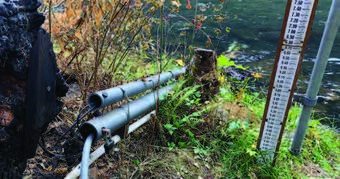
Sources/Usage: Public Domain. View Media Details
- The effects of wildfire in California (Caldor, Dixie, and KNP Complex Fires) and Washington State (Cedar Creek and Muckamuck Fires) may persist for years as vegetation regrows and landscapes recover.
- Funding will be used to address the needs of land and emergency management agencies at the Federal, Tribal, State, and local levels by providing new information to identify information gaps, support recovery planning, and aid in recovery and rebuilding decisions.
- Funding will also be used to focus on data and information for vegetation recovery for resource management, debris-flow hazard assessments in priority high-risk areas for recovery and emergency planning, and water flow and quality modeling water-supply protection.
Return to 2022 Supplemental Appropriations Activities
Related
Postfire Landslide Monitoring Station: "Chips" (2021 Dixie Fire) near Belden, CA
Wildfire can increase landslide susceptibility in mountainous terrain. The USGS maintains postfire landslide monitoring stations to track hillslope hydrologic conditions in the years following fire.
Postfire Landslide Monitoring Station: "Chambers" (2021 Dixie Fire) near Belden, CA
Wildfire can increase landslide susceptibility in mountainous terrain. The USGS maintains postfire landslide monitoring stations to track hillslope hydrologic conditions in the years following fire.
"Chips" - Recent Conditions
Recent Monitoring Data
Filter Total Items: 16
Post-Wildfire Debris-Flow Runout Hazard Assessment (PWFDF-R) Collection (updated 20260423) Post-Wildfire Debris-Flow Runout Hazard Assessment (PWFDF-R) Collection (updated 20260423)
Wildfire can substantially alter the hydrologic response of watersheds to rainfall, and debris-flow activity is among the most destructive consequences of these events. To assist federal, state, and local agencies in planning for postfire hazards, the U.S. Geological Survey conducts debris-flow hazard runout assessments. This collection contains the results of those assessments conducted...
Sediment computed tomography (CT) scans, photographs, and core-log descriptions from Conconully Reservoir, Okanogan County, WA, 2022-2023 Sediment computed tomography (CT) scans, photographs, and core-log descriptions from Conconully Reservoir, Okanogan County, WA, 2022-2023
This data release contains information on four sediment cores that were collected by the U.S. Geological Survey in Conconully Reservoir, Okanogan County, Washington, in June 2022 and October 2023. Data include the location each sediment core was collected, descriptions of the sediment profile of two of the cores (i.e., texture, color, structure, and visible constituents), photographs of...
Charcoal and soil, water, and reservoir sediment-core chemistry in the North Fork Salmon Creek basin and Conconully Reservoir, Washington, 2022-2023 Charcoal and soil, water, and reservoir sediment-core chemistry in the North Fork Salmon Creek basin and Conconully Reservoir, Washington, 2022-2023
Charcoal counts and soil, water, and reservoir sediment-core geochemistry were characterized eight months after the November 2021 Muckamuck Fire in the North Fork Salmon Creek basin and Conconully Reservoir, Washington, the receiving water body. Parameters include sand-sized charcoal, Cesium-137, excess Lead-210, aqueous and solid-phase elemental chemistry, and polycyclic aromatic...
Data Describing the Presence of Live Trees for Three Years in Sentinel-2 Pixels Across Four Fires in California, USA Data Describing the Presence of Live Trees for Three Years in Sentinel-2 Pixels Across Four Fires in California, USA
This dataset represents photointerpretation of live tree presence and raw pixel values from 500 randomly selected Sentinel-2 pixels across four fires in the state of California. This dataset was used to run random forest models to predict live tree presence in the Cabin Fire, Rough Fire, Pier Fire, and Schaeffer Fire at 1, 3, and 5 years post fire.
Post-Wildfire Debris-Flow Hazard Assessment (PWFDF) Collection Post-Wildfire Debris-Flow Hazard Assessment (PWFDF) Collection
Wildfire can substantially alter the hydrologic response of watersheds to rainfall, and debris-flow activity is among the most destructive consequences of these events. To assist federal, state, and local agencies in planning for postfire hazards, the U.S. Geological Survey conducts debris-flow hazard assessments for recent wildfires. This collection contains the results of those...
Fuels Data for the 2021 KNP Complex Fire in Sequoia and Kings Canyon National Parks, Collected in 2024 (ver. 1.1, January 2026) Fuels Data for the 2021 KNP Complex Fire in Sequoia and Kings Canyon National Parks, Collected in 2024 (ver. 1.1, January 2026)
Post-fire vegetation structure and fuels data are essential for understanding the recovery process after major disturbances. To meet this need, 40 plots within and around the perimeter of the 2021 KNP Complex Fire were surveyed between July 12 and July 28, 2024. Data was collected on sites previously established by the U.S. Geological Survey Kings Canyon and Sequoia Field Station, as...
Proportional Basal Area Mortality Following Four Large Wildfires in California, USA Proportional Basal Area Mortality Following Four Large Wildfires in California, USA
This dataset provides estimates of the proportion of basal area that survived along with burn severity indices for 585 plots following four large fires in California, including the Carr (2018), Dixie (2021), Caldor (2021), and KNP (2021) fires.
Field Validation Data for Live Tree Presence/Absence Following Two Large Wildfires in California, USA Field Validation Data for Live Tree Presence/Absence Following Two Large Wildfires in California, USA
This data file contains observations recorded during field surveys of post-fire vegetation in the 2021 Caldor and 2022 Mosquito Fires in the Sierra Nevada of California. The surveys were performed in summer 2023. All tree species were surveyed and treated the same.
Postfire erosion estimates for large California wildfires that occurred between 1984 and 2021 Postfire erosion estimates for large California wildfires that occurred between 1984 and 2021
This data release presents a compilation of postfire sediment mobilization data from wildfires greater than 100 km2 that occurred in California or regions of southern Oregon that drain to the California coast between 1984 and 2021. This compilation includes three sources of sediment mobilization data: hillslope erosion modeled using the Water Erosion Prediction Project (WEPP) postfire...
Bathymetry and Acoustic Backscatter data for Jenkinson Lake, California collected during three USGS field activities, 2022-604-FA, 2022-649-FA, and 2023-634-FA Bathymetry and Acoustic Backscatter data for Jenkinson Lake, California collected during three USGS field activities, 2022-604-FA, 2022-649-FA, and 2023-634-FA
Bathymetry and acoustic-backscatter data were collected during three separate SWATHPlus surveys of Jenkinson Lake, California to determine any impacts on the lake floor following the 2021 Caldor fire. Data were collected and processed by the U.S. Geological Survey (USGS), Pacific Coastal and Marine Science Center (PCMSC) with fieldwork activity numbers 2022-604-FA (January 2022), 2022...
Digital Surface Models and orthomosaic images from UAS surveys of Jenkinson Lake, El Dorado County, CA Digital Surface Models and orthomosaic images from UAS surveys of Jenkinson Lake, El Dorado County, CA
This data release presents Digital Surface Models (DSM) and orthomosaic images derived from uncrewed aerial system (UAS) surveys conducted at Jenkinson Lake in El Dorado County, California. The surveys were conducted to perform repeat structure-from-motion topographic mapping at the upper end of the reservoir, near the inlets of Sly Park Creek and Hazel Creek, with the purpose of...
Compilation of runoff-generated debris-flow inventories for 18 fires across Arizona, California, Colorado, New Mexico, Utah, and Washington, USA Compilation of runoff-generated debris-flow inventories for 18 fires across Arizona, California, Colorado, New Mexico, Utah, and Washington, USA
Description This data release is an inventory of runoff-generated postfire debris flows compiled from 18 burn areas across six western U.S. states. Debris-flow data from the following fires are included: Arizona: 2019 Museum, 2021 Flag, and 2022 Pipeline Fires California: 2014 Silverado, 2015 Valley, 2019 Briceburg, 2020 Dolan, 2020 El Dorado, 2020 Lake, and 2021 Dixie Fires Colorado...
Quantifying post-fire live tree presence and spatial variation using Sentinel-2 time series Quantifying post-fire live tree presence and spatial variation using Sentinel-2 time series
Accurate mapping of post-fire surviving trees is important for tracking forest recovery and prioritizing land management decisions. Satellite-based remote sensing is an effective method to assess post-fire forest conditions. Traditionally, differenced satellite-derived burn severity indices are computed by differencing one year pre- and post-fire spectral reflectance values. Differenced...
Authors
Saba J. Saberi, Phillip J. van Mantgem, Micah C. Wright, Christopher Y.S. Wong, Andrew M. Latimer, Derek J.N. Young
Cascading consequences and interventions for hazards after wildfire in Okanogan County, Washington Cascading consequences and interventions for hazards after wildfire in Okanogan County, Washington
This report details the application of the chains of consequences method within the postfire hazard context after the 2021 Cedar Creek and Muckamuck Fires around Okanogan County, Washington. The U.S. Geological Survey Social and Economic Analysis branch convened 20 stakeholders with content- and context-specific knowledge related to these fires and their postfire hazards in an April 2023...
Authors
Briar H. Goldwyn, James R. Meldrum, Rudy Schuster
Rainfall thresholds for postfire debris-flow initiation vary with short-duration rainfall climatology Rainfall thresholds for postfire debris-flow initiation vary with short-duration rainfall climatology
The size, frequency, and geographic scope of severe wildfires are expanding across the globe, including in the Western United States. Recently burned steeplands have an increased likelihood of debris flows, which pose hazards to downstream communities. The conditions for postfire debris-flow initiation are commonly expressed as rainfall intensity-duration thresholds, which can be...
Authors
David B. Cavagnaro, Scott W. McCoy, Donald N. Lindsay, Luke A. McGuire, Jason W. Kean, Daniel T. Trugman
Assessment of western Oregon debris-flow hazards in burned and unburned environments Assessment of western Oregon debris-flow hazards in burned and unburned environments
In the steep and mountainous environment of western Oregon, debris flows pose a considerable threat to property, infrastructure and life. Wildfire is commonly known to increase the susceptibility of steep slopes to debris flows, but the extent of this process in the western Cascades is not well understood. The US Geological Survey (USGS) currently estimates postfire debris-flow...
Authors
Brittany Danielle Selander, Nancy C. Calhoun, William Burns, Jason W. Kean, Francis K. Rengers
Post-fire sediment yield from a western Sierra Nevada watershed burned by the 2021 Caldor Fire Post-fire sediment yield from a western Sierra Nevada watershed burned by the 2021 Caldor Fire
Watershed sediment yield commonly increases after wildfire, often causing negative impacts to downstream infrastructure and water resources. Post-fire erosion is important to understand and quantify because it is increasingly placing water supplies, habitat, communities, and infrastructure at risk as fire regimes intensify in a warming climate. However, measurements of post-fire sediment
Authors
Amy E. East, Joshua B. Logan, Peter Dartnell, Helen Willemien Dow, Donald N. Lindsay, David B. Cavagnaro
Postfire sediment mobilization and its downstream implications across California, 1984 – 2021 Postfire sediment mobilization and its downstream implications across California, 1984 – 2021
Fire facilitates erosion through changes in vegetation and soil, with major postfire erosion commonly occurring even with moderate rainfall. As climate warms, the western United States (U.S.) is experiencing an intensifying fire regime and increasing frequency of extreme rain. We evaluated whether these hydroclimatic changes are evident in patterns of postfire erosion by modeling...
Authors
Helen Willemien Dow, Amy E. East, Joel B. Sankey, Jonathan A. Warrick, Jaime Kostelnik, Donald N. Lindsay, Jason W. Kean
A robust quantitative method to distinguish runoff-generated debris flows from floods A robust quantitative method to distinguish runoff-generated debris flows from floods
Debris flows and floods generated by rainfall runoff occur in rocky mountainous landscapes and burned steeplands. Flow type is commonly identified post-event through interpretation of depositional structures, but these may be poorly preserved or misinterpreted. Prior research indicates that discharge magnitude is commonly amplified in debris flows relative to floods due to volumetric...
Authors
David B. Cavagnaro, Scott W. McCoy, Jason W. Kean, Matthew A. Thomas, Donald N. Lindsay, Brian W. McArdell, Jacob Hirschberg
Post-fire sediment yield from a central California watershed: Field measurements and validation of the WEPP model Post-fire sediment yield from a central California watershed: Field measurements and validation of the WEPP model
In a warming climate, an intensifying fire regime and higher likelihood of extreme rain are expected to increase watershed sediment yield in many regions. Understanding regional variability in landscape response to fire and post-fire rainfall is essential for managing water resources and infrastructure. We measured sediment yield resulting from sequential wildfire and extreme rain and...
Authors
Amy E. East, Joshua B. Logan, Helen Willemien Dow, Douglas P. Smith, Pat Iampietro, Jonathan A. Warrick, Thomas Lorenson, Leticia Hallas, Benjamin Kozlowicz
How long do runoff-generated debris-flow hazards persist after wildfire? How long do runoff-generated debris-flow hazards persist after wildfire?
Runoff-generated debris flows are a potentially destructive and deadly response to wildfire until sufficient vegetation and soil-hydraulic recovery have reduced susceptibility to the hazard. Elevated debris-flow susceptibility may persist for several years, but the controls on the timespan of the susceptible period are poorly understood. To evaluate the connection between vegetation...
Authors
Andrew Paul Graber, Matthew A. Thomas, Jason W. Kean
The rainfall intensity-duration control of debris flows after wildfire The rainfall intensity-duration control of debris flows after wildfire
Increased wildfire activity in the western United States has exposed regional gaps in our understanding of postfire debris-flow generation. To address this problem, we characterized flows in an unstudied area to test the rainfall intensity-duration control of the hazard. Our rainfall measurements and field observations from the northern Sierra Nevada (California, USA) show that debris...
Authors
Matthew A. Thomas, Donald N. Lindsay, David B. Cavagnaro, Jason W. Kean, Scott W. McCoy, Andrew Paul Graber
ocelote 1.1.0 ocelote 1.1.0
This release adds functionality for building debris-flow likelihood lookup tables, and uploading the results to the National Weather Service (NWS) FTP endpoint. The release: * Adds the `authenticate nws` command, which collects authentication credentials for uploading to the NWS FTP endpoint * Updates the `run` command to compute debris-flow likelihood lookup tables, and save the results...
wildcat 1.1.0 wildcat 1.1.0
This release allows users to select the CRS of exported files, and to specify alternate configuration files. The release also updates wildcat’s backend for compatibility with pfdf 3+. Documentation: https://ghsc.code-pages.usgs.gov/lhp/wildcat/ Release Notes: https://ghsc.code-pages.usgs.gov/lhp/wildcat/resources/release-notes/1.1.0.html
pfdf 1.1.0 pfdf 1.1.0
This release add the following major features to pfdf: * Comprehensive documentation * Raster preprocessing * Parallelization options when locating outlet basins * Windowed raster reading The release also provides minor improvements, as follows: * Raster data/nodata masks, * Improved model broadcasting options, * The Segments.in_mask and Segments.in_perimeter methods
Related
Postfire Landslide Monitoring Station: "Chips" (2021 Dixie Fire) near Belden, CA
Wildfire can increase landslide susceptibility in mountainous terrain. The USGS maintains postfire landslide monitoring stations to track hillslope hydrologic conditions in the years following fire.
Postfire Landslide Monitoring Station: "Chambers" (2021 Dixie Fire) near Belden, CA
Wildfire can increase landslide susceptibility in mountainous terrain. The USGS maintains postfire landslide monitoring stations to track hillslope hydrologic conditions in the years following fire.
"Chips" - Recent Conditions
Recent Monitoring Data
Filter Total Items: 16
Post-Wildfire Debris-Flow Runout Hazard Assessment (PWFDF-R) Collection (updated 20260423) Post-Wildfire Debris-Flow Runout Hazard Assessment (PWFDF-R) Collection (updated 20260423)
Wildfire can substantially alter the hydrologic response of watersheds to rainfall, and debris-flow activity is among the most destructive consequences of these events. To assist federal, state, and local agencies in planning for postfire hazards, the U.S. Geological Survey conducts debris-flow hazard runout assessments. This collection contains the results of those assessments conducted...
Sediment computed tomography (CT) scans, photographs, and core-log descriptions from Conconully Reservoir, Okanogan County, WA, 2022-2023 Sediment computed tomography (CT) scans, photographs, and core-log descriptions from Conconully Reservoir, Okanogan County, WA, 2022-2023
This data release contains information on four sediment cores that were collected by the U.S. Geological Survey in Conconully Reservoir, Okanogan County, Washington, in June 2022 and October 2023. Data include the location each sediment core was collected, descriptions of the sediment profile of two of the cores (i.e., texture, color, structure, and visible constituents), photographs of...
Charcoal and soil, water, and reservoir sediment-core chemistry in the North Fork Salmon Creek basin and Conconully Reservoir, Washington, 2022-2023 Charcoal and soil, water, and reservoir sediment-core chemistry in the North Fork Salmon Creek basin and Conconully Reservoir, Washington, 2022-2023
Charcoal counts and soil, water, and reservoir sediment-core geochemistry were characterized eight months after the November 2021 Muckamuck Fire in the North Fork Salmon Creek basin and Conconully Reservoir, Washington, the receiving water body. Parameters include sand-sized charcoal, Cesium-137, excess Lead-210, aqueous and solid-phase elemental chemistry, and polycyclic aromatic...
Data Describing the Presence of Live Trees for Three Years in Sentinel-2 Pixels Across Four Fires in California, USA Data Describing the Presence of Live Trees for Three Years in Sentinel-2 Pixels Across Four Fires in California, USA
This dataset represents photointerpretation of live tree presence and raw pixel values from 500 randomly selected Sentinel-2 pixels across four fires in the state of California. This dataset was used to run random forest models to predict live tree presence in the Cabin Fire, Rough Fire, Pier Fire, and Schaeffer Fire at 1, 3, and 5 years post fire.
Post-Wildfire Debris-Flow Hazard Assessment (PWFDF) Collection Post-Wildfire Debris-Flow Hazard Assessment (PWFDF) Collection
Wildfire can substantially alter the hydrologic response of watersheds to rainfall, and debris-flow activity is among the most destructive consequences of these events. To assist federal, state, and local agencies in planning for postfire hazards, the U.S. Geological Survey conducts debris-flow hazard assessments for recent wildfires. This collection contains the results of those...
Fuels Data for the 2021 KNP Complex Fire in Sequoia and Kings Canyon National Parks, Collected in 2024 (ver. 1.1, January 2026) Fuels Data for the 2021 KNP Complex Fire in Sequoia and Kings Canyon National Parks, Collected in 2024 (ver. 1.1, January 2026)
Post-fire vegetation structure and fuels data are essential for understanding the recovery process after major disturbances. To meet this need, 40 plots within and around the perimeter of the 2021 KNP Complex Fire were surveyed between July 12 and July 28, 2024. Data was collected on sites previously established by the U.S. Geological Survey Kings Canyon and Sequoia Field Station, as...
Proportional Basal Area Mortality Following Four Large Wildfires in California, USA Proportional Basal Area Mortality Following Four Large Wildfires in California, USA
This dataset provides estimates of the proportion of basal area that survived along with burn severity indices for 585 plots following four large fires in California, including the Carr (2018), Dixie (2021), Caldor (2021), and KNP (2021) fires.
Field Validation Data for Live Tree Presence/Absence Following Two Large Wildfires in California, USA Field Validation Data for Live Tree Presence/Absence Following Two Large Wildfires in California, USA
This data file contains observations recorded during field surveys of post-fire vegetation in the 2021 Caldor and 2022 Mosquito Fires in the Sierra Nevada of California. The surveys were performed in summer 2023. All tree species were surveyed and treated the same.
Postfire erosion estimates for large California wildfires that occurred between 1984 and 2021 Postfire erosion estimates for large California wildfires that occurred between 1984 and 2021
This data release presents a compilation of postfire sediment mobilization data from wildfires greater than 100 km2 that occurred in California or regions of southern Oregon that drain to the California coast between 1984 and 2021. This compilation includes three sources of sediment mobilization data: hillslope erosion modeled using the Water Erosion Prediction Project (WEPP) postfire...
Bathymetry and Acoustic Backscatter data for Jenkinson Lake, California collected during three USGS field activities, 2022-604-FA, 2022-649-FA, and 2023-634-FA Bathymetry and Acoustic Backscatter data for Jenkinson Lake, California collected during three USGS field activities, 2022-604-FA, 2022-649-FA, and 2023-634-FA
Bathymetry and acoustic-backscatter data were collected during three separate SWATHPlus surveys of Jenkinson Lake, California to determine any impacts on the lake floor following the 2021 Caldor fire. Data were collected and processed by the U.S. Geological Survey (USGS), Pacific Coastal and Marine Science Center (PCMSC) with fieldwork activity numbers 2022-604-FA (January 2022), 2022...
Digital Surface Models and orthomosaic images from UAS surveys of Jenkinson Lake, El Dorado County, CA Digital Surface Models and orthomosaic images from UAS surveys of Jenkinson Lake, El Dorado County, CA
This data release presents Digital Surface Models (DSM) and orthomosaic images derived from uncrewed aerial system (UAS) surveys conducted at Jenkinson Lake in El Dorado County, California. The surveys were conducted to perform repeat structure-from-motion topographic mapping at the upper end of the reservoir, near the inlets of Sly Park Creek and Hazel Creek, with the purpose of...
Compilation of runoff-generated debris-flow inventories for 18 fires across Arizona, California, Colorado, New Mexico, Utah, and Washington, USA Compilation of runoff-generated debris-flow inventories for 18 fires across Arizona, California, Colorado, New Mexico, Utah, and Washington, USA
Description This data release is an inventory of runoff-generated postfire debris flows compiled from 18 burn areas across six western U.S. states. Debris-flow data from the following fires are included: Arizona: 2019 Museum, 2021 Flag, and 2022 Pipeline Fires California: 2014 Silverado, 2015 Valley, 2019 Briceburg, 2020 Dolan, 2020 El Dorado, 2020 Lake, and 2021 Dixie Fires Colorado...
Quantifying post-fire live tree presence and spatial variation using Sentinel-2 time series Quantifying post-fire live tree presence and spatial variation using Sentinel-2 time series
Accurate mapping of post-fire surviving trees is important for tracking forest recovery and prioritizing land management decisions. Satellite-based remote sensing is an effective method to assess post-fire forest conditions. Traditionally, differenced satellite-derived burn severity indices are computed by differencing one year pre- and post-fire spectral reflectance values. Differenced...
Authors
Saba J. Saberi, Phillip J. van Mantgem, Micah C. Wright, Christopher Y.S. Wong, Andrew M. Latimer, Derek J.N. Young
Cascading consequences and interventions for hazards after wildfire in Okanogan County, Washington Cascading consequences and interventions for hazards after wildfire in Okanogan County, Washington
This report details the application of the chains of consequences method within the postfire hazard context after the 2021 Cedar Creek and Muckamuck Fires around Okanogan County, Washington. The U.S. Geological Survey Social and Economic Analysis branch convened 20 stakeholders with content- and context-specific knowledge related to these fires and their postfire hazards in an April 2023...
Authors
Briar H. Goldwyn, James R. Meldrum, Rudy Schuster
Rainfall thresholds for postfire debris-flow initiation vary with short-duration rainfall climatology Rainfall thresholds for postfire debris-flow initiation vary with short-duration rainfall climatology
The size, frequency, and geographic scope of severe wildfires are expanding across the globe, including in the Western United States. Recently burned steeplands have an increased likelihood of debris flows, which pose hazards to downstream communities. The conditions for postfire debris-flow initiation are commonly expressed as rainfall intensity-duration thresholds, which can be...
Authors
David B. Cavagnaro, Scott W. McCoy, Donald N. Lindsay, Luke A. McGuire, Jason W. Kean, Daniel T. Trugman
Assessment of western Oregon debris-flow hazards in burned and unburned environments Assessment of western Oregon debris-flow hazards in burned and unburned environments
In the steep and mountainous environment of western Oregon, debris flows pose a considerable threat to property, infrastructure and life. Wildfire is commonly known to increase the susceptibility of steep slopes to debris flows, but the extent of this process in the western Cascades is not well understood. The US Geological Survey (USGS) currently estimates postfire debris-flow...
Authors
Brittany Danielle Selander, Nancy C. Calhoun, William Burns, Jason W. Kean, Francis K. Rengers
Post-fire sediment yield from a western Sierra Nevada watershed burned by the 2021 Caldor Fire Post-fire sediment yield from a western Sierra Nevada watershed burned by the 2021 Caldor Fire
Watershed sediment yield commonly increases after wildfire, often causing negative impacts to downstream infrastructure and water resources. Post-fire erosion is important to understand and quantify because it is increasingly placing water supplies, habitat, communities, and infrastructure at risk as fire regimes intensify in a warming climate. However, measurements of post-fire sediment
Authors
Amy E. East, Joshua B. Logan, Peter Dartnell, Helen Willemien Dow, Donald N. Lindsay, David B. Cavagnaro
Postfire sediment mobilization and its downstream implications across California, 1984 – 2021 Postfire sediment mobilization and its downstream implications across California, 1984 – 2021
Fire facilitates erosion through changes in vegetation and soil, with major postfire erosion commonly occurring even with moderate rainfall. As climate warms, the western United States (U.S.) is experiencing an intensifying fire regime and increasing frequency of extreme rain. We evaluated whether these hydroclimatic changes are evident in patterns of postfire erosion by modeling...
Authors
Helen Willemien Dow, Amy E. East, Joel B. Sankey, Jonathan A. Warrick, Jaime Kostelnik, Donald N. Lindsay, Jason W. Kean
A robust quantitative method to distinguish runoff-generated debris flows from floods A robust quantitative method to distinguish runoff-generated debris flows from floods
Debris flows and floods generated by rainfall runoff occur in rocky mountainous landscapes and burned steeplands. Flow type is commonly identified post-event through interpretation of depositional structures, but these may be poorly preserved or misinterpreted. Prior research indicates that discharge magnitude is commonly amplified in debris flows relative to floods due to volumetric...
Authors
David B. Cavagnaro, Scott W. McCoy, Jason W. Kean, Matthew A. Thomas, Donald N. Lindsay, Brian W. McArdell, Jacob Hirschberg
Post-fire sediment yield from a central California watershed: Field measurements and validation of the WEPP model Post-fire sediment yield from a central California watershed: Field measurements and validation of the WEPP model
In a warming climate, an intensifying fire regime and higher likelihood of extreme rain are expected to increase watershed sediment yield in many regions. Understanding regional variability in landscape response to fire and post-fire rainfall is essential for managing water resources and infrastructure. We measured sediment yield resulting from sequential wildfire and extreme rain and...
Authors
Amy E. East, Joshua B. Logan, Helen Willemien Dow, Douglas P. Smith, Pat Iampietro, Jonathan A. Warrick, Thomas Lorenson, Leticia Hallas, Benjamin Kozlowicz
How long do runoff-generated debris-flow hazards persist after wildfire? How long do runoff-generated debris-flow hazards persist after wildfire?
Runoff-generated debris flows are a potentially destructive and deadly response to wildfire until sufficient vegetation and soil-hydraulic recovery have reduced susceptibility to the hazard. Elevated debris-flow susceptibility may persist for several years, but the controls on the timespan of the susceptible period are poorly understood. To evaluate the connection between vegetation...
Authors
Andrew Paul Graber, Matthew A. Thomas, Jason W. Kean
The rainfall intensity-duration control of debris flows after wildfire The rainfall intensity-duration control of debris flows after wildfire
Increased wildfire activity in the western United States has exposed regional gaps in our understanding of postfire debris-flow generation. To address this problem, we characterized flows in an unstudied area to test the rainfall intensity-duration control of the hazard. Our rainfall measurements and field observations from the northern Sierra Nevada (California, USA) show that debris...
Authors
Matthew A. Thomas, Donald N. Lindsay, David B. Cavagnaro, Jason W. Kean, Scott W. McCoy, Andrew Paul Graber
ocelote 1.1.0 ocelote 1.1.0
This release adds functionality for building debris-flow likelihood lookup tables, and uploading the results to the National Weather Service (NWS) FTP endpoint. The release: * Adds the `authenticate nws` command, which collects authentication credentials for uploading to the NWS FTP endpoint * Updates the `run` command to compute debris-flow likelihood lookup tables, and save the results...
wildcat 1.1.0 wildcat 1.1.0
This release allows users to select the CRS of exported files, and to specify alternate configuration files. The release also updates wildcat’s backend for compatibility with pfdf 3+. Documentation: https://ghsc.code-pages.usgs.gov/lhp/wildcat/ Release Notes: https://ghsc.code-pages.usgs.gov/lhp/wildcat/resources/release-notes/1.1.0.html
pfdf 1.1.0 pfdf 1.1.0
This release add the following major features to pfdf: * Comprehensive documentation * Raster preprocessing * Parallelization options when locating outlet basins * Windowed raster reading The release also provides minor improvements, as follows: * Raster data/nodata masks, * Improved model broadcasting options, * The Segments.in_mask and Segments.in_perimeter methods