U.S. flag

An official website of the United States government

Images

Kīlauea images of eruptive activity, field work, and more.

Filter Total Items: 2915
Color photograph of lava fountain and eruption plume
July 9, 2025 — Episode 28 Halema‘uma‘u lava fountain and eruption plume at Kīlauea summit

Episode 28 of the ongoing Halemaʻumaʻu eruption began just after 4 a.m. HST on July 9, 2025. This photograph was taken from the north rim of the caldera around 6:30 a.m., as Hawaiʻi Volcanoes National Park visitors gathered to view the episode. USGS photo by K. Mulliken.

Episode 28 of the ongoing Halemaʻumaʻu eruption began just after 4 a.m. HST on July 9, 2025. This photograph was taken from the north rim of the caldera around 6:30 a.m., as Hawaiʻi Volcanoes National Park visitors gathered to view the episode. USGS photo by K. Mulliken.

Color panoramic photo of a volcanic caldera with eruption
July 9, 2025 — Panoramic image showing episode 28 of Halema‘uma‘u eruption within Kaluapele

This panoramic image, taken around 6:30 a.m. HST on July 9, 2025, shows episode 28 of the ongoing eruption in Halemaʻumaʻu crater, within Kaluapele (the summit caldera of Kīlauea volcano). This view, from the north rim of the caldera, shows that the ongoing eruption has been occurring in the southwest part of the caldera. USGS photo by K. Mulliken. 

This panoramic image, taken around 6:30 a.m. HST on July 9, 2025, shows episode 28 of the ongoing eruption in Halemaʻumaʻu crater, within Kaluapele (the summit caldera of Kīlauea volcano). This view, from the north rim of the caldera, shows that the ongoing eruption has been occurring in the southwest part of the caldera. USGS photo by K. Mulliken. 

Color photograph of volcanic material deposited on landscape
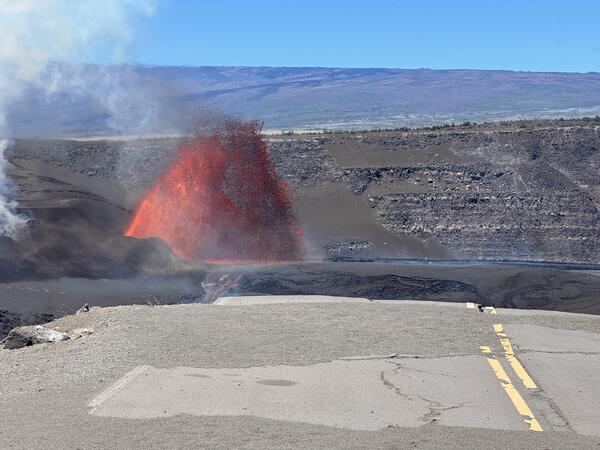
July 9, 2025 — View of the growing tephra hill after episode 28 at Kīlauea

After episode 28 ended, USGS geologists inspected the tephra deposit southwest of the eruptive vents, in the closed area of Hawai‘i Volcanoes National Park. The tephra continues to accumulate and build up a hill that is more than 80 ft (~25 m) high, covering parts of Crater Rim Drive.

After episode 28 ended, USGS geologists inspected the tephra deposit southwest of the eruptive vents, in the closed area of Hawai‘i Volcanoes National Park. The tephra continues to accumulate and build up a hill that is more than 80 ft (~25 m) high, covering parts of Crater Rim Drive.

Color photograph of lava fountain in crater
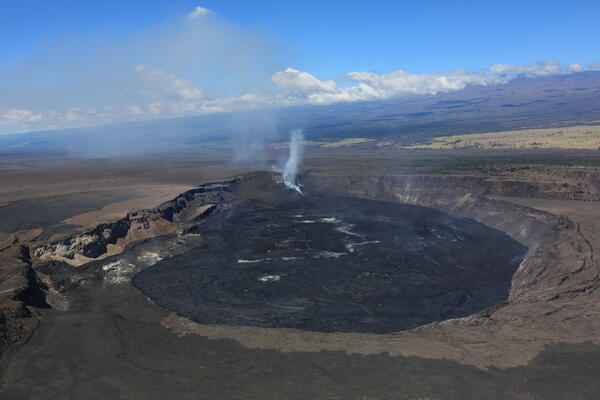
July 9, 2025 – Aerial view of episode 28 of Halema‘uma‘u Kīlauea summit eruption

In this view from an eruption monitoring helicopter overflight on Wednesday, July 9, new lava flows can be seen traveling across the Halema‘uma‘u crater floor—these appear as fluid forms with a shiny, silvery crust over incandescent red-hot lava. Older lava flows from previous eruptive episodes have a darker or duller appearance.

In this view from an eruption monitoring helicopter overflight on Wednesday, July 9, new lava flows can be seen traveling across the Halema‘uma‘u crater floor—these appear as fluid forms with a shiny, silvery crust over incandescent red-hot lava. Older lava flows from previous eruptive episodes have a darker or duller appearance.

Color photograph of lava fountain with flowering tree in foreground
July 9, 2025 — Kīlauea lava fountain and ‘ōhi‘a lehua

Near the Kīlauea Overlook in Hawaiʻi Volcanoes National Park, an ‘ōhi‘a lehua frames the lava fountains of episode 28 on July 9. USGS photo by K. Mulliken. 

Near the Kīlauea Overlook in Hawaiʻi Volcanoes National Park, an ‘ōhi‘a lehua frames the lava fountains of episode 28 on July 9. USGS photo by K. Mulliken. 

Color photograph of scientists setting up monitoring equipment next to lava fountain
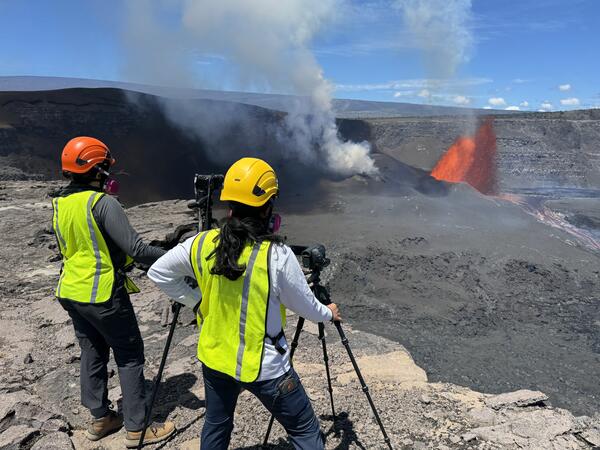
July 9, 2025 – Scientists measure gas emissions during episode 28 of the Halema‘uma‘u Kīlauea summit eruption

During episode 28 of lava fountaining during the ongoing Kīlauea summit eruption, USGS scientists approached the caldera rim to measure volcanic gas emissions with permission from Hawai‘i Volcanoes National Park. This lava fountain on the morning of July 9 was approximately 1000 feet tall (300 meters).

Color photograph of lava sample in a gloved hand
July 9, 2025 – A glassy lava bomb from lava fountaining episode 28 of the Halema‘uma‘u Kīlauea summit eruption

During episode 28 lava fountaining on Wednesday, July 9, clasts of fluid, molten lava were ejected to heights of approximately 1000 feet (300 meters) from the vent within Halema‘uma‘u crater and deposited onto the growing tephra hill on the western side of Kaluapele (Kīlauea summit caldera).

Color photographs showing volcano monitoring equipment covered with tephra
July 1, 2025 — Volcano monitoring equipment covered with tephra after episode 27 lava fountaining at Kīlauea

Following episode 27 of the Kīlauea summit eruption on June 29, USGS Hawaiian Volcano Observatory field engineers visited several sites southwest of Halemaʻumaʻu on July 1 to remove tephra that had accumulated on the solar panels and station infrastructure. USGS photos by M. Warren. 

Color photograph of altered rock and steaming ground
Ha‘akulamanu
Ha‘akulamanu
Ha‘akulamanu

The Ha‘akulamanu trail within Hawai‘i Volcanoes National Park passes through the Sulphur Banks area, where long-term degassing near Kaluapele (Kīlauea summit caldera) has altered the basalt to colorful minerals including yellow sulfur, white gypsum, and reddish-brown hematite. USGS photo by C. Sealing.

The Ha‘akulamanu trail within Hawai‘i Volcanoes National Park passes through the Sulphur Banks area, where long-term degassing near Kaluapele (Kīlauea summit caldera) has altered the basalt to colorful minerals including yellow sulfur, white gypsum, and reddish-brown hematite. USGS photo by C. Sealing.

Color photograph annotated with video title
30 episodes of lava fountaining at Kīlauea video thumbnail

Since December 23, 2024, 30 episodes of lava fountaining have happened in summit caldera of Kīlauea volcano, in Hawaiʻi Volcanoes National Park. 

Lava fountains in the background with visitors visible in the foreground
June 29, 2025 — Kīlauea summit episode 27

From the south rim of Kaluapele (Kīlauea summit caldera), the growing tephra cone downwind of the ongoing eruption site in Halemaʻumaʻu is easily visible. On June 29, visitors gathered along the rim near Keanakākoʻi Overlook within Hawaiʻi Volcanoes National Park to view lava fountaining associated with episode 27. USGS photo by K. Mulliken. 

From the south rim of Kaluapele (Kīlauea summit caldera), the growing tephra cone downwind of the ongoing eruption site in Halemaʻumaʻu is easily visible. On June 29, visitors gathered along the rim near Keanakākoʻi Overlook within Hawaiʻi Volcanoes National Park to view lava fountaining associated with episode 27. USGS photo by K. Mulliken. 

Color photograph of lava fountains
June 29, 2025 — Episode 27 of the Halema‘uma‘u Kīlauea summit eruption

Episode 27 of the Halema‘uma‘u Kīlauea summit eruption began around 9:05 a.m. HST on June 29, 2025. The north vent was active for majority of the eruption and reached approximately 1115 ft (~340 m) high by 11:00 am HST. The south vent became active with low level fountaining of about 65 ft (20 m) just before 4:00 p.m. HST. The fountains lasted just under 11 hours.

Episode 27 of the Halema‘uma‘u Kīlauea summit eruption began around 9:05 a.m. HST on June 29, 2025. The north vent was active for majority of the eruption and reached approximately 1115 ft (~340 m) high by 11:00 am HST. The south vent became active with low level fountaining of about 65 ft (20 m) just before 4:00 p.m. HST. The fountains lasted just under 11 hours.

Strands of volcanic glass on the ground
June 29, 2025 — Pele's Hair at Kīlauea

Strands of Pele's Hair collect in low-lying areas near Keanakākoʻi Overlook in Hawaiʻi Volcanoes National Park. USGS photo by K. Mulliken. 

Strands of Pele's Hair collect in low-lying areas near Keanakākoʻi Overlook in Hawaiʻi Volcanoes National Park. USGS photo by K. Mulliken. 

Color photograph of people sitting on the ground with an eruption visible in the background
June 29, 2025 — Episode 27 at the summit of Kīlauea

Visitors near the Keanakākoʻi Overlook in Hawaiʻi Volcanoes National Park view lava fountaining during episode 27 of the ongoing Kīlauea summit eruption on June 29. Approximately 1.6 billion gallons (8.1 million cubic yards, 6.2 million cubic meters) of lava erupted during the sustained fountaining phase of episode 27.

Visitors near the Keanakākoʻi Overlook in Hawaiʻi Volcanoes National Park view lava fountaining during episode 27 of the ongoing Kīlauea summit eruption on June 29. Approximately 1.6 billion gallons (8.1 million cubic yards, 6.2 million cubic meters) of lava erupted during the sustained fountaining phase of episode 27.

Color photograph of lava fountain
June 29, 2025 — Kīlauea lava fountain and koaʻe kea

A koaʻe kea (white-tailed tropicbird) flies near the lava fountain during episode 27 of the ongoing Kīlauea summit eruption in Halemaʻumaʻu. These birds are often visible in the vicinity of Kaluapele (Kīlauea summit caldera), as they nest in the walls of the caldera. USGS photo by K. Mulliken. 

A koaʻe kea (white-tailed tropicbird) flies near the lava fountain during episode 27 of the ongoing Kīlauea summit eruption in Halemaʻumaʻu. These birds are often visible in the vicinity of Kaluapele (Kīlauea summit caldera), as they nest in the walls of the caldera. USGS photo by K. Mulliken. 

Color photograph of lava within volcanic vent
June 26, 2025 — UAS view into north vent

This near-vertical view into the north vent within Halema‘uma‘u crater was captured during a USGS Hawaiian Volcano Observatory UAS (uncrewed aircraft systems) flight on June 26, 2025. The aircraft was about 150 m (500 ft) above the vent, with north oriented to the upper left in this view.

This near-vertical view into the north vent within Halema‘uma‘u crater was captured during a USGS Hawaiian Volcano Observatory UAS (uncrewed aircraft systems) flight on June 26, 2025. The aircraft was about 150 m (500 ft) above the vent, with north oriented to the upper left in this view.

Color graphics showing distribution of volcanic material
lava flow and tephra accumulation at Kīlauea volcano associated with episodes 23 (left) and 24 (right) of the ongoing eruption in Halemaʻumaʻu

These maps show lava flow and tephra accumulation at Kīlauea volcano associated with episodes 23 (left) and 24 (right) of the ongoing eruption in Halemaʻumaʻu that started on December 23, 2024, using data recorded by the Italian Space Agency's (ASI) COSMO-SkyMed Second Generation satellite constellation.

Color animated gif showing growth of a volcanic feature downwind of an eruption site
Kīlauea episodic eruption in Halemaʻumaʻu - growth of the tephra cone through 26 episodes

This animated GIF shows a timelapse sequence consisting of one image every several days between December 25, 2024, and June 20, 2025.  The photos were taken from the northern rim of the caldera, near Uēkahuna overlook and the view is south towards the ongoing eruption site in Halemaʻumaʻu.

This animated GIF shows a timelapse sequence consisting of one image every several days between December 25, 2024, and June 20, 2025.  The photos were taken from the northern rim of the caldera, near Uēkahuna overlook and the view is south towards the ongoing eruption site in Halemaʻumaʻu.

Color photograph of scientist operating UAS on volcanic terrain
June 26, 2025 — UAS monitoring/mapping flights at Kīlauea summit

On June 26, the USGS Hawaiian Volcano Observatory conducted a UAS (uncrewed aircraft systems) mission to monitor the ongoing Kīlauea summit eruption and map its tephra deposits. Here, a geologist prepares for a flight from former Crater Rim Drive within the closed portion of Hawai‘i Volcanoes National Park.

On June 26, the USGS Hawaiian Volcano Observatory conducted a UAS (uncrewed aircraft systems) mission to monitor the ongoing Kīlauea summit eruption and map its tephra deposits. Here, a geologist prepares for a flight from former Crater Rim Drive within the closed portion of Hawai‘i Volcanoes National Park.

Color photograph of two scientists walking on volcanic landscape
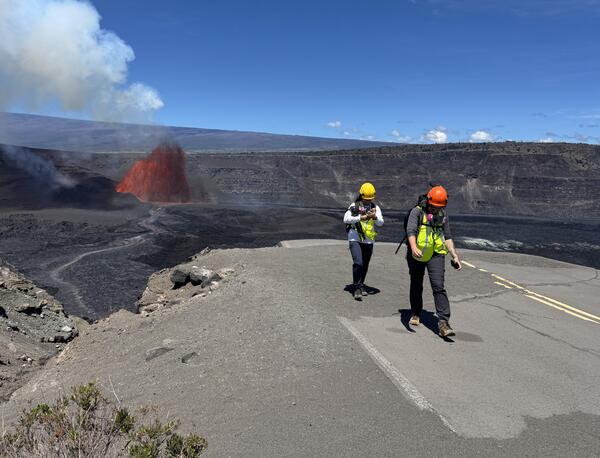
June 24, 2025 — Kīlauea monitoring network fieldwork

USGS Hawaiian Volcano Observatory physical science technicians leave the field after installing two webcams and a continuous laser at the summit of Kīlauea, to help monitor the ongoing lava fountains. The landscape here is now covered by a thick carpet of tephra from the recent lava fountaining episodes, changing much of the appearance of the western caldera rim.

USGS Hawaiian Volcano Observatory physical science technicians leave the field after installing two webcams and a continuous laser at the summit of Kīlauea, to help monitor the ongoing lava fountains. The landscape here is now covered by a thick carpet of tephra from the recent lava fountaining episodes, changing much of the appearance of the western caldera rim.

Color photograph of webcamera equipment perched on the edge of a crater
June 24, 2025 — Kīlauea caldera monitoring equipment

The V1cam (far right), KWcam, F1cam, and continuous laser rangefinder are perched on the northwest rim of Halemaʻumaʻu crater. This monitoring equipment are powered by a series of solar panels and battery banks (visible in the background of the photo), all of which are installed with permission from Hawaiʻi Volcanoes National Park. USGS photo by M.

The V1cam (far right), KWcam, F1cam, and continuous laser rangefinder are perched on the northwest rim of Halemaʻumaʻu crater. This monitoring equipment are powered by a series of solar panels and battery banks (visible in the background of the photo), all of which are installed with permission from Hawaiʻi Volcanoes National Park. USGS photo by M.

Was this page helpful?