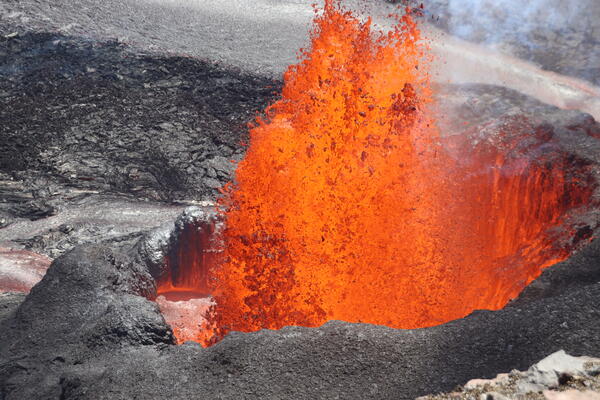
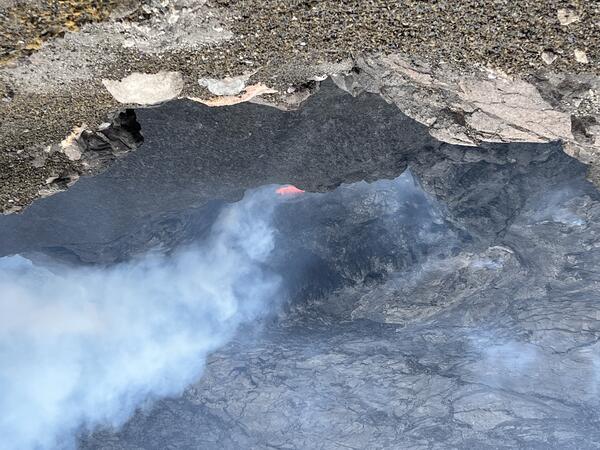
Looking out across Kaluapele, Kīlauea summit caldera, from the south rim, small islands of solidified crust dot the area of the lava pond that was fed from the lava fountains during the most recent eruption from December 23, 2024, to January 3, 2025. USGS photo by M. Patrick.
Images
Kīlauea images of eruptive activity, field work, and more.
Looking out across Kaluapele, Kīlauea summit caldera, from the south rim, small islands of solidified crust dot the area of the lava pond that was fed from the lava fountains during the most recent eruption from December 23, 2024, to January 3, 2025. USGS photo by M. Patrick.
Rockfalls continue from the steep caldera walls of Kaluapele, above the new cinder cone within Halemaʻumaʻu at the summit of Kīlauea. Large blocks roll down the flanks of the cone that formed between December 23, 2024, and January 3, 2025, leaving paths in the tephra cone material. USGS photo by M. Patrick.
An early morning view of summit of Mauna Kea, the flank of Mauna Loa, and the current eruption of Kīlauea captured during a USGS Hawaiian Volcano Observatory helicopter overflight. The north vent shutdown at 2:16 p.m. on January 2 after parts of the cone collapsed into the fountain but is still producing a small gas plume to the right of the active fountain.
A view of the large pyroclastic cone that continued lava fountaining at Kīlauea summit has produced against the western wall of the caldera. Lava pours out of the vents into a large, ponded area in the southwest portion of Halema‘uma‘u crater. USGS photo by M. Patrick.
January 3, 2025 — Kīlauea tephra blankets closed road
January 3, 2025 — Kīlauea tephra blankets closed roadPieces of lava (called tephra because they travel through the air before being deposited on the ground) blanket the crater rim downwind of the erupting vents in Kīlauea summit caldera (Kaluapele). Geologists collect samples of this material to analyze later to learn about the magma storage conditions before the eruption.
January 3, 2025 — Kīlauea tephra blankets closed road
January 3, 2025 — Kīlauea tephra blankets closed roadPieces of lava (called tephra because they travel through the air before being deposited on the ground) blanket the crater rim downwind of the erupting vents in Kīlauea summit caldera (Kaluapele). Geologists collect samples of this material to analyze later to learn about the magma storage conditions before the eruption.
January 3, 2025 — Kīlauea Overlook within Hawaiʻi Volcanoes National Park
January 3, 2025 — Kīlauea Overlook within Hawaiʻi Volcanoes National ParkUSGS Hawaiian Volcano Observatory scientists captured this image of the Kīlauea Overlook within Hawaiʻi Volcanoes National Park during an early morning helicopter overflight on January 3, 2025. Using the cars as a scale, it's easy to see how close the overlook is from the edge of the cliff.
January 3, 2025 — Kīlauea Overlook within Hawaiʻi Volcanoes National Park
January 3, 2025 — Kīlauea Overlook within Hawaiʻi Volcanoes National ParkUSGS Hawaiian Volcano Observatory scientists captured this image of the Kīlauea Overlook within Hawaiʻi Volcanoes National Park during an early morning helicopter overflight on January 3, 2025. Using the cars as a scale, it's easy to see how close the overlook is from the edge of the cliff.
January 3, 2025 — Lava fountain and associated plume at Halema‘uma‘u, Kīlauea, on January 3, 2025
January 3, 2025 — Lava fountain and associated plume at Halema‘uma‘u, Kīlauea, on January 3, 2025This photo, taken from near the S2cam, shows the active lava fountain within Halema‘uma‘u, Kīlauea, the cone (brown) that has built up around the lava fountain, the southwest portion of the lava lake (silver and black), and the rising plume of volcanic gas.
January 3, 2025 — Lava fountain and associated plume at Halema‘uma‘u, Kīlauea, on January 3, 2025
January 3, 2025 — Lava fountain and associated plume at Halema‘uma‘u, Kīlauea, on January 3, 2025This photo, taken from near the S2cam, shows the active lava fountain within Halema‘uma‘u, Kīlauea, the cone (brown) that has built up around the lava fountain, the southwest portion of the lava lake (silver and black), and the rising plume of volcanic gas.
From the Volcano House Hotel in Hawaiʻi Volcanoes National Park, the Kīlauea summit eruption plume was visible the morning of January 3, 2025. Mauna Loa is draped in morning alpen-glow in the right side of the image. USGS photo by K. Mulliken.
Volcanic gas scientists service one of the volcanic gas monitoring stations downwind of Kīlauea summit, with the eruption plume passing overhead. Sulfur dioxide (SO2) emissions have remained elevated over the past week and were measured as 30,000 tonnes per day on January 2. USGS photo by B. Lopez.
January 3, 2025 — Telephoto view of Kīlauea summit eruption lava fountain
January 3, 2025 — Telephoto view of Kīlauea summit eruption lava fountainThis telephoto view shows the active lava fountain within Halema‘uma‘u as seen from the south looking north. Since the eruption started on December 23, 2024, a 125-foot (38 meter) cone has built up around the lava fountain shown here.
January 3, 2025 — Telephoto view of Kīlauea summit eruption lava fountain
January 3, 2025 — Telephoto view of Kīlauea summit eruption lava fountainThis telephoto view shows the active lava fountain within Halema‘uma‘u as seen from the south looking north. Since the eruption started on December 23, 2024, a 125-foot (38 meter) cone has built up around the lava fountain shown here.
January 3, 2025 — Kīlauea summit eruption overflight
January 3, 2025 — Kīlauea summit eruption overflightHawaiian Volcano Observatory geologists captured this aerial view of Kīlauea summit on January 3, 2025. The shadow of Kīlauea eruption plume is visible on Mauna Loa. USGS photo by M. Patrick.
January 3, 2025 — Kīlauea summit eruption overflight
January 3, 2025 — Kīlauea summit eruption overflightHawaiian Volcano Observatory geologists captured this aerial view of Kīlauea summit on January 3, 2025. The shadow of Kīlauea eruption plume is visible on Mauna Loa. USGS photo by M. Patrick.
A close-up view of an active lobe of pāhoehoe lava flowing in Kaluapele, the summit caldera of Kīlauea volcano, on January 3, 2025. USGS photo by M. Patrick.
Lava fountaining in the southwest portion of Kaluapele (Kīlauea caldera) has producing tephra cone perched along the caldera wall. USGS photo by M. Patrick on January 2, 2025.
On January 2, USGS-Hawaiian Volcano Observatory geologists measured lava fountains at Kīlauea summit reaching heights of 262-295 feet (80-90 meters). USGS photo by M. Patrick.
January 2, 2025 — Vigorous lava fountaining continues at Kīlauea summit
January 2, 2025 — Vigorous lava fountaining continues at Kīlauea summitTwo vents were active today at Kīlauea summit. The southern vent was producing the dominant fountain (left side of image) and had built a large pyroclastic cone abutting the western caldera wall. The northern vent had a lower fountain (right side of image) and a smaller cone. USGS photo by M. Patrick.
January 2, 2025 — Vigorous lava fountaining continues at Kīlauea summit
January 2, 2025 — Vigorous lava fountaining continues at Kīlauea summitTwo vents were active today at Kīlauea summit. The southern vent was producing the dominant fountain (left side of image) and had built a large pyroclastic cone abutting the western caldera wall. The northern vent had a lower fountain (right side of image) and a smaller cone. USGS photo by M. Patrick.
A view from the west rim of Kaluapele (Kīlauea summit caldera) of the vents erupting at Kīlauea summit. USGS photo by M. Patrick.
A broader view of the activity at Kīlauea summit. The lava fountaining has produced a large pyroclastic cone against the western wall, with deposits draped on the walls. Lava pours out of the vents into a large ponded area in the southwest portion of Halema‘uma‘u crater.
Over the past day, vents in the southwest portion of Kaluapele (Kīlauea caldera) have continued producing a fan of lava flows covering the western portion of the crater floor during sustained lava fountaining. USGS photo by M. Patrick on January 2, 2025.
Graph of recent ground tilting at the summit of Kīlauea
Graph of recent ground tilting at the summit of KīlaueaGraph of tilting at the summit of Kīlauea recorded by the UWD tiltmeter, located near Uēkahuna bluff on the north side of the caldera and the SDH tiltmeter located south of the caldera.
Graph of recent ground tilting at the summit of Kīlauea
Graph of recent ground tilting at the summit of KīlaueaGraph of tilting at the summit of Kīlauea recorded by the UWD tiltmeter, located near Uēkahuna bluff on the north side of the caldera and the SDH tiltmeter located south of the caldera.
January 2, 2025—Kīlauea summit eruption reference map
January 2, 2025—Kīlauea summit eruption reference mapThis reference map depicts the Kīlauea summit eruption within Halema‘uma‘u as of January 2, 2025. Since the onset of the eruption on December 23, 2024, it has covered a total of 673 acres (272 hectares) with new lava (pink area), and approximately half that area still hosts active flows (red area).
January 2, 2025—Kīlauea summit eruption reference map
January 2, 2025—Kīlauea summit eruption reference mapThis reference map depicts the Kīlauea summit eruption within Halema‘uma‘u as of January 2, 2025. Since the onset of the eruption on December 23, 2024, it has covered a total of 673 acres (272 hectares) with new lava (pink area), and approximately half that area still hosts active flows (red area).
Another telephoto view of the vents erupting at Kīlauea summit on January 2, 2025. View is from the closed west rim area of Hawaiʻi Volcanoes National Park. USGS photo by M. Patrick.