POV Polar Bear Collar Cam B-roll 2019, 2021, and 2022
POV Polar Bear Collar Cam B-roll 2019, 2021, and 2022This is B-roll video of POV Polar Bear Collar Cam B-roll 2019, 2021, and 2022.


Official websites use .gov
A .gov website belongs to an official government organization in the United States.

Secure .gov websites use HTTPS
A lock () or https:// means you’ve safely connected to the .gov website. Share sensitive information only on official, secure websites.

Polar bears (Ursus maritimus) are one of 4 marine mammal species managed by the U.S. Department of Interior. The USGS Alaska Science Center leads long–term research on polar bears to inform local, state, national and international policy makers regarding conservation of the species and its habitat. Our studies, ongoing since 1985, are focused on population dynamics, health and energetics, distribution and movements, maternal denning, and methods development. The majority of our research focuses on the two polar bear subpopulation’s whose range includes Alaska: the Southern Beaufort Sea subpopulation that ranges between the North Slope of Alaska and western Canada and the Chukchi Sea or Alaska-Chukotka subpopulation that ranges between the northwest coast of Alaska and eastern Russia. The overarching goal of our research is to assess current and projected future responses of polar bears to a rapidly changing Arctic environment.
Return to Ecosystems >> Marine Ecosystems
Information on the status and trends of polar bear populations are needed to inform management of polar bears under US laws and international agreements.
Below are other science projects associated with this project.


Below are multimedia associated with this project.

This is B-roll video of POV Polar Bear Collar Cam B-roll 2019, 2021, and 2022.
This is B-roll video of POV Polar Bear Collar Cam B-roll 2019, 2021, and 2022.

The USGS Alaska Science Center leads long–term research on polar bears to inform local, state, national and international policy makers regarding conservation of the species and its habitat.
The USGS Alaska Science Center leads long–term research on polar bears to inform local, state, national and international policy makers regarding conservation of the species and its habitat.
Point-of-view image of an adult male polar bear interacting with another bear while in the ocean near Churchill, Manitoba, Canada. The image was recorded from a GPS-enabled video camera collar as part of a study measuring the energy expenditure, behavior, movement, and body composition changes of polar bears on land.
Point-of-view image of an adult male polar bear interacting with another bear while in the ocean near Churchill, Manitoba, Canada. The image was recorded from a GPS-enabled video camera collar as part of a study measuring the energy expenditure, behavior, movement, and body composition changes of polar bears on land.

Point-of-view image of an adult male polar bear interacting with two other bears while in the ocean near Churchill, Manitoba, Canada. The image was recorded from a GPS-enabled video camera collar as part of a study measuring the energy expenditure, behavior, movement, and body composition changes of polar bears on land.
Point-of-view image of an adult male polar bear interacting with two other bears while in the ocean near Churchill, Manitoba, Canada. The image was recorded from a GPS-enabled video camera collar as part of a study measuring the energy expenditure, behavior, movement, and body composition changes of polar bears on land.

An adult male polar bear with a GPS-enabled video camera collar on land in Wapusk National Park, Canada as part of a study measuring the energy expenditure, behavior, movement, and body composition changes of polar bears on land.
An adult male polar bear with a GPS-enabled video camera collar on land in Wapusk National Park, Canada as part of a study measuring the energy expenditure, behavior, movement, and body composition changes of polar bears on land.

Point-of-view image of an adult male polar bear walking along the coast in Wapusk National Park, Canada. The image was recorded from a GPS-enabled video camera collar as part of a study measuring the energy expenditure, behavior, movement, and body composition changes of polar bears on land.
Point-of-view image of an adult male polar bear walking along the coast in Wapusk National Park, Canada. The image was recorded from a GPS-enabled video camera collar as part of a study measuring the energy expenditure, behavior, movement, and body composition changes of polar bears on land.

Point-of-view image of an adult male polar bear interacting with two other bears while on land near Churchill, Manitoba, Canada. The image was recorded from a GPS-enabled video camera collar as part of a study measuring the energy expenditure, behavior, movement, and body composition changes of polar bears on land.
Point-of-view image of an adult male polar bear interacting with two other bears while on land near Churchill, Manitoba, Canada. The image was recorded from a GPS-enabled video camera collar as part of a study measuring the energy expenditure, behavior, movement, and body composition changes of polar bears on land.

This is a graphical abstract for a publication by the USGS and collaborators that examines the role of diet and food intake affecting polar bear population dynamics. Polar bears consume diets consisting of high proportions of marine mammal blubber that they access from the sea ice.
This is a graphical abstract for a publication by the USGS and collaborators that examines the role of diet and food intake affecting polar bear population dynamics. Polar bears consume diets consisting of high proportions of marine mammal blubber that they access from the sea ice.
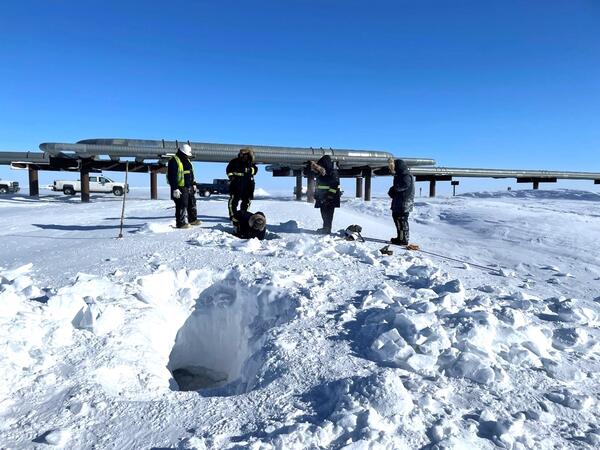
USGS Alaska Science Center scientists and industry collaborators examine features of a vacated maternal polar bear den near the Alyeska oil pipeline in northern Alaska to determine how to more reliably locate dens that occur near industrial activities.
USGS Alaska Science Center scientists and industry collaborators examine features of a vacated maternal polar bear den near the Alyeska oil pipeline in northern Alaska to determine how to more reliably locate dens that occur near industrial activities.

Scientists continue to study how a warming Arctic will affect polar bear populations. The new 2022 Polar Bear Research Council Masterplan identifies how polar bears in zoos can help fill knowledge gaps that benefit wild populations.
Scientists continue to study how a warming Arctic will affect polar bear populations. The new 2022 Polar Bear Research Council Masterplan identifies how polar bears in zoos can help fill knowledge gaps that benefit wild populations.

This video showcases the latest polar bear point-of-view footage to date along with an interview of the research scientist who is responsible for the project. Released in conjunction with a new scientific study led by the USGS.
This video showcases the latest polar bear point-of-view footage to date along with an interview of the research scientist who is responsible for the project. Released in conjunction with a new scientific study led by the USGS.

Exciting polar bear cam b-roll footage from the bear’s perspective from 2014, 2015, and 2016. The USGS Alaska Science Center Polar Bear Research Project conducts long-term research on polar bears to inform, local, state, national and international policy makers regarding conservation and management of the species and its habitat.
Exciting polar bear cam b-roll footage from the bear’s perspective from 2014, 2015, and 2016. The USGS Alaska Science Center Polar Bear Research Project conducts long-term research on polar bears to inform, local, state, national and international policy makers regarding conservation and management of the species and its habitat.
Exciting polar bear cam b-roll footage from the bear’s perspective from 2014, 2015, and 2016. The USGS Alaska Science Center Polar Bear Research Project conducts long-term research on polar bears to inform, local, state, national and international policy makers regarding conservation and management of the species and its habitat.
Exciting polar bear cam b-roll footage from the bear’s perspective from 2014, 2015, and 2016. The USGS Alaska Science Center Polar Bear Research Project conducts long-term research on polar bears to inform, local, state, national and international policy makers regarding conservation and management of the species and its habitat.

Adult polar bear walking across a recently overwashed barrier island during a large Arctic storm in September 2016. The barrier island is offshore of Barter Island on Alaska’s north coast.
Adult polar bear walking across a recently overwashed barrier island during a large Arctic storm in September 2016. The barrier island is offshore of Barter Island on Alaska’s north coast.

This short clip is representative of a large amount of video footage of an adult female polar bear, equipped with a point of view camera, that is used by scientists to study polar bear behavior and feeding rates.
This short clip is representative of a large amount of video footage of an adult female polar bear, equipped with a point of view camera, that is used by scientists to study polar bear behavior and feeding rates.

Karyn Rode taking vitals on a polar bear in the Chukchi Sea April 2016. On sea ice off the northwest coast of Alaska in the Chukchi Sea.
Karyn Rode taking vitals on a polar bear in the Chukchi Sea April 2016. On sea ice off the northwest coast of Alaska in the Chukchi Sea.

Photo of adult male polar bear walking towards seal (upper right) Chukchi Sea, Alaska
Photo of adult male polar bear walking towards seal (upper right) Chukchi Sea, Alaska

An adult female polar bear and her two cubs travel across the sea ice of the Arctic Ocean north of the Alaska coast.
An adult female polar bear and her two cubs travel across the sea ice of the Arctic Ocean north of the Alaska coast.

Data collected from long distance swims by Polar bears suggest that they do not stop to rest during their journey.
Data collected from long distance swims by Polar bears suggest that they do not stop to rest during their journey.

Data collected from long distance swims by Polar bears suggest that they do not stop to rest during their journey.
Data collected from long distance swims by Polar bears suggest that they do not stop to rest during their journey.

An adult female polar bear on the sea ice wearing a GPS satellite video-camera collar. GPS video-camera collars were applied to solitary adult female polar bears for 8 - 12 days in April, 2014-2016. These collars enabled researchers to understand the movements, behaviors, and foraging success of polar bears on the sea ice.
An adult female polar bear on the sea ice wearing a GPS satellite video-camera collar. GPS video-camera collars were applied to solitary adult female polar bears for 8 - 12 days in April, 2014-2016. These collars enabled researchers to understand the movements, behaviors, and foraging success of polar bears on the sea ice.
Below are other science projects associated with this project.
Below are multimedia associated with this project.
This is B-roll video of POV Polar Bear Collar Cam B-roll 2019, 2021, and 2022.
This is B-roll video of POV Polar Bear Collar Cam B-roll 2019, 2021, and 2022.
The USGS Alaska Science Center leads long–term research on polar bears to inform local, state, national and international policy makers regarding conservation of the species and its habitat.
The USGS Alaska Science Center leads long–term research on polar bears to inform local, state, national and international policy makers regarding conservation of the species and its habitat.
Point-of-view image of an adult male polar bear interacting with another bear while in the ocean near Churchill, Manitoba, Canada. The image was recorded from a GPS-enabled video camera collar as part of a study measuring the energy expenditure, behavior, movement, and body composition changes of polar bears on land.
Point-of-view image of an adult male polar bear interacting with another bear while in the ocean near Churchill, Manitoba, Canada. The image was recorded from a GPS-enabled video camera collar as part of a study measuring the energy expenditure, behavior, movement, and body composition changes of polar bears on land.
Point-of-view image of an adult male polar bear interacting with two other bears while in the ocean near Churchill, Manitoba, Canada. The image was recorded from a GPS-enabled video camera collar as part of a study measuring the energy expenditure, behavior, movement, and body composition changes of polar bears on land.
Point-of-view image of an adult male polar bear interacting with two other bears while in the ocean near Churchill, Manitoba, Canada. The image was recorded from a GPS-enabled video camera collar as part of a study measuring the energy expenditure, behavior, movement, and body composition changes of polar bears on land.
An adult male polar bear with a GPS-enabled video camera collar on land in Wapusk National Park, Canada as part of a study measuring the energy expenditure, behavior, movement, and body composition changes of polar bears on land.
An adult male polar bear with a GPS-enabled video camera collar on land in Wapusk National Park, Canada as part of a study measuring the energy expenditure, behavior, movement, and body composition changes of polar bears on land.
Point-of-view image of an adult male polar bear walking along the coast in Wapusk National Park, Canada. The image was recorded from a GPS-enabled video camera collar as part of a study measuring the energy expenditure, behavior, movement, and body composition changes of polar bears on land.
Point-of-view image of an adult male polar bear walking along the coast in Wapusk National Park, Canada. The image was recorded from a GPS-enabled video camera collar as part of a study measuring the energy expenditure, behavior, movement, and body composition changes of polar bears on land.
Point-of-view image of an adult male polar bear interacting with two other bears while on land near Churchill, Manitoba, Canada. The image was recorded from a GPS-enabled video camera collar as part of a study measuring the energy expenditure, behavior, movement, and body composition changes of polar bears on land.
Point-of-view image of an adult male polar bear interacting with two other bears while on land near Churchill, Manitoba, Canada. The image was recorded from a GPS-enabled video camera collar as part of a study measuring the energy expenditure, behavior, movement, and body composition changes of polar bears on land.
This is a graphical abstract for a publication by the USGS and collaborators that examines the role of diet and food intake affecting polar bear population dynamics. Polar bears consume diets consisting of high proportions of marine mammal blubber that they access from the sea ice.
This is a graphical abstract for a publication by the USGS and collaborators that examines the role of diet and food intake affecting polar bear population dynamics. Polar bears consume diets consisting of high proportions of marine mammal blubber that they access from the sea ice.
USGS Alaska Science Center scientists and industry collaborators examine features of a vacated maternal polar bear den near the Alyeska oil pipeline in northern Alaska to determine how to more reliably locate dens that occur near industrial activities.
USGS Alaska Science Center scientists and industry collaborators examine features of a vacated maternal polar bear den near the Alyeska oil pipeline in northern Alaska to determine how to more reliably locate dens that occur near industrial activities.
Scientists continue to study how a warming Arctic will affect polar bear populations. The new 2022 Polar Bear Research Council Masterplan identifies how polar bears in zoos can help fill knowledge gaps that benefit wild populations.
Scientists continue to study how a warming Arctic will affect polar bear populations. The new 2022 Polar Bear Research Council Masterplan identifies how polar bears in zoos can help fill knowledge gaps that benefit wild populations.
This video showcases the latest polar bear point-of-view footage to date along with an interview of the research scientist who is responsible for the project. Released in conjunction with a new scientific study led by the USGS.
This video showcases the latest polar bear point-of-view footage to date along with an interview of the research scientist who is responsible for the project. Released in conjunction with a new scientific study led by the USGS.
Exciting polar bear cam b-roll footage from the bear’s perspective from 2014, 2015, and 2016. The USGS Alaska Science Center Polar Bear Research Project conducts long-term research on polar bears to inform, local, state, national and international policy makers regarding conservation and management of the species and its habitat.
Exciting polar bear cam b-roll footage from the bear’s perspective from 2014, 2015, and 2016. The USGS Alaska Science Center Polar Bear Research Project conducts long-term research on polar bears to inform, local, state, national and international policy makers regarding conservation and management of the species and its habitat.
Exciting polar bear cam b-roll footage from the bear’s perspective from 2014, 2015, and 2016. The USGS Alaska Science Center Polar Bear Research Project conducts long-term research on polar bears to inform, local, state, national and international policy makers regarding conservation and management of the species and its habitat.
Exciting polar bear cam b-roll footage from the bear’s perspective from 2014, 2015, and 2016. The USGS Alaska Science Center Polar Bear Research Project conducts long-term research on polar bears to inform, local, state, national and international policy makers regarding conservation and management of the species and its habitat.
Adult polar bear walking across a recently overwashed barrier island during a large Arctic storm in September 2016. The barrier island is offshore of Barter Island on Alaska’s north coast.
Adult polar bear walking across a recently overwashed barrier island during a large Arctic storm in September 2016. The barrier island is offshore of Barter Island on Alaska’s north coast.
This short clip is representative of a large amount of video footage of an adult female polar bear, equipped with a point of view camera, that is used by scientists to study polar bear behavior and feeding rates.
This short clip is representative of a large amount of video footage of an adult female polar bear, equipped with a point of view camera, that is used by scientists to study polar bear behavior and feeding rates.
Karyn Rode taking vitals on a polar bear in the Chukchi Sea April 2016. On sea ice off the northwest coast of Alaska in the Chukchi Sea.
Karyn Rode taking vitals on a polar bear in the Chukchi Sea April 2016. On sea ice off the northwest coast of Alaska in the Chukchi Sea.
Photo of adult male polar bear walking towards seal (upper right) Chukchi Sea, Alaska
Photo of adult male polar bear walking towards seal (upper right) Chukchi Sea, Alaska
An adult female polar bear and her two cubs travel across the sea ice of the Arctic Ocean north of the Alaska coast.
An adult female polar bear and her two cubs travel across the sea ice of the Arctic Ocean north of the Alaska coast.
Data collected from long distance swims by Polar bears suggest that they do not stop to rest during their journey.
Data collected from long distance swims by Polar bears suggest that they do not stop to rest during their journey.
Data collected from long distance swims by Polar bears suggest that they do not stop to rest during their journey.
Data collected from long distance swims by Polar bears suggest that they do not stop to rest during their journey.
An adult female polar bear on the sea ice wearing a GPS satellite video-camera collar. GPS video-camera collars were applied to solitary adult female polar bears for 8 - 12 days in April, 2014-2016. These collars enabled researchers to understand the movements, behaviors, and foraging success of polar bears on the sea ice.
An adult female polar bear on the sea ice wearing a GPS satellite video-camera collar. GPS video-camera collars were applied to solitary adult female polar bears for 8 - 12 days in April, 2014-2016. These collars enabled researchers to understand the movements, behaviors, and foraging success of polar bears on the sea ice.