



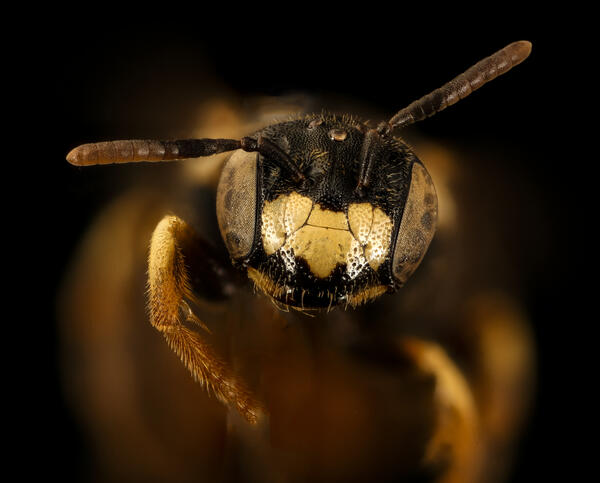
Sphecodes species, female
Images
Eastern Ecological Science Center images.
Filter Total Items: 5120

Sphecodes,-female,-face

Spider small, beltsville, md
Two VERY SMALL spiders. Sadly I know little about spiders so can't tell you the species / group other a number that it is not. This Spider was only about 4mm. Captured outside of my lab in Beltsville, MD. Once I started looking I realized...there are billions of such spiders (tiny ones that is) in an average field.
Two VERY SMALL spiders. Sadly I know little about spiders so can't tell you the species / group other a number that it is not. This Spider was only about 4mm. Captured outside of my lab in Beltsville, MD. Once I started looking I realized...there are billions of such spiders (tiny ones that is) in an average field.

Spider, U, underside, Patuxent, MD
Spider, Prince George's County, Experimental shot in a cuvette in hand sanitizer, this is the underside of the previous specimen...but Ben was able to eliminate more bubbles by carefully pouring the handsanitizer, will be working on lighting too
Spider, Prince George's County, Experimental shot in a cuvette in hand sanitizer, this is the underside of the previous specimen...but Ben was able to eliminate more bubbles by carefully pouring the handsanitizer, will be working on lighting too

Spotted Lanternfly, face 2
Beautiful, but scary. This is the Spotted Lanternfly (Lycorma delicatula). An impressive 2 inch exotic Fulgorid type thing from China and Southeast asia, it is a bark sucker and can do tremendous damage to smooth barked woody plants.
Beautiful, but scary. This is the Spotted Lanternfly (Lycorma delicatula). An impressive 2 inch exotic Fulgorid type thing from China and Southeast asia, it is a bark sucker and can do tremendous damage to smooth barked woody plants.

Stelis nitida, M, side, Catoctin Mt. Park
a new species record for Maryland collected by Richard Orr in the Catoctin Mountains. We will be looking into it over the next few weeks.
a new species record for Maryland collected by Richard Orr in the Catoctin Mountains. We will be looking into it over the next few weeks.

Stenotritus pubescens, f, cleaned, face
Experiment: This specimen has previously been photographed and uploaded to our account. The difference is that I have cleaned the specimen by rehydrating it overnight floating on foam in a tupper ware container of water and then vigorously washing it in hot soapy water by dunking the specimen on the pin into another plastic container and shaking.
Experiment: This specimen has previously been photographed and uploaded to our account. The difference is that I have cleaned the specimen by rehydrating it overnight floating on foam in a tupper ware container of water and then vigorously washing it in hot soapy water by dunking the specimen on the pin into another plastic container and shaking.

Stingless bee 1, f, face, peru
Tetragona species, Biting Stingless Bee, specimen collected by German Perilla in PeruStingless bees are just that, they cannot sting, their sting mechanism was reduced to non-functionality many tens of millions of years ago.
Tetragona species, Biting Stingless Bee, specimen collected by German Perilla in PeruStingless bees are just that, they cannot sting, their sting mechanism was reduced to non-functionality many tens of millions of years ago.

Stingless bee 1, f, side, peru
Tetragona species, Biting Stingless Bee, specimen collected by German Perilla in PeruStingless bees are just that, they cannot sting, their sting mechanism was reduced to non-functionality many tens of millions of years ago.
Tetragona species, Biting Stingless Bee, specimen collected by German Perilla in PeruStingless bees are just that, they cannot sting, their sting mechanism was reduced to non-functionality many tens of millions of years ago.

Stiretus smaragdulus, buenos aires, argentina
Another beautiful Stinkbug from South America...this time, Argentina. Insect taken from the Natural History collection of the Smithsonian. Photography Information: Canon Mark II 5D, Zerene Stacker, Stackshot Sled, 65mm Canon MP-E 1-5X macro lens, Twin Macro Flash in Styrofoam Cooler, F5.0, ISO 100, Shutter Speed 200.
Another beautiful Stinkbug from South America...this time, Argentina. Insect taken from the Natural History collection of the Smithsonian. Photography Information: Canon Mark II 5D, Zerene Stacker, Stackshot Sled, 65mm Canon MP-E 1-5X macro lens, Twin Macro Flash in Styrofoam Cooler, F5.0, ISO 100, Shutter Speed 200.

Svastra duplocineta,f,back,Pima Co, AZ
Another set of pictures of a different specimen of Svastra duplocincta. Below is a repeat of the previous verbage for the species.While most people would not necessarily think about this very much (beer, for example, is thought about a lot more), many bees are specialists on Cacti.
Another set of pictures of a different specimen of Svastra duplocincta. Below is a repeat of the previous verbage for the species.While most people would not necessarily think about this very much (beer, for example, is thought about a lot more), many bees are specialists on Cacti.

Svastra duplocineta,f,face,Pima Co, AZ
Another set of pictures of a different specimen of Svastra duplocincta. Below is a repeat of the previous verbage for the species.While most people would not necessarily think about this very much (beer, for example, is thought about a lot more), many bees are specialists on Cacti.
Another set of pictures of a different specimen of Svastra duplocincta. Below is a repeat of the previous verbage for the species.While most people would not necessarily think about this very much (beer, for example, is thought about a lot more), many bees are specialists on Cacti.

Platanthera lacera, Green-fringed Orchid, PWRC, Helen Lowe Metzman
Platanthera lacera, Green-fringed Orchid, PWRC, Helen Lowe MetzmanWho doesn't like an orchid? This is green-fringed orchid, found at the edge of the USGS Bee Lab's grounds near some woods. Nice to see this uncommon species. Planathera lacera. Photo and specimen collected by Helen Lowe Metzman.
Platanthera lacera, Green-fringed Orchid, PWRC, Helen Lowe Metzman
Platanthera lacera, Green-fringed Orchid, PWRC, Helen Lowe MetzmanWho doesn't like an orchid? This is green-fringed orchid, found at the edge of the USGS Bee Lab's grounds near some woods. Nice to see this uncommon species. Planathera lacera. Photo and specimen collected by Helen Lowe Metzman.

Polistes (2), F, back, Dominican Republic, La Ve Jarabacoa
Polistes (2), F, back, Dominican Republic, La Ve JarabacoaPolistes dominulus from the Dominican Republic
Polistes (2), F, back, Dominican Republic, La Ve Jarabacoa
Polistes (2), F, back, Dominican Republic, La Ve JarabacoaPolistes dominulus from the Dominican Republic

Polistes metricus, u, Side, MD, PG county
Who doesn't like the physique of the Paper wasp.
Who doesn't like the physique of the Paper wasp.

Polistes nest 6, MD, side
Here we present a series of pictures of Polistes wasp nests with lavae, pupae, eggs, and interlopers.
Here we present a series of pictures of Polistes wasp nests with lavae, pupae, eggs, and interlopers.

pond 10.18.2012, damselfly nymph1, back, beltsville,MD
pond 10.18.2012, damselfly nymph1, back, beltsville,MDDamselfly in Hand Sanitizer, Beltsville, Maryland
pond 10.18.2012, damselfly nymph1, back, beltsville,MD
pond 10.18.2012, damselfly nymph1, back, beltsville,MDDamselfly in Hand Sanitizer, Beltsville, Maryland

pond 10.18.2012, water strider 2, ventral, Beltsville, MD
pond 10.18.2012, water strider 2, ventral, Beltsville, MDWater Strider, Gerridae, Beltsville, Maryland, Suspended in Hand Sanitzer
pond 10.18.2012, water strider 2, ventral, Beltsville, MD
pond 10.18.2012, water strider 2, ventral, Beltsville, MDWater Strider, Gerridae, Beltsville, Maryland, Suspended in Hand Sanitzer

Pontederia cordata, Pickerelweed, Howard County, MD, Helen Lowe Metzman
Pontederia cordata, Pickerelweed, Howard County, MD, Helen Lowe MetzmanAh, such an interesting plant for bees. Pontedaria cordata....Pickerelweed. Lives out in fairly deep water, emerges in the spring...sends up a spike of blue flowers in mid-summer. This plant is very attractive to long-tongued bees which have to reach way down to get nectar and pollen.
Pontederia cordata, Pickerelweed, Howard County, MD, Helen Lowe Metzman
Pontederia cordata, Pickerelweed, Howard County, MD, Helen Lowe MetzmanAh, such an interesting plant for bees. Pontedaria cordata....Pickerelweed. Lives out in fairly deep water, emerges in the spring...sends up a spike of blue flowers in mid-summer. This plant is very attractive to long-tongued bees which have to reach way down to get nectar and pollen.

Prenolepis imparis, jan reese, st michaels, md face
Prenolepis imparis, jan reese, st michaels, md faceAnt, The Winter Ant, Prenolepis imparis, aka False HoneyPot ant. This is the head of the male. Small, taken with 10X microscope objective on a 200mm Pentax. Found this past spring in a swarm by Jan Reese who noticed Cedar Waxwings munching on the males in St. Michael's Maryland. Another day in the life of Earth.
Prenolepis imparis, jan reese, st michaels, md face
Prenolepis imparis, jan reese, st michaels, md faceAnt, The Winter Ant, Prenolepis imparis, aka False HoneyPot ant. This is the head of the male. Small, taken with 10X microscope objective on a 200mm Pentax. Found this past spring in a swarm by Jan Reese who noticed Cedar Waxwings munching on the males in St. Michael's Maryland. Another day in the life of Earth.
Protandrena abdominalis, f, face, Colorado co., TX
Protandrena abdominalis, f, face, Colorado co., TXThis little red bee was collected on spotted beebalm. It seems to be the only species of plant, with the possibility of some close relatives being involved, that this bee finds worthy of collecting pollen from. If you Google images of spotted beebalm you'll see that it is quite the complicated and rather ornate flowering plant.
Protandrena abdominalis, f, face, Colorado co., TX
Protandrena abdominalis, f, face, Colorado co., TXThis little red bee was collected on spotted beebalm. It seems to be the only species of plant, with the possibility of some close relatives being involved, that this bee finds worthy of collecting pollen from. If you Google images of spotted beebalm you'll see that it is quite the complicated and rather ornate flowering plant.

Prunus serotina,Wild or Black Cherry flrs 3
One of the best bee plants...big, tall, and simply by being a tree, voluminous in pollen and nectar resources. Black Cherry. Prunus serotina. Specimen and plants by Helen Lowe Metzman.
One of the best bee plants...big, tall, and simply by being a tree, voluminous in pollen and nectar resources. Black Cherry. Prunus serotina. Specimen and plants by Helen Lowe Metzman.