



Developing Waterfowl Distribution and Abundance Models to Inform Avian Influenza Transmission Risk
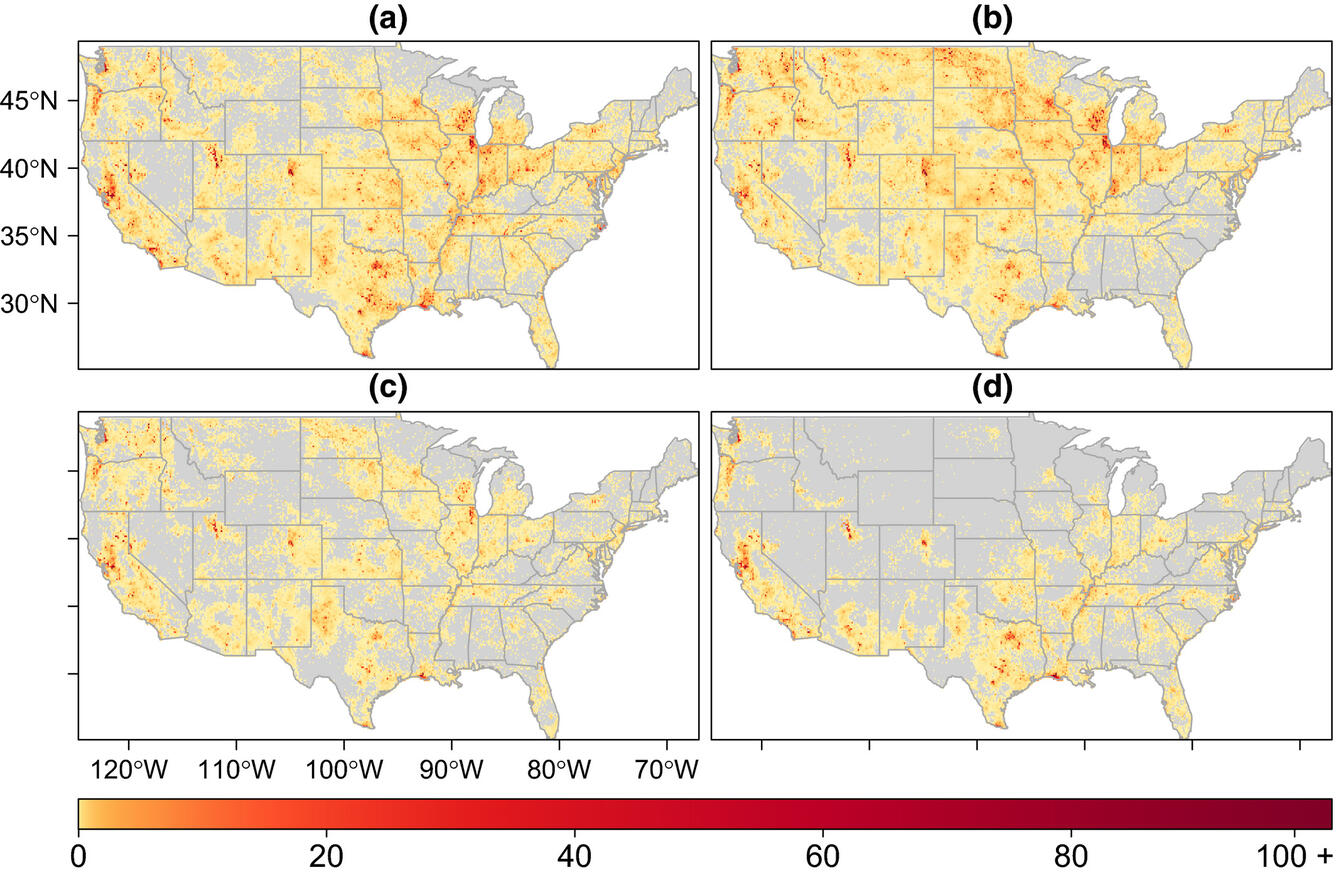
USGS researchers are developing novel methods to improve our understanding of waterfowl distributions and abundance across the United States to inform a variety of ongoing disease studies. Understanding the distribution of wild waterfowl is a critical component to assessing avian influenza transmission risks across the landscape.
What is the issue?
The role of wild waterfowl in moving avian influenza viruses across the landscape is well established. However, because birds are highly mobile and exhibit migratory behavior, habitat preferences change throughout the year and across the country, making it difficult to accurately forecast bird occurrence and abundance in space and time. Species distribution models can help managers understand the likely locations of wildlife and provide information that is crucial to effectively mitigate the risk of transmission of disease from one species to another, a phenomenon known as “spillover”.
What is at stake?
Previous USGS research has shown that overlap in the areas used for poultry production and the areas used by wild waterfowl is a key element in the risk of spillover of avian influenza virus from wild to domestic birds. Developing high resolution, spatial and temporal models of species-specific distribution and abundance across the contiguous United States is a necessary component to successfully model the risk of transmission from wild waterfowl to domestic poultry.
What is our approach?
For the creation of initial models, USGS researchers utilized a Bayesian hierarchical approach (integrated nested Laplace approximation) to develop dynamic spatial distribution models of relevant waterfowl species. This method allowed for building multiple distribution models across the breeding, wintering, and migratory seasons, improving the temporal detail of disease risk models. For example, instead of a single risk map showing areas of high transmission potential between wild and domestic birds, we aim for monthly or seasonal maps showing differences in areas of transmission potential at a given location.
However, initial models by USGS were only informed by participatory science observations provided by eBird, without the capacity to incorporate systematic scientific surveys (such as the USGS Breeding Bird Survey), encounter data from the USGS Bird Banding Laboratory, and telemetry data. Our scientists are currently leading innovative approaches to incorporate numerous datatypes via integrated species distribution models (iSDMs) that will help to address the biases in individual survey methods and result in more accurate estimates.
What are the benefits?
Species distribution models can facilitate a better understanding of the role of migratory waterfowl in global transmission of highly pathogenic avian influenza among wild bird populations and to domestic poultry. By providing managers with better estimates of the risk of disease spillover in space and time, USGS research will aid efforts to manage the threats that avian influenza pose to the nation’s food security, public safety and wildlife health.
<< Back to Avian Influenza Research at EESC
USGS researchers are developing novel methods to improve our understanding of waterfowl distributions and abundance across the United States to inform a variety of ongoing disease studies. Understanding the distribution of wild waterfowl is a critical component to assessing avian influenza transmission risks across the landscape.
What is the issue?
The role of wild waterfowl in moving avian influenza viruses across the landscape is well established. However, because birds are highly mobile and exhibit migratory behavior, habitat preferences change throughout the year and across the country, making it difficult to accurately forecast bird occurrence and abundance in space and time. Species distribution models can help managers understand the likely locations of wildlife and provide information that is crucial to effectively mitigate the risk of transmission of disease from one species to another, a phenomenon known as “spillover”.
What is at stake?
Previous USGS research has shown that overlap in the areas used for poultry production and the areas used by wild waterfowl is a key element in the risk of spillover of avian influenza virus from wild to domestic birds. Developing high resolution, spatial and temporal models of species-specific distribution and abundance across the contiguous United States is a necessary component to successfully model the risk of transmission from wild waterfowl to domestic poultry.
What is our approach?
For the creation of initial models, USGS researchers utilized a Bayesian hierarchical approach (integrated nested Laplace approximation) to develop dynamic spatial distribution models of relevant waterfowl species. This method allowed for building multiple distribution models across the breeding, wintering, and migratory seasons, improving the temporal detail of disease risk models. For example, instead of a single risk map showing areas of high transmission potential between wild and domestic birds, we aim for monthly or seasonal maps showing differences in areas of transmission potential at a given location.
However, initial models by USGS were only informed by participatory science observations provided by eBird, without the capacity to incorporate systematic scientific surveys (such as the USGS Breeding Bird Survey), encounter data from the USGS Bird Banding Laboratory, and telemetry data. Our scientists are currently leading innovative approaches to incorporate numerous datatypes via integrated species distribution models (iSDMs) that will help to address the biases in individual survey methods and result in more accurate estimates.
What are the benefits?
Species distribution models can facilitate a better understanding of the role of migratory waterfowl in global transmission of highly pathogenic avian influenza among wild bird populations and to domestic poultry. By providing managers with better estimates of the risk of disease spillover in space and time, USGS research will aid efforts to manage the threats that avian influenza pose to the nation’s food security, public safety and wildlife health.
<< Back to Avian Influenza Research at EESC