



FORT Science in Action, Part 18: Science and tools for cost-effective control of invasive brown treesnakes in Guam
In support of Department of the Interior restoration goals and military infrastructure safety, FORT scientists develop innovative science and tools to improve invasive brown treesnake management in Guam.
Brown treesnakes (BTS) are a highly invasive species on the island of Guam that were accidentally introduced after World War II. With no natural predators on the island, these snakes have flourished and occur at high densities throughout Guam. Annually, BTS cause ground faults and short circuits resulting in power outages costing Guam’s economy ~ \$4.5 million. BTS also threaten military infrastructure and can cause injury to humans through their venomous bites. Since their introduction, BTS have either caused local extinction or decline of most native forest birds on the island. Because Guam is a transportation hub for the Western Pacific, the accidental transport of BTS to other locations, such as Hawai’i’ or other islands in the Northern Mariana, is a significant and ongoing threat. The spread of BTS to Hawai’i could result in \$456 - \$761 million in annual costs to repair power systems. Below are three projects out of FORT that aim to reduce the spread of this destructive, invasive species.
A citizen science program for brown treesnake removal and native species recovery at a National Historical Park in Guam
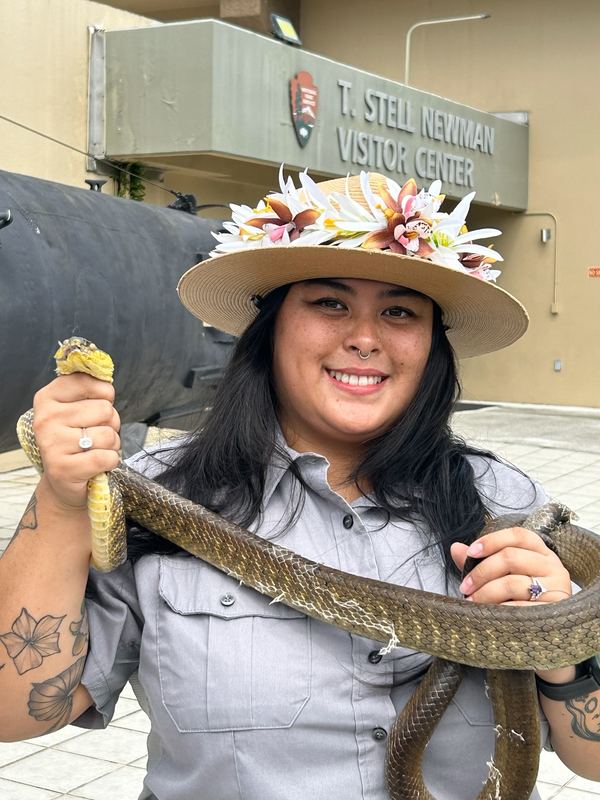
This collaborative Department of the Interior (DOI) applied research project, led by the USGS FORT, USGS PIERC, National Park Service (NPS), and U.S. Fish and Wildlife Service (USFWS), represents an important first step in restoring at-risk and extirpated native bird and reptile species—and their habitats—at Asan Beach Park by targeting the removal of BTS with the assistance of citizen science volunteers. As of September 2025, a total of 153 snakes have been removed from the area.
The initiative not only addresses immediate ecological threats but also builds long-term adaptive capacity for recovering keystone bird species that play a disproportionate role in maintaining ecosystem functions, like dispersing seeds. In addition, this project functions as a site-specific case study to inform broader, cost-effective conservation strategies across Guam. Learn More.
Developing and evaluating a point-of-use environmental DNA test for rapid field detection of highly invasive brown treesnakes

USGS researchers out of FORT, have advanced terrestrial eDNA sampling methods and created a lab-based assay for detecting BTS DNA. However, this approach can take weeks to return results, posing challenges for timely invasive species management. To overcome this, USGS researchers at FORT, UMESC, WARC, and PIERC are developing a point-of-use (POU) assay for BTS, enabling biologists to detect BTS DNA on-site without needing lab expertise or specialized equipment. Results will be available within minutes, allowing for real-time assessments and rapid decision-making, which is crucial for preventing the spread of BTS. Learn More.
Suppressing brown treesnakes on military lands
USGS FORT researchers, in collaboration with USDA-NWRC, are leading a long-term, multi-faceted effort to suppress BTS populations on military lands in Guam. Field trials have shown aerial baiting to be particularly effective for medium-sized snakes in these areas. However, this project combines several new and previously tested removal tools with aerial baiting to control snakes, including trapping and hand-capture. Combined, these removal tools target all size classes to reduce snake abundance and support native species recovery. As removals occur, researchers are collecting data on how the population responds using visual surveys, telemetry, bait stations, traps, and wildlife cameras. Additionally, scientists are testing new tools to see if they prevent population rebound. USGS is currently analyzing these data to guide cost-effective suppression strategies.
More FORT Science in Action
This September, FORT is highlighting how our science projects support sound decision-making. Each day, we will highlight a new project and its applications. To see more, follow the tabs below.
FORT Science in Action, Part 17
FORT Science in Action, Part 19
Related

Molecular Ecology Lab (MEL)

Invasive species science in support of public safety, America’s natural resources, and economic growth

Developing and evaluating a point-of-use environmental DNA test for rapid field detection of highly invasive brown treesnakes

A citizen science program for brown treesnake removal and native species recovery at a National Historical Park in Guam
Related
Molecular Ecology Lab (MEL)
Invasive species science in support of public safety, America’s natural resources, and economic growth
Developing and evaluating a point-of-use environmental DNA test for rapid field detection of highly invasive brown treesnakes