



Vessels like this use various sampling methods to collect fish at all life stages, adult, larvae, and eggs.
Images
Images captured by GLSC scientists while working in and around the Great Lakes.
Filter Total Items: 494

Vessels Sampling in a River in Ohio
Vessels like this use various sampling methods to collect fish at all life stages, adult, larvae, and eggs.

Tracking the Movement of Grass Carp in the Sandusky River, 2016
Tracking the Movement of Grass Carp in the Sandusky River, 2016Nicole King (University of Toledo graduate student) holding a Grass Carp. The Ohio Department of Natural Resources and Michigan State University responded to a report from a commercial fisherman that grass carp were being captured in the Sandusky River. Researchers captured, tagged, and released grass carp to track their movements.
Tracking the Movement of Grass Carp in the Sandusky River, 2016
Tracking the Movement of Grass Carp in the Sandusky River, 2016Nicole King (University of Toledo graduate student) holding a Grass Carp. The Ohio Department of Natural Resources and Michigan State University responded to a report from a commercial fisherman that grass carp were being captured in the Sandusky River. Researchers captured, tagged, and released grass carp to track their movements.

Juvenile Cisco in a Holding Tank at HBBS
Juvenile cisco (Coregonus artedi) swim in a tank at Hammond Bay Biological Station. The station hosts multiple researchers conducting projects to aid restoration of Great Lakes cisco populations.
Juvenile cisco (Coregonus artedi) swim in a tank at Hammond Bay Biological Station. The station hosts multiple researchers conducting projects to aid restoration of Great Lakes cisco populations.
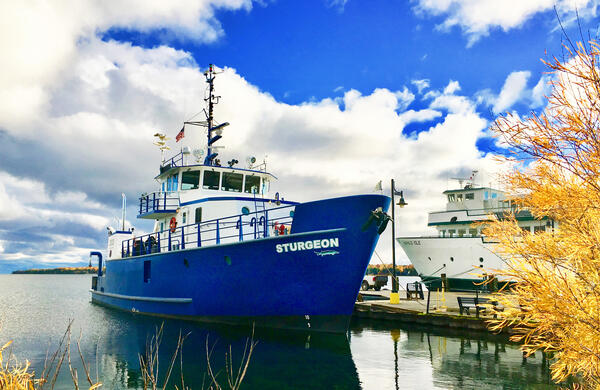
The Research Vessel Sturgeon at port in St. James Harbor
The Research Vessel Sturgeon at port in St. James HarborThe R/V Sturgeon, based in Cheboygan, Michigan, was built in 1974 and currently operates on Lakes Huron and Michigan. The Sturgeon was transferred to the GLSC in the 1990s and was later retrofitted and commissioned in 2004.
The Research Vessel Sturgeon at port in St. James Harbor
The Research Vessel Sturgeon at port in St. James HarborThe R/V Sturgeon, based in Cheboygan, Michigan, was built in 1974 and currently operates on Lakes Huron and Michigan. The Sturgeon was transferred to the GLSC in the 1990s and was later retrofitted and commissioned in 2004.

Beaver Island During a Fall Gillnet Survey
View of Beaver Island captured during a fall gillnet survey assessing the adult lake trout population in the Northern Refuge of Lake Michigan in support of restoration.
View of Beaver Island captured during a fall gillnet survey assessing the adult lake trout population in the Northern Refuge of Lake Michigan in support of restoration.

Measuring Fish During Lake Huron Acoustic Survey
GLSC Fisheries Technician Kristy Phillips (Ann Arbor, Michigan) measuring and Supervisory Biologist Tim O’Brien (Ann Arbor, Michigan) recording biometric data for fish species caught during the 2020 Lake Huron acoustics cruise aboard the Great Lakes Science Center’s R/V Sturgeon.
GLSC Fisheries Technician Kristy Phillips (Ann Arbor, Michigan) measuring and Supervisory Biologist Tim O’Brien (Ann Arbor, Michigan) recording biometric data for fish species caught during the 2020 Lake Huron acoustics cruise aboard the Great Lakes Science Center’s R/V Sturgeon.

Lake Trout Under a Microscope Aboard R/V Sturgeon
First mate, Lyle Grivicich (GLSC, Cheboygan, Michigan), looks on as Supervisory Fisheries Biologist, Tim O’Brien (GLSC, Ann Arbor, Michigan) examines a recently-caught lake trout under a microscope aboard the USGS Great Lakes Science Center’s Research Vessel Sturgeon, during the 2020 Lake Huron Acoustics cruise.
First mate, Lyle Grivicich (GLSC, Cheboygan, Michigan), looks on as Supervisory Fisheries Biologist, Tim O’Brien (GLSC, Ann Arbor, Michigan) examines a recently-caught lake trout under a microscope aboard the USGS Great Lakes Science Center’s Research Vessel Sturgeon, during the 2020 Lake Huron Acoustics cruise.

Tracking Bees in Indiana Dunes National Lakeshore
Tyler McGill (National Park Service) and GLSC ecologist Johanna Nifosi (Chesterton, Indiana) placing bee nests in forested parts of Indiana Dunes National Park. This collaboration between both agencies aims to understand how habitat traits influence native bee connectivity in the area.
Tyler McGill (National Park Service) and GLSC ecologist Johanna Nifosi (Chesterton, Indiana) placing bee nests in forested parts of Indiana Dunes National Park. This collaboration between both agencies aims to understand how habitat traits influence native bee connectivity in the area.

Invasive Dreissenid Mussel-Encrusted Acoustic Telemetry Gear
Invasive Dreissenid Mussel-Encrusted Acoustic Telemetry GearInvasive dreissenid mussel-encrusted acoustic telemetry gear retrieved from Little Bay de Noc in Lake Michigan. Acoustic telemetry technology allows scientists to track fish movement throughout a water body, such as whitefish and walleye in the case of this project.
Invasive Dreissenid Mussel-Encrusted Acoustic Telemetry Gear
Invasive Dreissenid Mussel-Encrusted Acoustic Telemetry GearInvasive dreissenid mussel-encrusted acoustic telemetry gear retrieved from Little Bay de Noc in Lake Michigan. Acoustic telemetry technology allows scientists to track fish movement throughout a water body, such as whitefish and walleye in the case of this project.
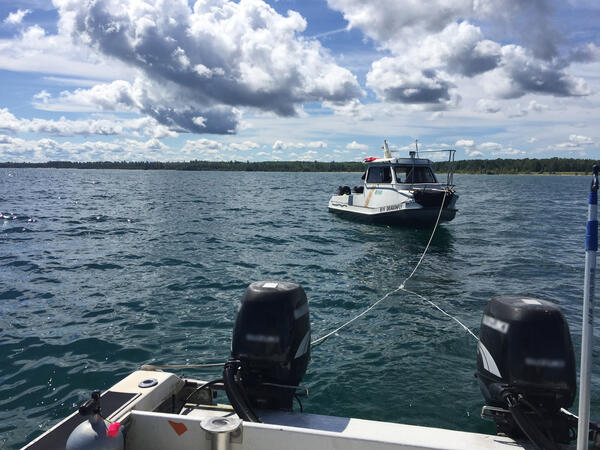
Tethered Boats Keeping a Distance
The tethered boats are well-distanced from one another while researchers SCUBA dive in Lake Huron as part of the Great Lakes Integrated Cladophora Assessment Project.
The tethered boats are well-distanced from one another while researchers SCUBA dive in Lake Huron as part of the Great Lakes Integrated Cladophora Assessment Project.

USGS Great Lakes Science Center’s Sea Ark at Sunrise
USGS Great Lakes Science Center’s Sea Ark at SunriseThe USGS Great Lakes Science Center’s Sea Ark at sunrise as the crew prepares to tend acoustic telemetry receivers around Isle Royale National Park in Lake Superior; the receivers monitor movement of tagged native lake trout in the area.
USGS Great Lakes Science Center’s Sea Ark at Sunrise
USGS Great Lakes Science Center’s Sea Ark at SunriseThe USGS Great Lakes Science Center’s Sea Ark at sunrise as the crew prepares to tend acoustic telemetry receivers around Isle Royale National Park in Lake Superior; the receivers monitor movement of tagged native lake trout in the area.

Collecting eDNA samples in the Little Calumet River
Collecting eDNA samples in the Little Calumet RiverSearching for native, unionid mussels, USGS researchers collect eDNA samples in the Little Calumet River within Indiana Dunes National Park as a part of unionid mussels restoration project. Photo Credit: Kasia Przybyla-Kelly.
Collecting eDNA samples in the Little Calumet River
Collecting eDNA samples in the Little Calumet RiverSearching for native, unionid mussels, USGS researchers collect eDNA samples in the Little Calumet River within Indiana Dunes National Park as a part of unionid mussels restoration project. Photo Credit: Kasia Przybyla-Kelly.

Acoustic Receiver Deployed Near Isle Royale in Lake Superior
Acoustic Receiver Deployed Near Isle Royale in Lake SuperiorA masked USGS Great Lakes Science Center technician deploys an acoustic receiver into the waters of Lake Superior near Isle Royale National Park; the receivers will track the movement of tagged native lake trout in the area.
Acoustic Receiver Deployed Near Isle Royale in Lake Superior
Acoustic Receiver Deployed Near Isle Royale in Lake SuperiorA masked USGS Great Lakes Science Center technician deploys an acoustic receiver into the waters of Lake Superior near Isle Royale National Park; the receivers will track the movement of tagged native lake trout in the area.

ARIS hydroacoustic sonar collecting fish passage imagery
ARIS hydroacoustic sonar collecting fish passage imageryAn Adaptive Resolution Imaging Sonar (ARIS) unit (Sound Metrics Corp., Bellevue, WA, USA) collects underwater images using sound waves at a water-control structure placed within the USFWS Shiawassee National Wildlife Refuge in Saginaw, Michigan.
ARIS hydroacoustic sonar collecting fish passage imagery
ARIS hydroacoustic sonar collecting fish passage imageryAn Adaptive Resolution Imaging Sonar (ARIS) unit (Sound Metrics Corp., Bellevue, WA, USA) collects underwater images using sound waves at a water-control structure placed within the USFWS Shiawassee National Wildlife Refuge in Saginaw, Michigan.

Annual Phragmites Examination
USGS Great Lakes Science Center staff performing annual monitoring for the Phragmites Adaptive Management Framework (PAMF). Photo Credit: Theresa Gruninger, USGS.
USGS Great Lakes Science Center staff performing annual monitoring for the Phragmites Adaptive Management Framework (PAMF). Photo Credit: Theresa Gruninger, USGS.

Young Raccoon Watches from Afar
A curious young raccoon peers in on GLSC researchers as they walk through a wetland in Ohio on the way to a study site.
A curious young raccoon peers in on GLSC researchers as they walk through a wetland in Ohio on the way to a study site.

Sheldon Marsh State Nature Preserve, Ohio
Sheldon Marsh State Nature Preserve, near Sandusky Ohio taken on 30 July 2020 for the GLSC Photo Challenge
Sheldon Marsh State Nature Preserve, near Sandusky Ohio taken on 30 July 2020 for the GLSC Photo Challenge

A praying mantis assists with field monitoring of invasive Phragmites
A praying mantis assists with field monitoring of invasive PhragmitesA praying mantis assists with field monitoring of invasive Phragmites in Saginaw, Michigan. Measuring establishment of Phragmites is an important aspect of the Phragmites Adaptive Management Framework.
A praying mantis assists with field monitoring of invasive Phragmites
A praying mantis assists with field monitoring of invasive PhragmitesA praying mantis assists with field monitoring of invasive Phragmites in Saginaw, Michigan. Measuring establishment of Phragmites is an important aspect of the Phragmites Adaptive Management Framework.
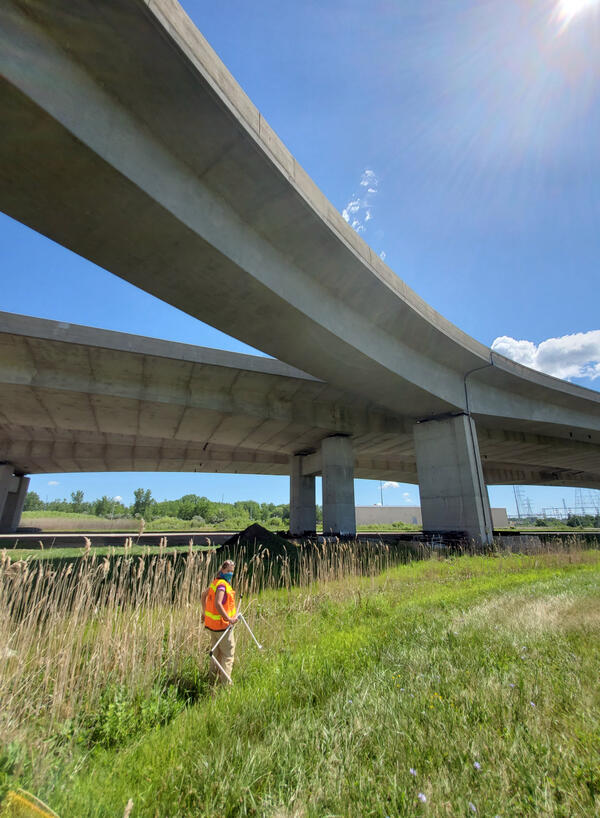
Using a quadrat to count invasive Phragmites
Dwarfed by the Zilwaukee bridge in Saginaw, Michigan, a GLSC contractor prepares to use a quadrat to count invasive Phragmites as part of a monitoring assistance program through the Phragmites Adaptive Management Framework. Read more at https://www.greatlakesphragmites.net/pamf/
Dwarfed by the Zilwaukee bridge in Saginaw, Michigan, a GLSC contractor prepares to use a quadrat to count invasive Phragmites as part of a monitoring assistance program through the Phragmites Adaptive Management Framework. Read more at https://www.greatlakesphragmites.net/pamf/
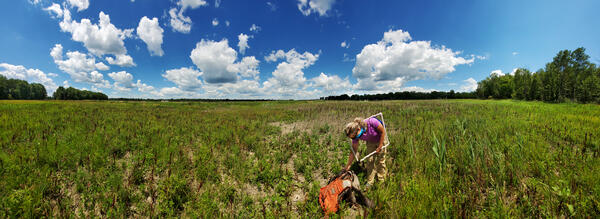
Surveying a Site for PAMF
Staff from the Phragmites Adaptive Management Framework survey a site enrolled in the program for invasive Phragmites australis. Photo credit: Taaja Tucker-Silva, USGS.
Staff from the Phragmites Adaptive Management Framework survey a site enrolled in the program for invasive Phragmites australis. Photo credit: Taaja Tucker-Silva, USGS.
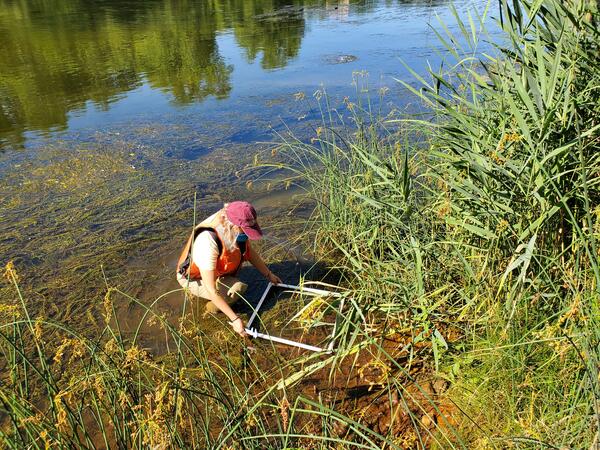
Taking Basic Density Measurements
USGS Great Lakes Science Center student contractor performing annual monitoring for the Phragmites Adaptive Management Framework (PAMF). Photo Credit: Taaja Tucker-Silva, USGS.
USGS Great Lakes Science Center student contractor performing annual monitoring for the Phragmites Adaptive Management Framework (PAMF). Photo Credit: Taaja Tucker-Silva, USGS.