



The Lake Erie Biological Station, a field station of the Great Lakes Science Center, moved from Sandusky Ohio to a new building in Huron Ohio in March 2022.
Images
Images captured by GLSC scientists while working in and around the Great Lakes.
Filter Total Items: 494

The Lake Erie Biological Station's new location
The Lake Erie Biological Station, a field station of the Great Lakes Science Center, moved from Sandusky Ohio to a new building in Huron Ohio in March 2022.

Surveying Lake Huron Coastal Areas for Larval Fish Sampling Sites
Surveying Lake Huron Coastal Areas for Larval Fish Sampling SitesPancake ice forms near the landing at Harbor Beach, Michigan, while USGS scientists scout for locations to sample for larval fishes at the start of the 2022 Lake Huron Cooperative Science and Monitoring Initiative field sampling season. Photo credit: Cory Brant, USGS.
Surveying Lake Huron Coastal Areas for Larval Fish Sampling Sites
Surveying Lake Huron Coastal Areas for Larval Fish Sampling SitesPancake ice forms near the landing at Harbor Beach, Michigan, while USGS scientists scout for locations to sample for larval fishes at the start of the 2022 Lake Huron Cooperative Science and Monitoring Initiative field sampling season. Photo credit: Cory Brant, USGS.

Winter Sonar Set-Up
A USGS researcher prepares a sonar device for deployment and remote operation at the Shiawassee National Wildlife Refuge near Saginaw, Michigan. Photo credit: Sasha Bozimowski, USGS.
A USGS researcher prepares a sonar device for deployment and remote operation at the Shiawassee National Wildlife Refuge near Saginaw, Michigan. Photo credit: Sasha Bozimowski, USGS.

Preparing ARIS Sonar Equipment for Use in a Wetland
Preparing ARIS Sonar Equipment for Use in a WetlandUSGS and USFWS researchers prepare an Adaptive Resolution Imaging Sonar (ARIS; Sound Metrics Corp., WA, USA) to be deployed at a water control structure. The sonar records fish movement between the Shiawassee River and a restored wetland unit at the Shiawassee National Wildlife Refuge. Photo Credit: Alexandra (Sasha) Bozimowski, USGS
Preparing ARIS Sonar Equipment for Use in a Wetland
Preparing ARIS Sonar Equipment for Use in a WetlandUSGS and USFWS researchers prepare an Adaptive Resolution Imaging Sonar (ARIS; Sound Metrics Corp., WA, USA) to be deployed at a water control structure. The sonar records fish movement between the Shiawassee River and a restored wetland unit at the Shiawassee National Wildlife Refuge. Photo Credit: Alexandra (Sasha) Bozimowski, USGS

Cisco Sampling Under the Ice
USGS leads the way out on a frozen Muskegon Lake to sample ciscoes with hook and line for morphometrics and acoustic telemetry projects. Photo credit: Cory Brant, USGS.
USGS leads the way out on a frozen Muskegon Lake to sample ciscoes with hook and line for morphometrics and acoustic telemetry projects. Photo credit: Cory Brant, USGS.

Andrew Honsey Ice Fishing for Cisco
Andew Honsey is pictured ice fishing for cisco on Lake Charlevoix on 31 January 2022. Photo Credit: Ralph Tingley, USGS.
Andew Honsey is pictured ice fishing for cisco on Lake Charlevoix on 31 January 2022. Photo Credit: Ralph Tingley, USGS.

Science on 100-Year-Old Fishes
A cisco (Coregonus artedi) collected by Dr. Walter Koelz on August 20, 1920, in Lake Michigan is photographed and measured by USGS scientists at the University of Michigan Research Museums Center over 100 years later. Photo credit: Cory Brant, USGS.
A cisco (Coregonus artedi) collected by Dr. Walter Koelz on August 20, 1920, in Lake Michigan is photographed and measured by USGS scientists at the University of Michigan Research Museums Center over 100 years later. Photo credit: Cory Brant, USGS.

Researcher In Wetlands With Phragmites
Non-native Phragmites covers the shores of a wetland as a man in waders walks through the water.
Non-native Phragmites covers the shores of a wetland as a man in waders walks through the water.

Electrical Barrier Prevents Lamprey Migration
Electric barriers such as this one on the Black Mallard River in northern Michigan can prevent up-migrating sea lamprey from accessing suitable spawning grounds. Photo credit: Scott Miehls, USGS.
Electric barriers such as this one on the Black Mallard River in northern Michigan can prevent up-migrating sea lamprey from accessing suitable spawning grounds. Photo credit: Scott Miehls, USGS.

Beach Littered With Dead Rhizomes
Dead rhizomes and stems of Phragmites australis are scattered along this beach on Lake Huron.
Dead rhizomes and stems of Phragmites australis are scattered along this beach on Lake Huron.

Ben Leonhardt Holding a Big Burbot
Great Lakes Science Center Biological Science Technician Ben Leonhardt is holding a big burbot (Lota lota) onboard a research vessel in this 2021 photo.
Great Lakes Science Center Biological Science Technician Ben Leonhardt is holding a big burbot (Lota lota) onboard a research vessel in this 2021 photo.
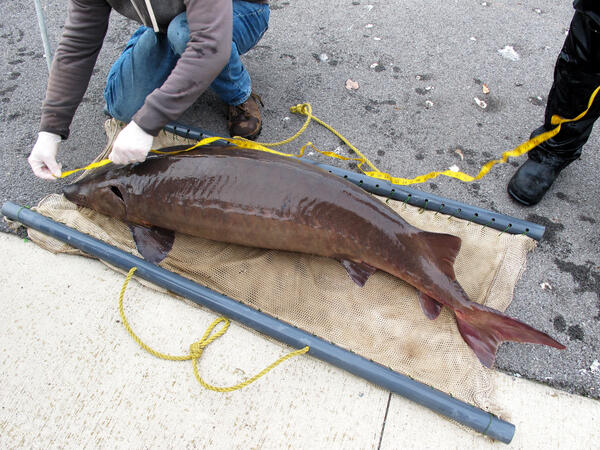
Measuring A Lake Sturgeon
Measuring a Lake Sturgeon in Cayuga Lake as part of the Lake Sturgeon Recovery Plan for New York State, written in 2018. Lake sturgeon can live for more than 100 years and grow to seven feet in length, making them the largest freshwater fish in New York.
Measuring a Lake Sturgeon in Cayuga Lake as part of the Lake Sturgeon Recovery Plan for New York State, written in 2018. Lake sturgeon can live for more than 100 years and grow to seven feet in length, making them the largest freshwater fish in New York.

Phragmites Growing Tall
Phragmites australis (ssp. australis), or invasive Common Reed, growing high overhead. Photo Credit: Alexndra (Sasha) Bozimowski, USGS.
Phragmites australis (ssp. australis), or invasive Common Reed, growing high overhead. Photo Credit: Alexndra (Sasha) Bozimowski, USGS.

Lake Huron Sculpins
A slimy sculpin (left) and deepwater sculpin (right), two native sculpin species in the Great Lakes, are compared side-by-side after capture in a bottom trawl during the Lake Huron fall forage survey aboard the R/V Arcticus. Photo credit: Cory Brant, USGS.
A slimy sculpin (left) and deepwater sculpin (right), two native sculpin species in the Great Lakes, are compared side-by-side after capture in a bottom trawl during the Lake Huron fall forage survey aboard the R/V Arcticus. Photo credit: Cory Brant, USGS.

Sculpin Up-close
A native deepwater sculpin, captured by bottom trawl in the Lake Huron depths off Cheboygan, Michigan, is held for a quick photo op during the USGS Great Lakes Science Center fall forage sampling cruise aboard the R/V Arcticus. Photo credit: Cory Brant, USGS.
A native deepwater sculpin, captured by bottom trawl in the Lake Huron depths off Cheboygan, Michigan, is held for a quick photo op during the USGS Great Lakes Science Center fall forage sampling cruise aboard the R/V Arcticus. Photo credit: Cory Brant, USGS.

Maankiki Center Shiawassee National Wildlife Refuge
Maankiki Center Shiawassee National Wildlife RefugeMaankiki Center Shiawassee National Wildlife Refuge Banner. Credit: Sasha Bozimowski, USGS
Maankiki Center Shiawassee National Wildlife Refuge
Maankiki Center Shiawassee National Wildlife RefugeMaankiki Center Shiawassee National Wildlife Refuge Banner. Credit: Sasha Bozimowski, USGS

Great Lakes Science at Sunset
The USGS Great Lakes Science Center R/V Arcticus pulls into port in Cheboygan, Michigan, after a day of sampling in Lake Huron during the annual fall forage cruise. Photo credit: Cory Brant, USGS.
The USGS Great Lakes Science Center R/V Arcticus pulls into port in Cheboygan, Michigan, after a day of sampling in Lake Huron during the annual fall forage cruise. Photo credit: Cory Brant, USGS.
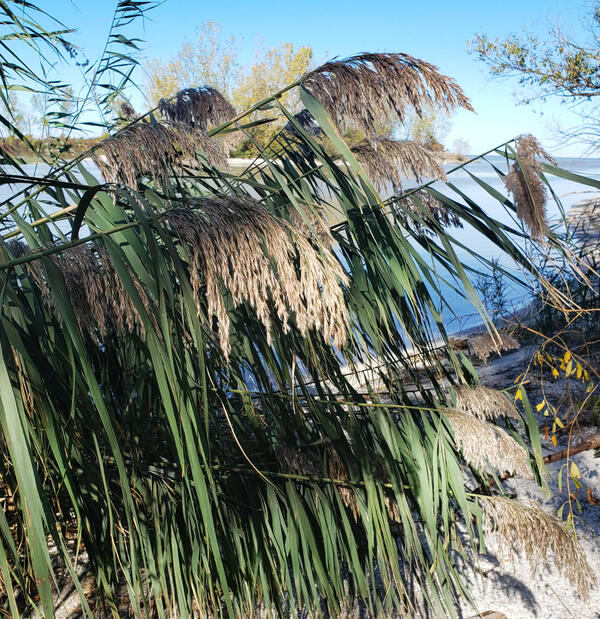
A Phragmites australis Stand at Crane Creek in Ohio
A Phragmites australis Stand at Crane Creek in OhioA Phragmites australis stand at Crane Creek in the Ottawa National Wildlife Refuge, Ohio. P. australis is an invasive species in North America.
A Phragmites australis Stand at Crane Creek in Ohio
A Phragmites australis Stand at Crane Creek in OhioA Phragmites australis stand at Crane Creek in the Ottawa National Wildlife Refuge, Ohio. P. australis is an invasive species in North America.

Phragmites invades coastal wetland in a changing climate
Phragmites invades coastal wetland in a changing climatePhragmites invades coastal wetland in a changing climate. Ottawa National Wildlife Refuge, Oak Harbor, OH. Photo Credit: Kurt Kowalski, USGS-GLSC.
Phragmites invades coastal wetland in a changing climate
Phragmites invades coastal wetland in a changing climatePhragmites invades coastal wetland in a changing climate. Ottawa National Wildlife Refuge, Oak Harbor, OH. Photo Credit: Kurt Kowalski, USGS-GLSC.

Lake Ontario at Sunset
Sunset on Lake Ontario aboard the USGS Great Lakes Science Center’s R/V Kaho. Photo credit: Thomas SanFilippo, USGS.
Sunset on Lake Ontario aboard the USGS Great Lakes Science Center’s R/V Kaho. Photo credit: Thomas SanFilippo, USGS.

Eye See You
Alewife peeking out of a pile of mussels caught on the 2021 Lake Michigan fall bottom trawl survey aboard the R/V Arcticus. Photo credit: Patty Dieter, USGS.
Alewife peeking out of a pile of mussels caught on the 2021 Lake Michigan fall bottom trawl survey aboard the R/V Arcticus. Photo credit: Patty Dieter, USGS.