
New England WSC Products in the First Quarter of 2026
By New England Water Science Center
April 2, 2026
List of products from the New England Water Science Center released in the first quarter of 2026.
Related
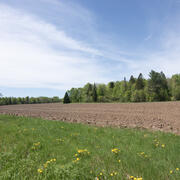
Determining How New England’s Water Resources Respond to Various Climate Scenarios
Possible changes in temperature and precipitation over the next several decades may have implications for New England’s agricultural community, such as changing plant water availability and crop yield variability. The U.S. Geological Survey, in cooperation with the U.S. Department of Agriculture and the University of Maine, is predicting the potential hydrological effects based on these climatic...
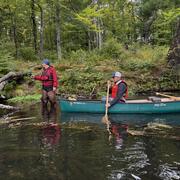
Thermal Imagery to Inform Brook Trout Habitat Suitability and Restoration Potential, Upper Namekagon River, Wisconsin
The U.S. Geological Survey (USGS), in cooperation with the National Park Service (NPS), is using thermal infrared technology to identify cold-water habitat for brook trout and other cold-water species in the upper Namekagon River in Wisconsin. The upper Namekagon River and its tributaries have long served as a stronghold for brook trout and other cold- and cool-water species; however, changing...
Soil-Water-Balance (SWB) Model Archive Used to Simulate Potential Recharge with Projections for Future Climate Scenarios, Saco River Basin, Maine and New Hampshire Soil-Water-Balance (SWB) Model Archive Used to Simulate Potential Recharge with Projections for Future Climate Scenarios, Saco River Basin, Maine and New Hampshire
This model archive makes available the Soil-Water-Balance (SWB) model used to simulate potential recharge for the Saco Headwaters Watershed. This model was used to simulate potential recharge (net infiltration) for use in a groundwater model in the same region to understand the effects of water bottling. The model was used to produce a historical simulation (2000 -2021) and a series of...
MODFLOW 6 Datasets for a Groundwater-flow Model in the Saco River Basin, New Hampshire and Maine MODFLOW 6 Datasets for a Groundwater-flow Model in the Saco River Basin, New Hampshire and Maine
A MODFLOW 6 groundwater model for the Wards Brook aquifer in New Hampshire and Maine was developed to understand the effects of groundwater withdrawals for historical and potential future conditions. The model assesses how groundwater withdrawals, including for bottled water, affect base flows from Wards Brook, groundwater levels, and pond levels under different scenarios. Model runs...
Low-flow metrics and explanatory variable data for 107 basins in Massachusetts, 1943-2022 Low-flow metrics and explanatory variable data for 107 basins in Massachusetts, 1943-2022
The U.S. Geological Survey, in cooperation with the Massachusetts Department of Conservation and Recreation, evaluated potential drivers of low streamflows in Massachusetts by use of statistical models with selected low-flow metrics as the dependent variables. Low-flow metrics were computed in six ways: the 2nd and 10th percentile of daily flows during a climate year, these same...
Hydroacoustic Data to Support Embayment Monitoring in Long Island Sound, Farm River Embayment, Connecticut, 2023-2025 Hydroacoustic Data to Support Embayment Monitoring in Long Island Sound, Farm River Embayment, Connecticut, 2023-2025
This data release includes hydroacoustic data for the 2023 to 2025 water years at one station. This station is part of a discrete and continuous monitoring project in embayments on Long Island Sound to support nutrient management activities in Connecticut. The data were collected by the U.S Geological Survey (USGS) in cooperation with the Connecticut Departments of Energy and...
Groundwater drought in the United States: Spatial and temporal variability Groundwater drought in the United States: Spatial and temporal variability
Many communities and ecosystems in the United States that are dependent on groundwater are potentially adversely affected by groundwater drought. We computed yearly groundwater-drought metrics and mean groundwater levels at well locations across the conterminous United States (CONUS), using data from wells and remotely sensed and modeled Gravity Recovery and Climate Experiment Drought...
Authors
Glenn Hodgkins, Caelan Simeone, Melissa A. Lombard, Todd Caldwell, John C. Hammond, Michael Wieczorek, Robert W. Dudley
Erosion potential and flood vulnerability of streams and stream crossings at Acadia National Park, Maine Erosion potential and flood vulnerability of streams and stream crossings at Acadia National Park, Maine
Acadia National Park has had increases in the frequency and magnitude of precipitation in recent years, leading to increased flood flows, stream erosion, and costly infrastructure damage. To improve infrastructure management in a changing climate, the U.S. Geological Survey, in cooperation with the National Park Service, has developed multiple datasets that can help natural resource...
Authors
Ian P. Armstrong, Meghan A. McCallister, Kristina M. Hyslop, Adam J. Benthem
Effects of groundwater withdrawals for water bottling and municipal use, Wards Brook Valley, Maine and New Hampshire Effects of groundwater withdrawals for water bottling and municipal use, Wards Brook Valley, Maine and New Hampshire
Hydrologic models for the Wards Brook valley near Fryeburg, Maine were developed for historical (2016 – 2021) and hypothetical future conditions (2046 – 2065 and 2080 – 2099) to understand the effects of groundwater withdrawals for bottled water and municipal use on hydrologic conditions (stream base flows and groundwater levels). Analyses showed that the simulated base flows in Wards...
Authors
John R Mullaney, Janet R. Barclay, Jennifer S. Stanton, Carl S Carlson, Madeleine Holland
Drinking water arsenic, urinary arsenic biomarkers, and cognitive impairment in the REGARDS study Drinking water arsenic, urinary arsenic biomarkers, and cognitive impairment in the REGARDS study
BackgroundThere are several pathways by which inorganic arsenic (iAs) exposure can affect cognition among adults. Few epidemiologic studies evaluate iAs in water and inter-individual differences in urinary arsenic toxicokinetics. We aimed to estimate the association between individual-level urinary arsenic biomarkers, county-level iAs in drinking water, and cognitive impairment in a...
Authors
Meghan Angley, Yijia Zhang, Anne E. Nigra, Melissa A. Lombard, Matthew O. Gribble, Liping Lu, Frederick W. Unverzagt, Leslie A. McClure, Suzanne E. Judd, Mary Cushman, John Brockman, Ka Kahe
Related
Determining How New England’s Water Resources Respond to Various Climate Scenarios
Possible changes in temperature and precipitation over the next several decades may have implications for New England’s agricultural community, such as changing plant water availability and crop yield variability. The U.S. Geological Survey, in cooperation with the U.S. Department of Agriculture and the University of Maine, is predicting the potential hydrological effects based on these climatic...
Thermal Imagery to Inform Brook Trout Habitat Suitability and Restoration Potential, Upper Namekagon River, Wisconsin
The U.S. Geological Survey (USGS), in cooperation with the National Park Service (NPS), is using thermal infrared technology to identify cold-water habitat for brook trout and other cold-water species in the upper Namekagon River in Wisconsin. The upper Namekagon River and its tributaries have long served as a stronghold for brook trout and other cold- and cool-water species; however, changing...
Soil-Water-Balance (SWB) Model Archive Used to Simulate Potential Recharge with Projections for Future Climate Scenarios, Saco River Basin, Maine and New Hampshire Soil-Water-Balance (SWB) Model Archive Used to Simulate Potential Recharge with Projections for Future Climate Scenarios, Saco River Basin, Maine and New Hampshire
This model archive makes available the Soil-Water-Balance (SWB) model used to simulate potential recharge for the Saco Headwaters Watershed. This model was used to simulate potential recharge (net infiltration) for use in a groundwater model in the same region to understand the effects of water bottling. The model was used to produce a historical simulation (2000 -2021) and a series of...
MODFLOW 6 Datasets for a Groundwater-flow Model in the Saco River Basin, New Hampshire and Maine MODFLOW 6 Datasets for a Groundwater-flow Model in the Saco River Basin, New Hampshire and Maine
A MODFLOW 6 groundwater model for the Wards Brook aquifer in New Hampshire and Maine was developed to understand the effects of groundwater withdrawals for historical and potential future conditions. The model assesses how groundwater withdrawals, including for bottled water, affect base flows from Wards Brook, groundwater levels, and pond levels under different scenarios. Model runs...
Low-flow metrics and explanatory variable data for 107 basins in Massachusetts, 1943-2022 Low-flow metrics and explanatory variable data for 107 basins in Massachusetts, 1943-2022
The U.S. Geological Survey, in cooperation with the Massachusetts Department of Conservation and Recreation, evaluated potential drivers of low streamflows in Massachusetts by use of statistical models with selected low-flow metrics as the dependent variables. Low-flow metrics were computed in six ways: the 2nd and 10th percentile of daily flows during a climate year, these same...
Hydroacoustic Data to Support Embayment Monitoring in Long Island Sound, Farm River Embayment, Connecticut, 2023-2025 Hydroacoustic Data to Support Embayment Monitoring in Long Island Sound, Farm River Embayment, Connecticut, 2023-2025
This data release includes hydroacoustic data for the 2023 to 2025 water years at one station. This station is part of a discrete and continuous monitoring project in embayments on Long Island Sound to support nutrient management activities in Connecticut. The data were collected by the U.S Geological Survey (USGS) in cooperation with the Connecticut Departments of Energy and...
Groundwater drought in the United States: Spatial and temporal variability Groundwater drought in the United States: Spatial and temporal variability
Many communities and ecosystems in the United States that are dependent on groundwater are potentially adversely affected by groundwater drought. We computed yearly groundwater-drought metrics and mean groundwater levels at well locations across the conterminous United States (CONUS), using data from wells and remotely sensed and modeled Gravity Recovery and Climate Experiment Drought...
Authors
Glenn Hodgkins, Caelan Simeone, Melissa A. Lombard, Todd Caldwell, John C. Hammond, Michael Wieczorek, Robert W. Dudley
Erosion potential and flood vulnerability of streams and stream crossings at Acadia National Park, Maine Erosion potential and flood vulnerability of streams and stream crossings at Acadia National Park, Maine
Acadia National Park has had increases in the frequency and magnitude of precipitation in recent years, leading to increased flood flows, stream erosion, and costly infrastructure damage. To improve infrastructure management in a changing climate, the U.S. Geological Survey, in cooperation with the National Park Service, has developed multiple datasets that can help natural resource...
Authors
Ian P. Armstrong, Meghan A. McCallister, Kristina M. Hyslop, Adam J. Benthem
Effects of groundwater withdrawals for water bottling and municipal use, Wards Brook Valley, Maine and New Hampshire Effects of groundwater withdrawals for water bottling and municipal use, Wards Brook Valley, Maine and New Hampshire
Hydrologic models for the Wards Brook valley near Fryeburg, Maine were developed for historical (2016 – 2021) and hypothetical future conditions (2046 – 2065 and 2080 – 2099) to understand the effects of groundwater withdrawals for bottled water and municipal use on hydrologic conditions (stream base flows and groundwater levels). Analyses showed that the simulated base flows in Wards...
Authors
John R Mullaney, Janet R. Barclay, Jennifer S. Stanton, Carl S Carlson, Madeleine Holland
Drinking water arsenic, urinary arsenic biomarkers, and cognitive impairment in the REGARDS study Drinking water arsenic, urinary arsenic biomarkers, and cognitive impairment in the REGARDS study
BackgroundThere are several pathways by which inorganic arsenic (iAs) exposure can affect cognition among adults. Few epidemiologic studies evaluate iAs in water and inter-individual differences in urinary arsenic toxicokinetics. We aimed to estimate the association between individual-level urinary arsenic biomarkers, county-level iAs in drinking water, and cognitive impairment in a...
Authors
Meghan Angley, Yijia Zhang, Anne E. Nigra, Melissa A. Lombard, Matthew O. Gribble, Liping Lu, Frederick W. Unverzagt, Leslie A. McClure, Suzanne E. Judd, Mary Cushman, John Brockman, Ka Kahe