



Since its emergence in 2006, white-nose syndrome (WNS) continues to spread in North America and has substantially impacted hibernating bat populations, contributing to declines of over 90% in northern long-eared (Myotis septentrionalis), little brown (Myotis lucifugus), and tri-colored bat (Perimyotis subflavus) populations. We are developing tools and management strategies to protect bat populations from WNS and to help preserve the ecological and agricultural services they provide.
What is the issue

Eighteen years after Pseudogymnoascus destructans (Pd), the fungus that causes WNS in bats, was first recognized in New York, its range extends across much of the continental US, threatening hibernating bat populations across the country. The National Wildlife Health Center (NWHC) and our partners are developing and field testing a vaccine against WNS for use by management agencies in at-risk wild bat populations.
What's at stake
North American bats are vital to healthy ecosystems and contribute billions of dollars annually to the U.S. agricultural economy through services such as pest control and pollination. White-nose syndrome, first recognized in the U.S. in 2007, is estimated to have resulted in the deaths of over 6 million bats, leaving some species, such as the endangered northern long-eared bat, facing risk of extinction.
What is our approach
Vaccination can be a powerful tool to control disease in wildlife when both effective vaccines and administration strategies are available. We have developed a vaccine against Pd that can be administered orally to wild bats. We are currently investigating the potential for topical application of the vaccine, where bats could consume the vaccine by natural grooming behaviors.
The goal of this work, which began in 2015, is to provide natural resource managers with a tool to reduce disease severity from WNS, while improving a bat’s odds of surviving the infection.
Several vaccine candidates, using raccoon poxvirus as a vector, were tested to determine which provided the best protection in laboratory studies and field trials. One of these was selected for mass production at NWHC for continued use on bats. To date, field trials have occurred in Wisconsin, Texas, Idaho, Washington, Wyoming, Colorado, and Montana. These bat populations range from having survived multiple years of WNS exposure to not yet having encountered the disease. Radio-frequency identification (RFID) pit tags and readers are used to continuously monitor activity levels at hibernacula and maternity colonies to compare vaccinated and placebo-treated bats over time. Since beginning our field trials in 2019, we have treated more than 7,000 bats, including little brown bats and other Myotis species (cave myotis (M. velifer), Yuma myotis (M. yumanensis), long-eared myotis (M. evotis), and long-legged myotis (M. volans)).
What are the benefits
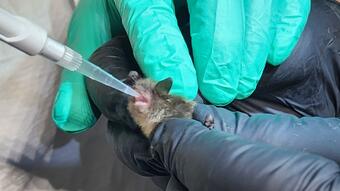
Results of field trials have shown that vaccination can result in lower fungal loads, less severe wing damage, and higher return rates of bats the year following treatment. Female bats are more responsive to vaccination if administered at their maternity roosts and less responsive when administered during fall swarm or early hibernation. Unlike females, male bats are quite active during the fall and early winter, and they are responsive to vaccination during that time. Juvenile males can also be vaccinated at maternity roosts.
Bats in eastern and midwestern states have been exposed to Pd for 15 years or more. Initially, their numbers declined quickly, but evidence is accumulating that suggests bats in these areas may be developing natural resistance to the disease. Their population numbers have mostly stabilized and some populations are slowly increasing, while their Pd loads in general are decreasing.
Based on these findings, vaccination against WNS is likely to be more effective prior to or immediately after disease emergence in naive populations. Most of our efforts to manage the disease through vaccination is now focused on Myotis bats in western states and on endangered species, like the northern long-eared bat.
Recent accomplishments
Until 2026, NWHC's efforts have focused on measuring and comparing the survival of individual bats by treating half the bats captured in a single colony with vaccine and half with a placebo. In 2026, scientists moved to a population-focused approach. In collaboration with state and federal partners and non-governmental organizations, NWHC is attempting to capture and vaccinate approximately 70% of bats in a single maternity colony and will compare their persistence with an unvaccinated paired colony nearby. To date, paired colonies for this treatment/no treatment approach have been in Washington state (2 pairs), Montana (1 pair), Wyoming (1 pair) and California (1 pair). At six sites selected for vaccination, over 2000 bats were vaccinated, with nearly 900 vaccinated at a single colony. NWHC will enroll additional pairs next year and continue treating bats over the next several years using a matched pairs approach to measure the impact of vaccination against WNS on population persistence. Metrics to be measured annually include Pd presence at the maternity colony shortly after spring return and emergence counts before and after young bats begin flying.
Next steps
NWHC remains the only producer of this specialized vaccine. To maximize the amount of vaccine available, scientists are using new, more automated methods for producing the vaccine at NWHC. In addition, NWHC is continuing to develop and test methods for hands-off, mass delivery of vaccine to bats. One such option is to topically spray the bats with vaccine, which they ingest upon grooming, similar to the method under development to control rabies in vampire bats.

Acknowledgements
We would like to thank our collaborators, including the U.S. Fish and Wildlife Service, the National Parks Service, the Wisconsin Department of Natural Resources, Texas Parks and Wildlife Department, Washington Department of Fish and Wildlife, Idaho Fish and Game. Colorado Parks and Wildlife, Wyoming Game and Fish Department, and Montana Fish, Wildlife, and Parks.

Field trials for testing of white-nose syndrome vaccine candidates

Vaccines

White-Nose Syndrome Surveillance

White-Nose Syndrome
Since its emergence in 2006, white-nose syndrome (WNS) continues to spread in North America and has substantially impacted hibernating bat populations, contributing to declines of over 90% in northern long-eared (Myotis septentrionalis), little brown (Myotis lucifugus), and tri-colored bat (Perimyotis subflavus) populations. We are developing tools and management strategies to protect bat populations from WNS and to help preserve the ecological and agricultural services they provide.
What is the issue
Eighteen years after Pseudogymnoascus destructans (Pd), the fungus that causes WNS in bats, was first recognized in New York, its range extends across much of the continental US, threatening hibernating bat populations across the country. The National Wildlife Health Center (NWHC) and our partners are developing and field testing a vaccine against WNS for use by management agencies in at-risk wild bat populations.
What's at stake
North American bats are vital to healthy ecosystems and contribute billions of dollars annually to the U.S. agricultural economy through services such as pest control and pollination. White-nose syndrome, first recognized in the U.S. in 2007, is estimated to have resulted in the deaths of over 6 million bats, leaving some species, such as the endangered northern long-eared bat, facing risk of extinction.
What is our approach
Vaccination can be a powerful tool to control disease in wildlife when both effective vaccines and administration strategies are available. We have developed a vaccine against Pd that can be administered orally to wild bats. We are currently investigating the potential for topical application of the vaccine, where bats could consume the vaccine by natural grooming behaviors.
The goal of this work, which began in 2015, is to provide natural resource managers with a tool to reduce disease severity from WNS, while improving a bat’s odds of surviving the infection.
Several vaccine candidates, using raccoon poxvirus as a vector, were tested to determine which provided the best protection in laboratory studies and field trials. One of these was selected for mass production at NWHC for continued use on bats. To date, field trials have occurred in Wisconsin, Texas, Idaho, Washington, Wyoming, Colorado, and Montana. These bat populations range from having survived multiple years of WNS exposure to not yet having encountered the disease. Radio-frequency identification (RFID) pit tags and readers are used to continuously monitor activity levels at hibernacula and maternity colonies to compare vaccinated and placebo-treated bats over time. Since beginning our field trials in 2019, we have treated more than 7,000 bats, including little brown bats and other Myotis species (cave myotis (M. velifer), Yuma myotis (M. yumanensis), long-eared myotis (M. evotis), and long-legged myotis (M. volans)).
What are the benefits
Results of field trials have shown that vaccination can result in lower fungal loads, less severe wing damage, and higher return rates of bats the year following treatment. Female bats are more responsive to vaccination if administered at their maternity roosts and less responsive when administered during fall swarm or early hibernation. Unlike females, male bats are quite active during the fall and early winter, and they are responsive to vaccination during that time. Juvenile males can also be vaccinated at maternity roosts.
Bats in eastern and midwestern states have been exposed to Pd for 15 years or more. Initially, their numbers declined quickly, but evidence is accumulating that suggests bats in these areas may be developing natural resistance to the disease. Their population numbers have mostly stabilized and some populations are slowly increasing, while their Pd loads in general are decreasing.
Based on these findings, vaccination against WNS is likely to be more effective prior to or immediately after disease emergence in naive populations. Most of our efforts to manage the disease through vaccination is now focused on Myotis bats in western states and on endangered species, like the northern long-eared bat.
Recent accomplishments
Until 2026, NWHC's efforts have focused on measuring and comparing the survival of individual bats by treating half the bats captured in a single colony with vaccine and half with a placebo. In 2026, scientists moved to a population-focused approach. In collaboration with state and federal partners and non-governmental organizations, NWHC is attempting to capture and vaccinate approximately 70% of bats in a single maternity colony and will compare their persistence with an unvaccinated paired colony nearby. To date, paired colonies for this treatment/no treatment approach have been in Washington state (2 pairs), Montana (1 pair), Wyoming (1 pair) and California (1 pair). At six sites selected for vaccination, over 2000 bats were vaccinated, with nearly 900 vaccinated at a single colony. NWHC will enroll additional pairs next year and continue treating bats over the next several years using a matched pairs approach to measure the impact of vaccination against WNS on population persistence. Metrics to be measured annually include Pd presence at the maternity colony shortly after spring return and emergence counts before and after young bats begin flying.
Next steps
NWHC remains the only producer of this specialized vaccine. To maximize the amount of vaccine available, scientists are using new, more automated methods for producing the vaccine at NWHC. In addition, NWHC is continuing to develop and test methods for hands-off, mass delivery of vaccine to bats. One such option is to topically spray the bats with vaccine, which they ingest upon grooming, similar to the method under development to control rabies in vampire bats.
Acknowledgements
We would like to thank our collaborators, including the U.S. Fish and Wildlife Service, the National Parks Service, the Wisconsin Department of Natural Resources, Texas Parks and Wildlife Department, Washington Department of Fish and Wildlife, Idaho Fish and Game. Colorado Parks and Wildlife, Wyoming Game and Fish Department, and Montana Fish, Wildlife, and Parks.
Field trials for testing of white-nose syndrome vaccine candidates
Vaccines
White-Nose Syndrome Surveillance