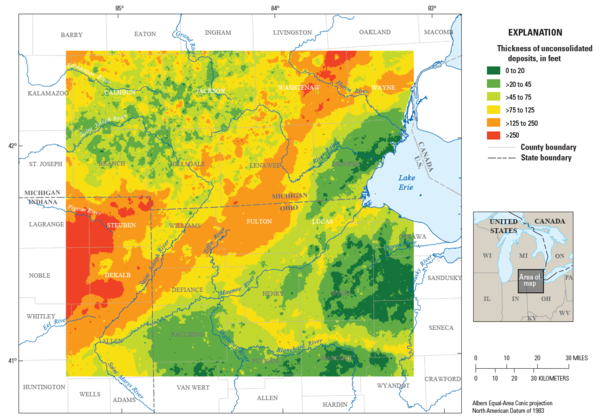
Map showing thickness of coarse-grained deposits created by scientists at the Ohio-Kentucky-Indiana Water Science Center
An official website of the United States government
Here's how you know
Official websites use .gov
A .gov website belongs to an official government organization in the United States.
Secure .gov websites use HTTPS
A lock () or https:// means you’ve safely connected to the .gov website. Share sensitive information only on official, secure websites.
Ohio-Kentucky-Indiana Water Science Center images.
Map showing thickness of coarse-grained deposits created by scientists at the Ohio-Kentucky-Indiana Water Science Center
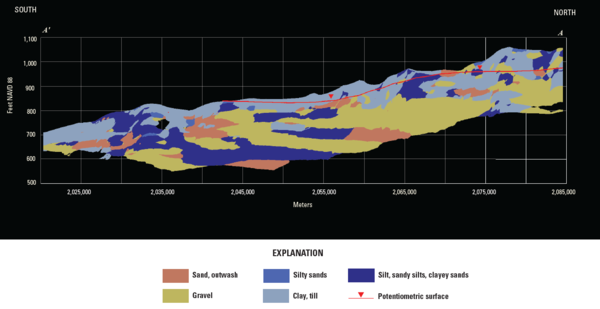
Volumetric model cross section through Allen, DeKalb, and Steuben Counties in Indiana created by the scientists of the Ohio-Kentucky-Indiana Water Science Center
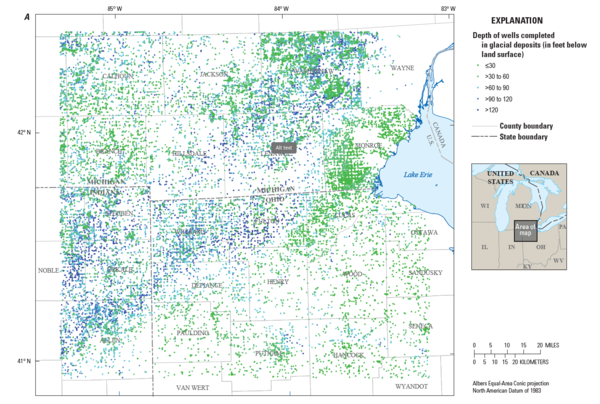
Description: Maps showing the distribution of wells completed in glacial deposits used to create maps of hydrogeologic information and a three-dimensional volumetric model for the glacial deposits.
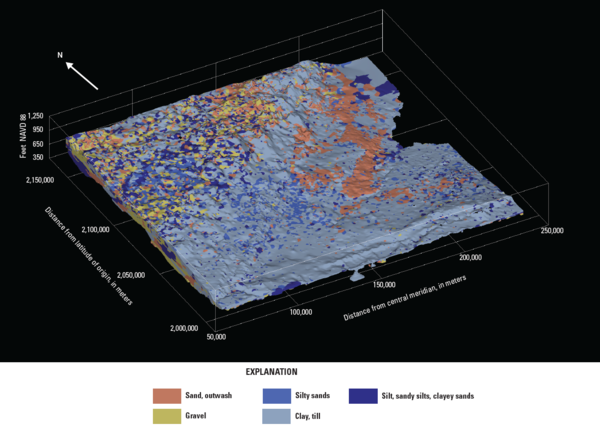
Block diagram showing the textural classes of lithologies in the study area, produced by the Ohio Kentucky Indiana Water Science Center
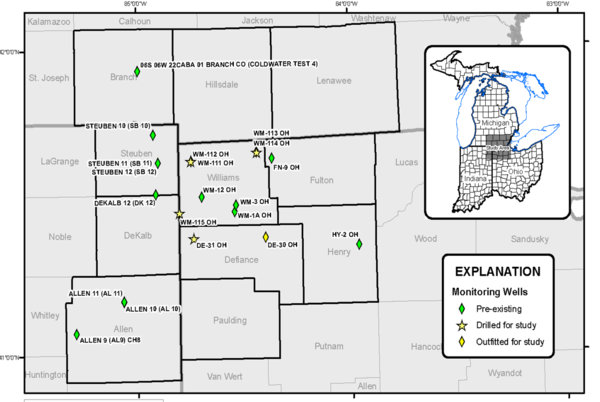
Existing USGS groundwater-level networks were enhanced through: 1) the addition of newly drilled deep wells that nearly reach bedrock, and 2) conversion of discrete wells to continuous, real-time wells
Ben Sperl is a Hydrologic Technician with the Indianapolis Office of the Ohio-Kentucky-Indiana (OKI) WSC.
USGS hydrologists record field notes for dip and equal-width increment (EWI) water samples as an EWI streamflow measurement is made.
A photo of the view of the park and Chase Street flowing well taken in January of 2023 by Harvie Pollard.
A photo of current discharge from Chase Street. This was taken in January of 2023 by Harvie Pollard.
A photo of USGS staff collecting water quality samples at USGS well B-8 taken in October of 2022 by Harvie Pollard
Sediment lab employee Logan Young weighing crucibles to capture their tare weights before sample is added
Kyle Barnett and Elisabeth Hernandez analyzing sediment samples using the sand/fine break method
A photo of USGS staff conducting Borehole Geophysics at Chase Street in June of 2022. Photo by Harvie Pollard.
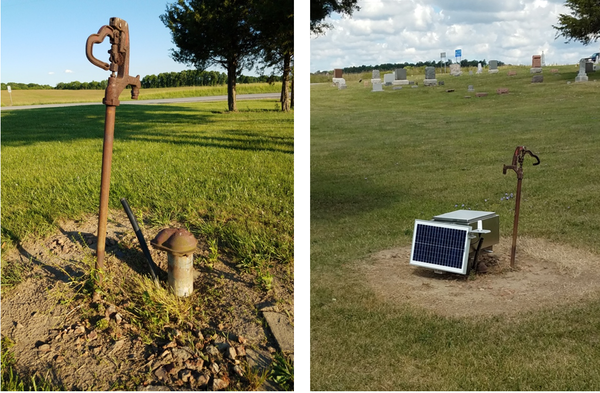
Picture of the USGS Groundwater Monitoring Well WM-111 in Williams County, Ohio before and after conversion to a Real-Time Monitoring well.
Microbiologist Erin Stelzer samples a wetland for infectious avian influenza virus at DeSoto National Wildlife Refuge, Iowa.
A super streamgage sits inside the brown structure underneath the bridge over the Wabash River linking Indiana and Illinois. The closest town is New Harmony, IN.
The Kentucky Sediment Laboratory's oven full of filtration crucibles to be dried. After baking, the crucibles are placed in a desiccator box to cool.
Sieves determine the sand size class of sediment samples, 0.250mm and 0.063mm steel mesh are used.
The Kentucky Sediment Laboratory's sample storage space, samples are stored in a temperature and light controlled environment.
Environ. Sci. Technol. cover featuring Perfluoroalkyl and Polyfluoroalkyl Substances in Groundwater Used as a Source of Drinking Water in the Eastern United States
The soil amendments consisted of a mixture of compost plus sand or compost plus expanded shale that were rototilled into the existing soil to depths of 4 or 6 inches. The amended soils were then topped with a compost blanket, seeded, and covered with erosion-control matting