U.S. flag

An official website of the United States government

Images

Pacific Coastal and Marine Science Center images.

Filter Total Items: 1369
Photos of coastal wetland, coral reef, dryland, and alpine ecosystems
Examples of ecosystems that are chronically exposed to high levels of abiotic stress

Photos of (a) coastal wetland, (b) coral reef, (c) dryland, and (d) alpine ecosystems. These ecosystems are chronically exposed to high levels of abiotic stress that approach physiological tolerance limits.

Diagram of horizontal levee and map showing study area in SF Bay

Depiction of a horizontal levee (A) and study location in San Francisco Bay, CA(B and C). Transects used in the hydrodynamic simulations are shown by the white lines in (C).

Collage of Conceição-Duquesa beach oblique images with high-water line and prominent structures marked
Diagram showing occurrence and timeline of great earthquakes and rupture grid at the Aleutian Arc

Figure: a Great earthquakes in the 20th century. Inset numbers over the 3 by 12 grid indicate subfaults with large slip in meters from the updated 1957 rupture model3 with red and blue tones for shallow and deeper megathrust rupture, respectively.

Floodplain maps and bar graphs depicting the expansion of floodplain after earthquake driven subsidence

Floodplain maps and bar graphs depicting the expansion of the 1% floodplain after earthquake-driven subsidence today (2023) and in 2100 when the earthquake-driven subsidence is amplified by climate-driven sea-level rise for the (A) Necanicum River, OR; (B) Yaquina Bay, OR; (C) Alsea Bay, OR; and (D) Humboldt Bay, CA.

Floodplain maps and bar graphs depicting the expansion of the 1% floodplain after earthquake-driven subsidence today (2023) and in 2100 when the earthquake-driven subsidence is amplified by climate-driven sea-level rise for the (A) Necanicum River, OR; (B) Yaquina Bay, OR; (C) Alsea Bay, OR; and (D) Humboldt Bay, CA.

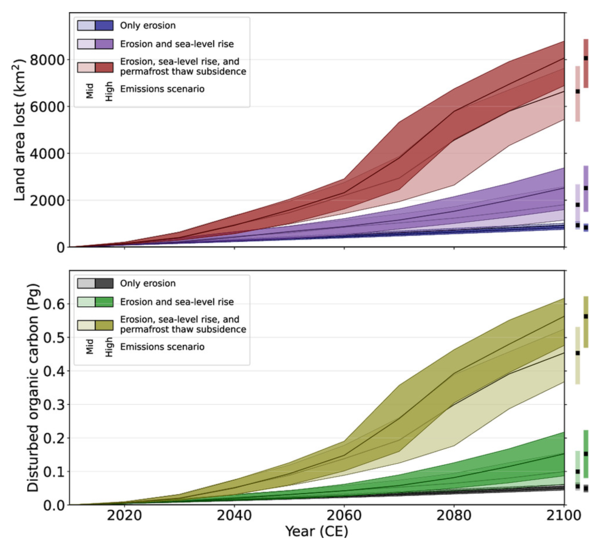
Chart showing projected 21st-century land loss and organic carbon disturbance on Alaska’s Arctic Coastal Plain
Projected 21st-century land loss and organic carbon disturbance on Alaska’s Arctic Coastal Plain
Diagram and map showing great earthquakes in the 20th century along the Aleutian Arc
Great earthquakes in the 20th century along the Aleutian Arc

Great earthquakes in the 20th century. Inset numbers over the 3 by 12 grid indicate subfaults with large slip in meters from the updated 1957 rupture model with red and blue tones for shallow and deeper megathrust rupture, respectively.

Great earthquakes in the 20th century. Inset numbers over the 3 by 12 grid indicate subfaults with large slip in meters from the updated 1957 rupture model with red and blue tones for shallow and deeper megathrust rupture, respectively.

Figure showing San Lorenzo River watershed on central California coast alongside a sediment rating curve
San Lorenzo River watershed on central California coast alongside a sediment rating curve

Figure shows (a) San Lorenzo River watershed, central California coast, which empties into Monterey Bay. Fluvial sediment sampling location is indicated just upstream of river mouth.

Figure shows study location, the reef-lined south coast of Moloka'i
Study location - reef-lined south coast of Moloka'i

Figure from the study "Hurricane wave energy dissipation and wave-driven currents over a fringing reef" showing the study location, the reef-lined south coast of Moloka'i.

Figure from the study "Hurricane wave energy dissipation and wave-driven currents over a fringing reef" showing the study location, the reef-lined south coast of Moloka'i.

Figure showing north-to-south rupture simulations at the intersection of the South San Andreas Fault and a normal fault
North-to-south rupture simulations at the intersection of the South San Andreas Fault and a normal fault

North-to-south (N2S) rupture simulations with oblique (−45°; panels a–d) and left-lateral (0°; panels e–h) normal fault (NF) pre-stress. In the left column (panels a, b, e, and f), the San Andreas (SSAF) ends at the intersection with the NF, while in the right column (panels c, d, g, and h), the San Andreas (SSAF-EXT) “extends” south of the SSAF-NF intersection.

North-to-south (N2S) rupture simulations with oblique (−45°; panels a–d) and left-lateral (0°; panels e–h) normal fault (NF) pre-stress. In the left column (panels a, b, e, and f), the San Andreas (SSAF) ends at the intersection with the NF, while in the right column (panels c, d, g, and h), the San Andreas (SSAF-EXT) “extends” south of the SSAF-NF intersection.

Figure showing satellite image of China Camp marsh with model boundaries
Study location showing satellite image of China Camp marsh with model boundaries

Satellite image of China Camp marsh, with model boundaries from the Delft3D model shown with white lines and the observation points marked with red dots; red lines mark where x and y are 0. (b) Overview of San Francisco Bay, with a star marking China Camp marsh.

Satellite image of China Camp marsh, with model boundaries from the Delft3D model shown with white lines and the observation points marked with red dots; red lines mark where x and y are 0. (b) Overview of San Francisco Bay, with a star marking China Camp marsh.

Figure showing an example of calibration and validation of CoSMoS-COAST using historical satellite-derived shoreline data
Example of calibration and validation of CoSMoS-COAST using historical satellite-derived shoreline data

An example of calibration and validation of CoSMoS-COAST using historical satellite-derived shoreline data. The figure shows the extent of the CoSMoS-COAST U.S. South Atlantic Coast model transects (panel A—in green) with a zoomed in section of Cape Hatteras, North Carolina (panel B), which shows a close-up of the 50 m transect spacing (green lines).

An example of calibration and validation of CoSMoS-COAST using historical satellite-derived shoreline data. The figure shows the extent of the CoSMoS-COAST U.S. South Atlantic Coast model transects (panel A—in green) with a zoomed in section of Cape Hatteras, North Carolina (panel B), which shows a close-up of the 50 m transect spacing (green lines).

Research Vessel Williams on a trailer, seen from the front

The USGS Research Vessel Williams is owned and operated by the Pacific Coastal and Marine Science Center.

A view of the USGS Research Vessel Parke Snavely's back deck from above

View looks down from a bridge as USGS research vessel R/V Parke Snavely passes beneath. Credit: Jenny McKee, USGS Pacific Coastal and Marine Science Center.

Santa Cruz wharf post-storm survey - Backscatter and draped sidescan overlayed with partial transparency

Santa Cruz wharf post-storm survey - Backscatter and draped sidescan overlayed with partial transparency. Following the partial collapse of the Santa Cruz Municipal Wharf during January 2025 storms, the USGS Pacific Coastal and Marine Science Center was requested to help map seafloor debris by NOAA’s Monterey Bay National Marine Sanctuary.

Santa Cruz wharf post-storm survey - Backscatter and draped sidescan overlayed with partial transparency. Following the partial collapse of the Santa Cruz Municipal Wharf during January 2025 storms, the USGS Pacific Coastal and Marine Science Center was requested to help map seafloor debris by NOAA’s Monterey Bay National Marine Sanctuary.

Was this page helpful?