



This is our office.
These are our co-workers.
This is our rush hour.
Pacific Island Ecosystems Research Center
Research at the Pacific Island Ecosystems Research Center focuses on providing the scientific understanding and technologies needed to support and implement sound management and conservation of our Nation's biological resources occurring in Hawai'i and other Pacific island locations.
Featured Research
Featured Research

Learn about research to understand power outages caused by brown treensnakes and explore approaches to protect sensitive infrastructure.
News
Saving imperiled native Hawaiian birds: Leveraging avian malaria and mosquito ecology research to support effective mosquito control in Hawaiʻi
Saving imperiled native Hawaiian birds: Leveraging avian malaria and mosquito ecology research to support effective mosquito control in Hawaiʻi
A Tale of Two Islands and the Future of an Ocean Sentinel Seabird
A Tale of Two Islands and the Future of an Ocean Sentinel Seabird
EcoNews - Vol. 7 | Issue 2
EcoNews - Vol. 7 | Issue 2
Publications
Dietary composition and diversity in an endemic island bat, the Hawaiian hoary bat (Lasiurus semotus) Dietary composition and diversity in an endemic island bat, the Hawaiian hoary bat (Lasiurus semotus)
Due to the importance of sufficient diets, conservation practices for endangered bats often involve protection and restoration of foraging resources. For insectivorous (or arthropodivorous) bats, detailed knowledge of prey consumption can inform effective management. In this study, we used metabarcoding techniques to investigate the diet of Lasiurus semotus, a primarily insectivorous...
Phylogenomic analyses reveal introgression and cryptic speciation in the globally distributed, vector-transmitted pathogen Plasmodium relictum Phylogenomic analyses reveal introgression and cryptic speciation in the globally distributed, vector-transmitted pathogen Plasmodium relictum
Establishing species limits is challenging, particularly for pathogens of wildlife. These pathogens can be difficult to sample and culture, and their genome sequencing must often be conducted in the presence of high levels of host DNA. Plasmodium relictum is a mosquito-vectored avian malaria pathogen that is a globally distributed host generalist, comprised of several genetic lineages...
Genomic structural variation rescues a classic biological invader from a population bottleneck Genomic structural variation rescues a classic biological invader from a population bottleneck
Invasion genetics presents a classic paradox: how do species successfully spread despite severe population bottlenecks? The brown treesnake (Boiga irregularis) in Guam represents a striking example of this phenomenon, having been introduced with only a handful of individuals. We show that the population endured an extreme bottleneck, with roughly half of the genome exhibiting runs of...
Science

Ecology and Distribution of the Endangered Hawaiian Hoary Bat
The ‘ōpe‘ape‘a (Hawaiian hoary bat, Lasiurus semotus) is listed as endangered due to population declines and a lack of knowledge on its distribution, abundance, and habitat needs. In order to help inform management for and recovery of this species, USGS-PIERC in collaboration with other agencies has conducted studies on the bat’s distribution, abundance, population genetics, food habitats, and...
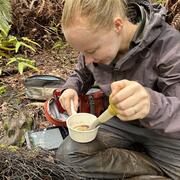
How to catch a vector: Mosquito monitoring for avian malaria control
USGS researchers are combatting avian malaria by improving the trapping and tracking of mosquitoes in endangered Hawaiian bird habitats.
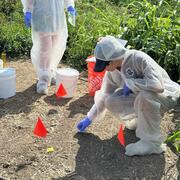
eDNA and the Efficacy of Management Actions
Environmental DNA (eDNA) is a powerful feedback tool, giving managers fast, clear, and cost-effective evidence to guide decisions and improve conservation outcomes.
By
Ecosystems Mission Area, Biological Threats and Invasive Species Research Program, Environmental Health Program, Species Management Research Program, Alaska Science Center, Columbia Environmental Research Center, Eastern Ecological Science Center, Forest and Rangeland Ecosystem Science Center, Fort Collins Science Center, Great Lakes Science Center, National Wildlife Health Center, Northern Prairie Wildlife Research Center, Northern Rocky Mountain Science Center, Pacific Island Ecosystems Research Center, Southwest Biological Science Center, Upper Midwest Environmental Sciences Center, Western Ecological Research Center (WERC), Western Fisheries Research Center, Wetland and Aquatic Research Center , Pacific Northwest Environmental DNA Laboratory