U.S. flag

An official website of the United States government

Images

Volcano Science Center images.

Filter Total Items: 551
Plot showing speeds of various animals and sprinters compared to magma ascent rates at different volcanoes
Range of speeds for several animals, athletes, and magmas from various volcanic eruptions.

Range of speeds for several animals, athletes, and magmas from various volcanic eruptions. Eruptions shown include the 25,400-year-old Oruanui eruption of Taupo (New Zealand), the 2.08-million-year-old Huckleberry Ridge Tuff of Yellowstone (USA), and the 767,000-year-old Bishop Tuff of Long Valley (USA). Magma ascent rates determined by Myers et al. (2018).

Range of speeds for several animals, athletes, and magmas from various volcanic eruptions. Eruptions shown include the 25,400-year-old Oruanui eruption of Taupo (New Zealand), the 2.08-million-year-old Huckleberry Ridge Tuff of Yellowstone (USA), and the 767,000-year-old Bishop Tuff of Long Valley (USA). Magma ascent rates determined by Myers et al. (2018).

Map of the Northwestern United States showing major volcanic features associated with the Yellowstone mantle plume

Map of the Northwestern United States showing major volcanic features associated with the mantle plume currently underneath Yellowstone caldera.  Colors indicate general basaltic (blues) versus rhyolitic (reds) compositions, with shades indicating age (darker shades are older).  Rough outlines of calderas that formed due to the Yellowstone hotspot are give

Map of the Northwestern United States showing major volcanic features associated with the mantle plume currently underneath Yellowstone caldera.  Colors indicate general basaltic (blues) versus rhyolitic (reds) compositions, with shades indicating age (darker shades are older).  Rough outlines of calderas that formed due to the Yellowstone hotspot are give

Map showing the geologic domains of the Greater Yellowstone Ecosystem in differing colors
Geologic domains of the Greater Yellowstone Ecosystem

Map of the geologic domains of the Greater Yellowstone Ecosystem (GYE). Boundaries are approximate.

Schematic showing magma storage beneath Yellowstone caldera as colored shapes
Schematic showing magma storage beneath Yellowstone caldera based on magnetotelluric data

Schematic showing magma storage beneath Yellowstone caldera. Nested calderas resulting from the Huckleberry Ridge Tuff, Mesa Falls Tuff, and Lava Creek Tuff caldera forming eruptions are shown as solid black, green, and orange lines, respectively.

Phot of Cleveland Volcano in eruption and title of presentation by J. Lowenstern
Presentation: The Challenge of Volcano Monitoring, Eruption Forecasting, and Protecting Vulnerable Populations

This presentation was prepared for the AGU 2024-2025 Distinguished Lecture Series. This, and other lectures, provide a high-level synthesis of different topics for general science audiences.

This presentation discusses the challenge of volcano monitoring, eruption forecasting, and protecting vulnerable populations. 

This presentation was prepared for the AGU 2024-2025 Distinguished Lecture Series. This, and other lectures, provide a high-level synthesis of different topics for general science audiences.

This presentation discusses the challenge of volcano monitoring, eruption forecasting, and protecting vulnerable populations. 

Shaded relief map of the Yellowstone region showing earthquakes during the year 2024 as red dots
Map of earthquakes in the Yellowstone National Park region in 2024

Map of seismicity (red circles) in the Yellowstone region during 2024. Gray lines are roads, black dashed line shows the caldera boundary, Yellowstone National Park is outlined by black dot-dashed line, and gray dashed lines denote state boundaries.

Map of seismicity (red circles) in the Yellowstone region during 2024. Gray lines are roads, black dashed line shows the caldera boundary, Yellowstone National Park is outlined by black dot-dashed line, and gray dashed lines denote state boundaries.

Graphic with two panels. Top shows steep subduction. Bottom shows flat-slab subduction
Comparison of steep subduction and flat-slab subduction

Comparison of steep subduction (like that occurring today beneath the Pacific Northwest of the United States) and flat-slab subduction (which led to the formation of the Rocky Mountains a few tens of millions of years ago). Black arrows indicate the relative direction of movement of the oceanic plate.

Comparison of steep subduction (like that occurring today beneath the Pacific Northwest of the United States) and flat-slab subduction (which led to the formation of the Rocky Mountains a few tens of millions of years ago). Black arrows indicate the relative direction of movement of the oceanic plate.

Map of the lower 48 US states with colors indicating subsurface seismic wave speeds
Example of a seismic tomography model

This example shows areas where seismic waves travel more quickly in blue, and slower areas in red, beneath the western United States. Faults are black lines, and blue line is the San Andreas Fault.

This example shows areas where seismic waves travel more quickly in blue, and slower areas in red, beneath the western United States. Faults are black lines, and blue line is the San Andreas Fault.

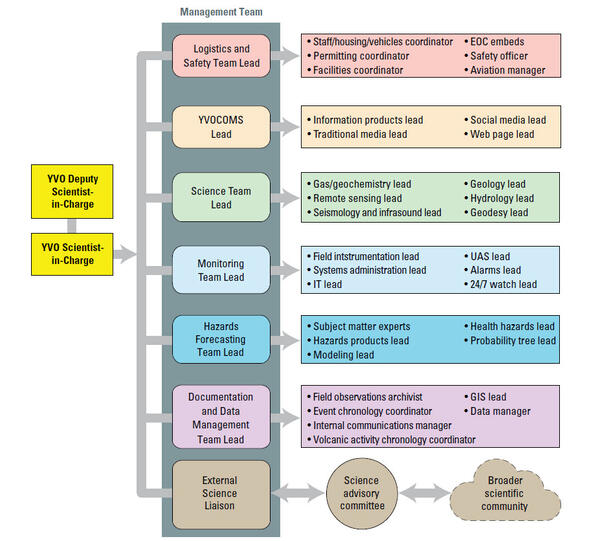
organizational chart with different hierarchies, and each branch with a specific response function
Organizational chart for the Yellowstone Volcano Observatory in the event of a response to a geological hazard

Organization chart giving the structure of a response by the Yellowstone Volcano Observatory to a significant episode of unrest or eruption at the Yellowstone volcanic system. The strategy is scalable (elements are activated as they are needed and deactivated when they are no longer needed) and can be adapted to meet the needs of the event response.

Organization chart giving the structure of a response by the Yellowstone Volcano Observatory to a significant episode of unrest or eruption at the Yellowstone volcanic system. The strategy is scalable (elements are activated as they are needed and deactivated when they are no longer needed) and can be adapted to meet the needs of the event response.

Photo and cartoon of 1959 Hebgen Lake earthquake deposit in Henrys Lake (ID) sediment core, along with Cesium-137 levels

Photo and cartoon of 1959 Hebgen Lake earthquake deposit in sediment core from Henrys Lake, Idaho, with references to Cesium-137 activity (or concentration). Changes in Cesium-137 are related to atmospheric nuclear tests and provide a means of dating the deposit; those measurements are plotted on the right with depth (in cm) of the core.

Photo and cartoon of 1959 Hebgen Lake earthquake deposit in sediment core from Henrys Lake, Idaho, with references to Cesium-137 activity (or concentration). Changes in Cesium-137 are related to atmospheric nuclear tests and provide a means of dating the deposit; those measurements are plotted on the right with depth (in cm) of the core.

Photoscans and computed tomography of sediment cores from Henrys Lake, Idaho

Transect of sediment cores from Henrys Lake, Idaho. (a) High‐resolution photoscans and computed tomography (CT) of each core correspond to the location tie line. White line on CT represents gamma ray attenuation bulk density (g/cc). Mapped facies are right of each correspondent core. Shades of gray represent background sedimentation and the event deposit by orange.

Transect of sediment cores from Henrys Lake, Idaho. (a) High‐resolution photoscans and computed tomography (CT) of each core correspond to the location tie line. White line on CT represents gamma ray attenuation bulk density (g/cc). Mapped facies are right of each correspondent core. Shades of gray represent background sedimentation and the event deposit by orange.

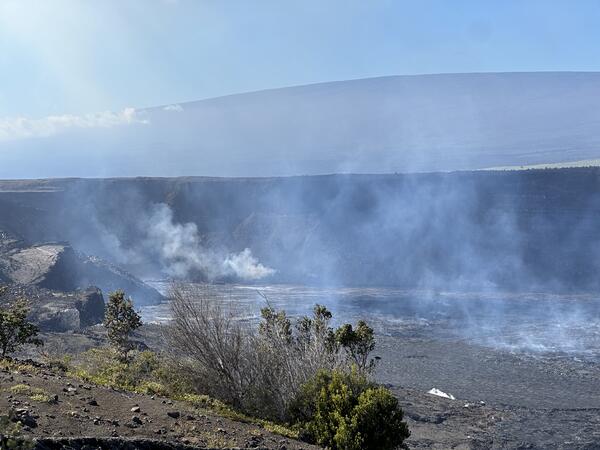
Hazy view of a crater wall with some vegetation in the foreground and a shield-shaped mountain in the background
Hazy conditions caused by sulfur dioxide emissions from Kīlauea, Hawai‘i

Hazy conditions caused by sulfur dioxide (SO2) emissions from Halema‘uma‘u crater, Kīlauea, Hawai‘i.  USGS photo by Jennifer Lewicki, December 25, 2024.

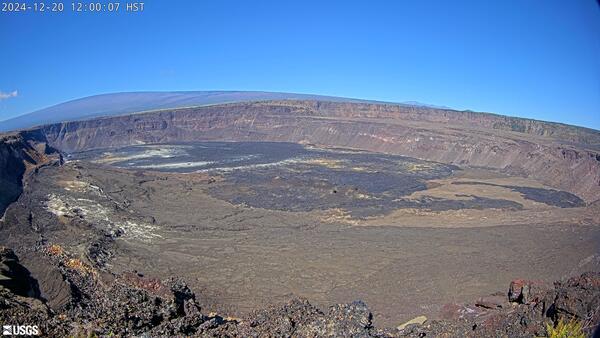
Desolate volcanic crater of gray/brown rick under a blue sky with a sloping mountain in the background
Kīlauea summit caldera from B1 camera on December 20, 2024

View of Kaluapele (Kīlauea's summit caldera) from the B1 webcam on December 20, 2024, just before the onset of the episodic lava fountaining eruption on December 23.

View of Kaluapele (Kīlauea's summit caldera) from the B1 webcam on December 20, 2024, just before the onset of the episodic lava fountaining eruption on December 23.

Three-panel figure showing scrubland vegetation (left), conifers (center), and lodgepole pines (right)
Modern vegetation on different geological substrates in Yellowstone

Modern vegetation on different geological substrates in Yellowstone.  Left: steppe/grassland on glacial clay found in places like Lamar and Hayden Valleys.  Center: Mixed conifer forest in the Absaroka andesite volcanic field in the eastern part of Yellowstone National Park.  Right: Lodgepole pine forest on Central Plateau rhyolite (hydrothermal grass

Modern vegetation on different geological substrates in Yellowstone.  Left: steppe/grassland on glacial clay found in places like Lamar and Hayden Valleys.  Center: Mixed conifer forest in the Absaroka andesite volcanic field in the eastern part of Yellowstone National Park.  Right: Lodgepole pine forest on Central Plateau rhyolite (hydrothermal grass

Vegetation history based on pollen records from three small lakes on different geological substrates in Yellowstone National
Vegetation history based on pollen records from three small lakes on different geological substrates in Yellowstone National Park

Vegetation history based on pollen records from three small lakes on different geological substrates in Yellowstone National Park.   Blue is open vegetation, light green is parkland, dark green is forest.  Top plot is from Slough Creek Pond, in a present grassland area dominated by glacial and lake sediment in the northeast part of Yellowstone Nationa

View of Mount Adams from a distance, scientists installing a monitoring station, and map where earthquakes have occurred.
Update on seismic activity at Mount Adams from September 2024 to early November 2024

Volcanoes tend to have seismicity that waxes and wanes over time. That’s considered normal and not necessarily a cause for concern. Let’s check on Mount Adams to see what USGS scientists are doing to learn more about its recent earthquake activity and what it could mean for this Cascade Range volcano.

Volcanoes tend to have seismicity that waxes and wanes over time. That’s considered normal and not necessarily a cause for concern. Let’s check on Mount Adams to see what USGS scientists are doing to learn more about its recent earthquake activity and what it could mean for this Cascade Range volcano.

Graphic showing how InSAR detects ground deformation

Graphic showing how InSAR detects ground deformation by measuring changes in the signal that bounces off the Earth. Figure by the EarthScope Consortium.

Bathymetric map of the West Thumb Basin, Yellowstone National Park

Bathymetric map of the West Thumb Basin showing numerous mapped active or inactive hydrothermal vent sites (small white circles) and sampled hot springs (white stars or larger white circles) and sediment cores (yellow diamonds).  The white-black line represents the 160,000-year-old West Thumb Caldera margin.  West Thumb Geyser Basin is near the southern en

Bathymetric map of the West Thumb Basin showing numerous mapped active or inactive hydrothermal vent sites (small white circles) and sampled hot springs (white stars or larger white circles) and sediment cores (yellow diamonds).  The white-black line represents the 160,000-year-old West Thumb Caldera margin.  West Thumb Geyser Basin is near the southern en

Plot showing frequency of rhyolite eruptions in the Yellowstone region over the past 1.3 million years
Schematic summary of rhyolite eruptions in the Yellowstone Plateau volcanic field over the past 1.3 million years

Schematic summary of rhyolite eruptions in the Yellowstone Plateau volcanic field over the past 1.3 million years. Smaller rhyolite eruptions are known intracaldera eruptions, meaning they occurred within existing caldera structures. Additional rhyolite eruptions that occurred outside the caldera are not included in the figure.

Schematic summary of rhyolite eruptions in the Yellowstone Plateau volcanic field over the past 1.3 million years. Smaller rhyolite eruptions are known intracaldera eruptions, meaning they occurred within existing caldera structures. Additional rhyolite eruptions that occurred outside the caldera are not included in the figure.

A brass-disk benchmark set in the top of a concrete post.  Mark is stamped "C9 1923 7337.580"
Benchmark C9, near Apollinaris Spring in Yellowstone National Park

Benchmark C9, installed by the US Coast and Geodetic Survey (now the National Geodetic Survey) in 1923 near Apollinaris Spring in Yellowstone National Park.  The number stamped into the mark, “7337.580,” is the elevation in feet that was determined by surveys the year the benchmark was established.  USGS photo by Michael Poland, September 4, 2024.

Benchmark C9, installed by the US Coast and Geodetic Survey (now the National Geodetic Survey) in 1923 near Apollinaris Spring in Yellowstone National Park.  The number stamped into the mark, “7337.580,” is the elevation in feet that was determined by surveys the year the benchmark was established.  USGS photo by Michael Poland, September 4, 2024.

Was this page helpful?