



Welcome to the Washington Water Science Center
Washington Water Science Center
The USGS Washington Water Science Center provides water resource information. You’ll find information about Washington’s rivers and streams, as well as groundwater, water quality, and cutting-edge water research. We welcome you to explore our data and scientific research.
Current Washington Water Conditions
Current Washington Water Conditions

Explore real-time Washington streamflow, groundwater, and water-quality conditions and access data with our new interactive map application.
View current water conditions
View current water conditions
Uncrewed Aviation Systems Program
Uncrewed Aviation Systems Program

Data collection provided by uncrewed aviation systems (UAS) enhances the Washington Water Science Center’s (WAWSC) ability to monitor dynamic environmental systems, respond to natural hazards, analyze the impacts of climate change, and assess landscape change.
News
Sediment contaminants in Puget Sound: Implications for ecosystem health and remediation
Sediment contaminants in Puget Sound: Implications for ecosystem health and remediation
Washington Waters Newsletter - Spring 2025
Washington Waters Newsletter - Spring 2025
New data products now available in StreamStats
New data products now available in StreamStats
Publications
Urban heterogeneity drives dissolved organic matter sources, transport, and transformation from local to macro scales Urban heterogeneity drives dissolved organic matter sources, transport, and transformation from local to macro scales
Urbanization reshapes dissolved organic matter (DOM) sources, transport, and transformations through changes in vegetation, hydrology, and management of waste and water. Yet the impacts of urbanization on DOM are variable within and among cities. Predicting heterogeneous responses to urbanization is challenged by diverse human activities and underlying biophysical variation along stream...
Refining PAH and PCB bioavailability predictions in industrial sediments using source-fingerprinting, particle size, and bulk carbon, Puget Sound, Washington Refining PAH and PCB bioavailability predictions in industrial sediments using source-fingerprinting, particle size, and bulk carbon, Puget Sound, Washington
Nearshore marine sediments in a Puget Sound, Washington industrial embayment had elevated levels of PAHs, PCBs and DDTs. Chemical fingerprints implicated nearshore sources including creosote, industrial oil and tar waste, and a landfill. Elevated concentrations were confined to an approximate 300-m shoreline buffer in the industrial waterfront, suggesting high site fidelity and limited...
Divergent trends in fluvial suspended-sediment concentrations following improved land-use practices, southwest Washington State Divergent trends in fluvial suspended-sediment concentrations following improved land-use practices, southwest Washington State
Improvements in logging practices since the mid-20th century are widely presumed to have reduced suspended sediment loads in streams across the Pacific Northwest. However, there have been few opportunities to directly assess this, particularly in larger rivers. We compare modern (2019–22) and historical (1960s) suspended sediment monitoring in three large, actively managed watersheds in...
Science
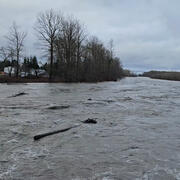
Testing non-contact discharge measurement methods in the Nooksack River
The Issue: The North Cedarville streamgage on the Nooksack River (USGS 12210700) is critical for flood monitoring and hazard assessments. However, making discharge measurements at high flows, which are necessary to maintain an accurate stage-discharge relation at this dynamic site, is complicated by transport of woody debris and difficulties detecting the bed using traditional acoustic doppler...
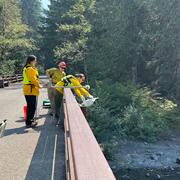
Bear Gulch Fire Water Quality Monitoring
The USGS is monitoring water quality in the North Fork Skokomish River following the Bear Gulch Fire that burned in summer 2025. USGS has over 100 years of data from this river. Streamflow data support water supply management and flood prediction. Post-fire data provides an important window into how watersheds are shaped by fire.
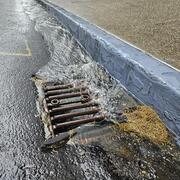
Integrating Stormwater Drainage into USGS StreamStats Application for the Duwamish and Lower Green River
The U.S. Geological Survey (USGS) is developing a Duwamish and Lower Green River Storm Drain StreamStats application to help communities and decision-makers address stormwater challenges in the Duwamish and lower Green River watershed. This free, publicly accessible tool will allow users to delineate stormwater drainage areas and calculate basin characteristics, supporting climate resiliency and...