



USGS scientist Eric Grossman demonstrates the water-quality instruments, used during the tribal canoe journeys, at the Swinomish Tribal Community Center.
Images
Below are images associated with the Washington Water Science Center's science and staff. Images appear according to the year they were taken. To search, type a keyword or select a year from the dropdown menu. Or, click through the pages using the arrows at the bottom of the page.
Filter Total Items: 241

Water Quality Demo
USGS scientist Eric Grossman demonstrates the water-quality instruments, used during the tribal canoe journeys, at the Swinomish Tribal Community Center.

Water Quality Demo
USGS scientist Eric Grossman demonstrates the water-quality instruments, used during the tribal canoe journeys, at the Swinomish Tribal Community Center.
USGS scientist Eric Grossman demonstrates the water-quality instruments, used during the tribal canoe journeys, at the Swinomish Tribal Community Center.

KOMO-TV Truck
KOMO-TV (ABC, Seattle) satellite truck parked near the beach at the Swinomish Tribal Community Center
KOMO-TV (ABC, Seattle) satellite truck parked near the beach at the Swinomish Tribal Community Center

Water Quality Demo
USGS scientist Eric Grossman demonstrates the water-quality instruments, used during the tribal canoe journeys, at the Swinomish Tribal Community Center.
USGS scientist Eric Grossman demonstrates the water-quality instruments, used during the tribal canoe journeys, at the Swinomish Tribal Community Center.

Water Quality Demo
USGS scientist Eric Grossman demonstrates the water-quality instruments, used during the tribal canoe journeys, at the Swinomish Tribal Community Center.
USGS scientist Eric Grossman demonstrates the water-quality instruments, used during the tribal canoe journeys, at the Swinomish Tribal Community Center.

Stormwater Runoff in Rapid City, SD
Stormwater runoff following a May 2008 storm event in the Arrowhead drainage basin in Rapid City, SD. Runoff from this drainage discharges into Rapid Creek. Stormwater runoff from urbanized lands is known to harm surface-water resources by increasing stream velocities, destroying natural habitat, and increasing pollutant loads in the receiving waters.
Stormwater runoff following a May 2008 storm event in the Arrowhead drainage basin in Rapid City, SD. Runoff from this drainage discharges into Rapid Creek. Stormwater runoff from urbanized lands is known to harm surface-water resources by increasing stream velocities, destroying natural habitat, and increasing pollutant loads in the receiving waters.
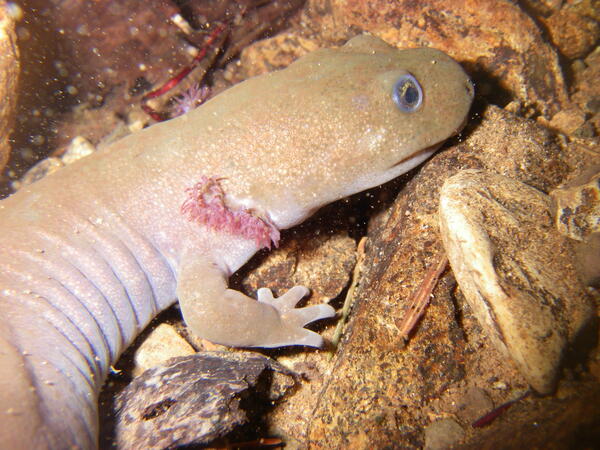
Salamander
A juvenile (neotone) salamander perches on a rock in a Pacific Northwest stream.
A juvenile (neotone) salamander perches on a rock in a Pacific Northwest stream.

Crest Gage Measurement of High Flows
Crest gages record high flows. In this case, pieces of cork floating in a tube record the highest level that water reached during a storm event. A technician records the level with a tape measure.
Crest gages record high flows. In this case, pieces of cork floating in a tube record the highest level that water reached during a storm event. A technician records the level with a tape measure.

Hydrologic Technician Prepares for High Flow Measurement from a Cableway
Hydrologic Technician Prepares for High Flow Measurement from a CablewayHigh flows and floods affected several Western Washington rivers in November 2006. This photo shows a hydrologic technician preparing to measure the Puyallup River near Orting, WA from a cableway.
Hydrologic Technician Prepares for High Flow Measurement from a Cableway
Hydrologic Technician Prepares for High Flow Measurement from a CablewayHigh flows and floods affected several Western Washington rivers in November 2006. This photo shows a hydrologic technician preparing to measure the Puyallup River near Orting, WA from a cableway.

High Flow Cableway Measurement
A USGS hydrologic technician adjusts equipment while preparing to make a measurement from a cableway. Cableways provide technicians with a way to safely measure fast-flowing rivers.
A USGS hydrologic technician adjusts equipment while preparing to make a measurement from a cableway. Cableways provide technicians with a way to safely measure fast-flowing rivers.

Large wood transported by flood waters
November 2006 recorded extensive flooding across Western Washington. High flows transported large amounts of sediment and large wood, as shown in this photograph taken near USGS streamgage 12093500.
November 2006 recorded extensive flooding across Western Washington. High flows transported large amounts of sediment and large wood, as shown in this photograph taken near USGS streamgage 12093500.

Flood waters erode riverbank
In November 2006, flooding damaged infrastructure alongside several rivers in Western Washington. This photograph shows where Puyallup River eroded parts of the riverbank near USGS streamgage 12092000.
In November 2006, flooding damaged infrastructure alongside several rivers in Western Washington. This photograph shows where Puyallup River eroded parts of the riverbank near USGS streamgage 12092000.

Measuring High Flows on the Puyallup River
High flows coursed through rivers in Western Washington in November 2006. USGS Hydrologic Technicians worked hard to measure the streamflow, using a variety of methods including cableway measurements which allow safe transport over high flowing water.
High flows coursed through rivers in Western Washington in November 2006. USGS Hydrologic Technicians worked hard to measure the streamflow, using a variety of methods including cableway measurements which allow safe transport over high flowing water.

Puyallup River Flood, 2006
In November 2006, the Puyallup River overtopped its banks in several locations, including near USGS streamgage 12096500. Flood waters carried sediment and large wood.
In November 2006, the Puyallup River overtopped its banks in several locations, including near USGS streamgage 12096500. Flood waters carried sediment and large wood.
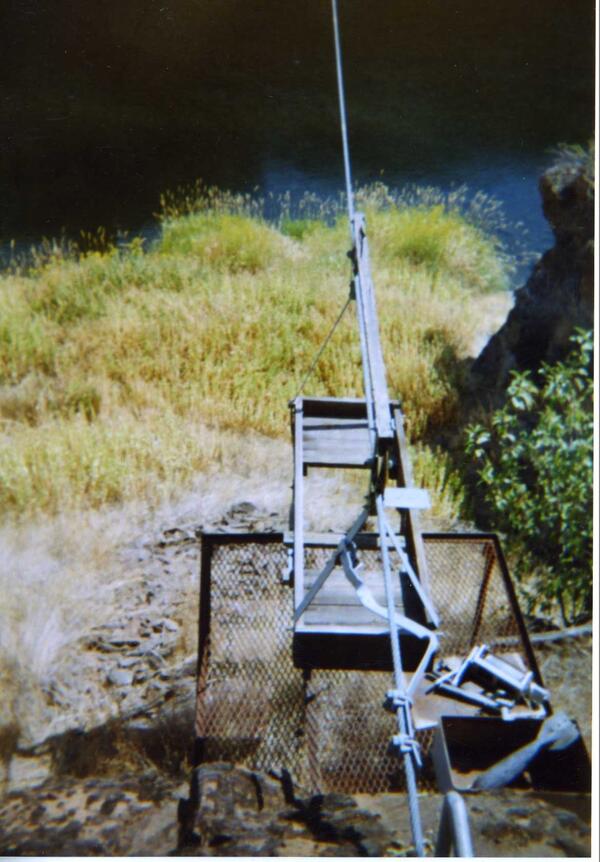
Historical cableway across NF John Day River, OR
Cableways allow USGS hydrologic technicians to cross fast-flowing and deep rivers to make measurements.
Cableways allow USGS hydrologic technicians to cross fast-flowing and deep rivers to make measurements.

Water quality sampling from a bridge
Hydrologic Technicians use bridge cranes and reels to collect water quality samples. Similar technology is still in use today.
Hydrologic Technicians use bridge cranes and reels to collect water quality samples. Similar technology is still in use today.

Columbia River Cableway
A cableway spanning the Columbia River allowed hydrologic technicians to traverse the steep basalt river banks. Pictured before the construction of Priest Rapids Dam, the cableway was located at USGS streamgage 12472800.
A cableway spanning the Columbia River allowed hydrologic technicians to traverse the steep basalt river banks. Pictured before the construction of Priest Rapids Dam, the cableway was located at USGS streamgage 12472800.

New Columbia River Cableway
Technicians installed a new cableway on the Columbia River below Priest Rapids Dam at USGS streamgage 12472800. Date unknown.
Technicians installed a new cableway on the Columbia River below Priest Rapids Dam at USGS streamgage 12472800. Date unknown.

Measuring a flood from cableway
USGS staff prepare to measure a flooding river from a cableway. The location is likely USGS streamgage 12472800 on the Columbia River below Priest Rapids Dam.
USGS staff prepare to measure a flooding river from a cableway. The location is likely USGS streamgage 12472800 on the Columbia River below Priest Rapids Dam.

Cableway measurement on Columbia River
The steep basalt banks of the Columbia River below Priest Rapids Dam at USGS streamgage 12472800 made for tricky streamflow measurements.
The steep basalt banks of the Columbia River below Priest Rapids Dam at USGS streamgage 12472800 made for tricky streamflow measurements.

Historical Gagehouse in Washington State
The USGS monitors streamflow in rivers across the nation year-round. Here, a technician makes notes at a gagehouse on a river in Washington State. The exact date and location are unknown.
The USGS monitors streamflow in rivers across the nation year-round. Here, a technician makes notes at a gagehouse on a river in Washington State. The exact date and location are unknown.