U.S. flag

An official website of the United States government

Images

A picture is worth a thousand words. Take a look at some images capturing science activities at the USGS Wetland and Aquatic Research Center. 

Filter Total Items: 212
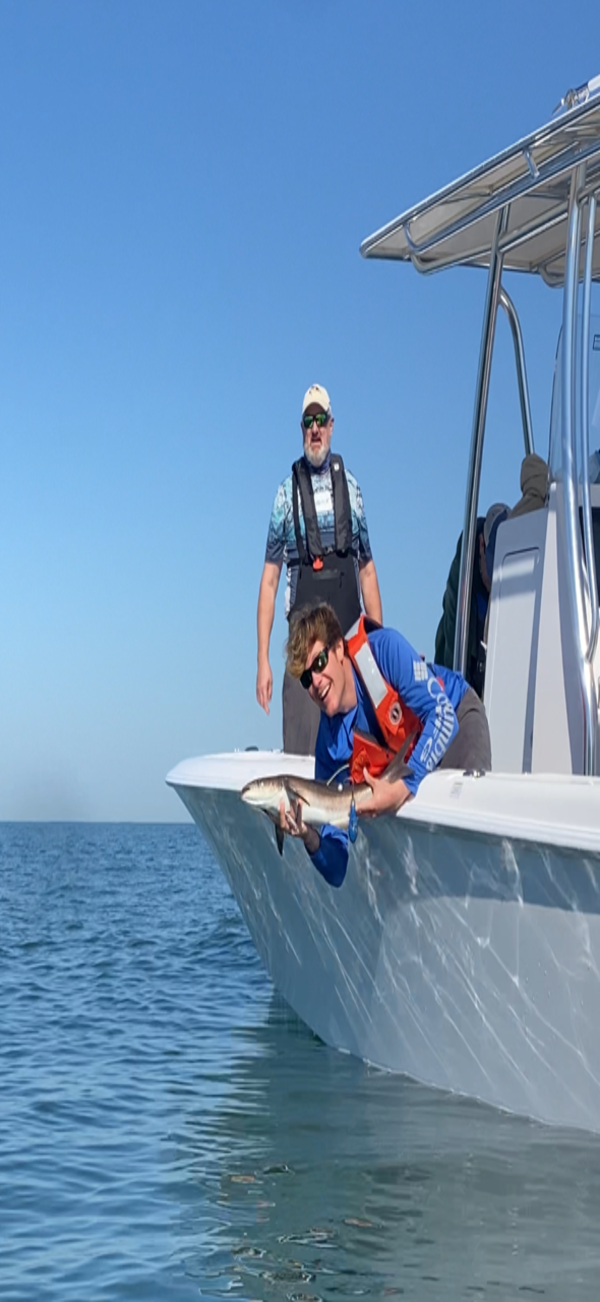
A person releases a fish off a boat while another person watches
USGS biologist Joseph Alday releases a tagged cobia off Naples, Florida with Steve Vanderkooy of the Gulf States Marine Fisheries Commission
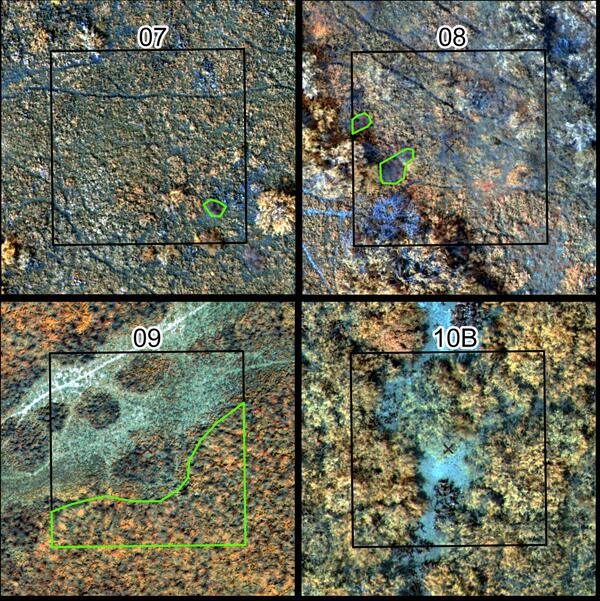
An Unoccupied Aerial System image of the Palo Alto Battlefield, TX.
Unoccupied Aerial Systems (UAS) imagery of four monitoring plots at Palo Alto Battlefield, Texas

High-resolution multispectral imagery collected in March 2024 by USGS of NPS vegetation monitoring plots at Palo Alto Battlefield in Brownsville, TX. The black boxes outline the sampling plot perimeter, and the green polygons outline patches of cordgrass (Spartina).

eight small test tubes in a row under a UV light, three on the left containing a glowing substance, purple background
Point-of-use assay for brown treesnake detection

Exposure with a UV-B light of CRISPR-Cas12a-processed samples after a reaction time of 30 minutes. Those that are illuminated are positive for brown treesnake DNA, those that are not illuminated contain negative controls (no brown treesnake DNA). Photo by Adam Perez (USGS).

Exposure with a UV-B light of CRISPR-Cas12a-processed samples after a reaction time of 30 minutes. Those that are illuminated are positive for brown treesnake DNA, those that are not illuminated contain negative controls (no brown treesnake DNA). Photo by Adam Perez (USGS).

Student holds an invasive swamp eel
Technician is holding an invasive swamp eel in Central Florida

Invasive swamp eel (Monopterus albus) collected in central Florida. Swamp eels are used as bait and in live food markets and have the potential to impact the ecology and economics of a waterbody. 

Invasive swamp eel (Monopterus albus) collected in central Florida. Swamp eels are used as bait and in live food markets and have the potential to impact the ecology and economics of a waterbody. 

A boat full of cold-stunned sea turtles bask in the hull of a USGS boat.
Almost 1,000 sea turtles returned to the wild after being saved from frigid water in Florida

A USGS boat holds dozens of endangered sea turtles recovered from St. Joseph Bay, Florida on January 24, 2025 in a coordinated effort to save over 1,000 turtles from a winter cold-stun event. (Dan Catizone, USGS)

A man in a USGS sweatshirt pulls a sled through sea grass by the ocean filled with sea turtles.
Almost 1,000 sea turtles returned to the wild after being saved from frigid water in Florida

U.S. Geological Survey biologist Dan Catizone pulls rescued endangered sea turtles along the shore of St. Joseph Bay, Florida, January 23, 2025 during a coordinated recovery event after water temperature drops made waters off of Florida's coast unsafe for the animals. (Samantha Snow, USGS)

U.S. Geological Survey biologist Dan Catizone pulls rescued endangered sea turtles along the shore of St. Joseph Bay, Florida, January 23, 2025 during a coordinated recovery event after water temperature drops made waters off of Florida's coast unsafe for the animals. (Samantha Snow, USGS)

A cold-stunned green sea turtle rests in shallow water.
Almost 1,000 sea turtles returned to the wild after being saved from frigid water in Florida
Three scientists hold one rescued sea turtle each in their hands on a beach.
Almost 1,000 sea turtles returned to the wild after being saved from frigid water in Florida

(From left) U.S. Geological Survey scientists Samantha Snow, Dan Catizone, and Meg Lamont each hold a sea turtle in advance of their release back into St. Joseph Bay, Florida on January 29, 2025. The three turtles were among the estimated 1,200 endangered sea turtles that were rescued from icy ocean water and beaches during a cold stun event January 21-26, 2025.

(From left) U.S. Geological Survey scientists Samantha Snow, Dan Catizone, and Meg Lamont each hold a sea turtle in advance of their release back into St. Joseph Bay, Florida on January 29, 2025. The three turtles were among the estimated 1,200 endangered sea turtles that were rescued from icy ocean water and beaches during a cold stun event January 21-26, 2025.

Whole blood smears from known diploid and triploid Grass Carp differ in both size and shape
Whole blood smears from known diploid and triploid Grass Carp

Whole blood smears from known diploid (A, C, E) and triploid (B, D, F) Grass Carp (Ctenopharyngodon idella) were stained with Diff Quik and imaged with a cell phone attached to a field microscope (A and B) or an Olympus microscope connected to a digital camera (C-F).  Polystyrene standard beads can be noted.  Total magnification was 600x with the

Whole blood smears from known diploid (A, C, E) and triploid (B, D, F) Grass Carp (Ctenopharyngodon idella) were stained with Diff Quik and imaged with a cell phone attached to a field microscope (A and B) or an Olympus microscope connected to a digital camera (C-F).  Polystyrene standard beads can be noted.  Total magnification was 600x with the

stylized wetland scene; water with a berm and wind cloud
Cover image for Elevation Gain | Wetland Loss

 Cover image for Elevation gain | Wetland loss animation. stylized water with a berm and wind cloud

Person holding mussels
handful of mussels
handful of mussels
handful of mussels

This is a photo of a USGS employee holding a handful of Fatmucket mussels at Columbia Environmental Research Center. These mussels will be used for reintroduction. 

This is a photo of a USGS employee holding a handful of Fatmucket mussels at Columbia Environmental Research Center. These mussels will be used for reintroduction. 

photograph tan loose ground with cactus and other desert plants under a partly cloudy blue sky
USGS scientists mapping vegetation and land use in Los Planes watershed, Baja California Sur, Mexico
A scientist loads a sea turtle into a crate for transporting.
USGS scientists coordinate the rescue of over 60 sea turtles in cold weather snap

U.S. Geological Survey Biologist Dan Catizone prepares a cold-stunned green sea turtle for transport to Gulf World Marine Institute near St. Joseph Bay, Florida January 23, 2024.

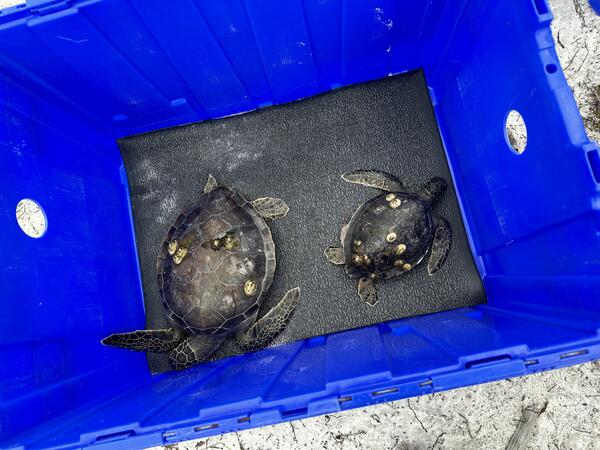
Two sea turtles in a crate for transporting.
USGS scientists coordinate the rescue of over 60 sea turtles in cold weather snap

Cold-stunned green sea turtles rescued from fatal water temperatures in St. Joseph Bay, Florida by U.S. Geological Survey staff members are held temporarily in a crate before being transferred to Gulf World Marine Institute for rehabilitation and medical treatment January 23, 2024. 

Cold-stunned green sea turtles rescued from fatal water temperatures in St. Joseph Bay, Florida by U.S. Geological Survey staff members are held temporarily in a crate before being transferred to Gulf World Marine Institute for rehabilitation and medical treatment January 23, 2024. 

A photo of a sea turtle in tall grass.
USGS scientists coordinate the rescue of over 60 sea turtles in cold weather snap

A cold-stunned green sea turtle near St. Joseph Bay, Florida moments before rescue by U.S. Geological Survey staff members January 23, 2024. The animals were pulled from fatal water temperatures off the coast of Florida and from beaches in a collaborative rescue event by the USGS, Florida Fish and Wildlife Conservation Commission, and the U.S.

A cold-stunned green sea turtle near St. Joseph Bay, Florida moments before rescue by U.S. Geological Survey staff members January 23, 2024. The animals were pulled from fatal water temperatures off the coast of Florida and from beaches in a collaborative rescue event by the USGS, Florida Fish and Wildlife Conservation Commission, and the U.S.

A scientist loads a sea turtle into a crate for transporting.
USGS scientists coordinate the rescue of over 60 sea turtles in cold weather snap

Margaret Lamont, a U.S. Geological Survey research biologist who has studied sea turtles for nearly 30 years, prepares a cold-stunned sea turtle for transport during a mass rescue event near St. Joseph Bay, Florida January 23, 2024. Water temperatures below 50 degrees Fahrenheit can be fatal to cold-blooded sea turtles, and about 60 were transported from St.

Margaret Lamont, a U.S. Geological Survey research biologist who has studied sea turtles for nearly 30 years, prepares a cold-stunned sea turtle for transport during a mass rescue event near St. Joseph Bay, Florida January 23, 2024. Water temperatures below 50 degrees Fahrenheit can be fatal to cold-blooded sea turtles, and about 60 were transported from St.

Photo of woman holding a sea turtle.
USGS scientists coordinate the rescue of over 60 sea turtles in cold weather snap

U.S. Geological Survey biologist Samantha Snow rescues a cold-stunned green sea turtle from the shores of St. Joseph Bay, Florida Jan. 23, 2024 during a recent cold weather event. About 60 sea turtles were transported from St. Joseph Bay to Gulf World Marine Institute for rehabilitation and medical treatment January 17-24, 2024. 

U.S. Geological Survey biologist Samantha Snow rescues a cold-stunned green sea turtle from the shores of St. Joseph Bay, Florida Jan. 23, 2024 during a recent cold weather event. About 60 sea turtles were transported from St. Joseph Bay to Gulf World Marine Institute for rehabilitation and medical treatment January 17-24, 2024. 

Vibrant UV light close-up image of a gloved hand holding a tray of glowing test samples.
New method to detect white-nose syndrome fungus in bats developed

A new test for white-nose syndrome-causing fungus in bats has been developed using a CRISPR biosensor. If white-nose syndrome-causing fungus is present, the reaction tube will glow under UV light.

A new test for white-nose syndrome-causing fungus in bats has been developed using a CRISPR biosensor. If white-nose syndrome-causing fungus is present, the reaction tube will glow under UV light.

Vibrant UV light close-up image of a tray of glowing test samples.
New method to detect white-nose syndrome fungus in bats developed

A new test for white-nose syndrome-causing fungus in bats has been developed using a CRISPR biosensor. If white-nose syndrome-causing fungus is present, the reaction tube will glow under UV light.

A new test for white-nose syndrome-causing fungus in bats has been developed using a CRISPR biosensor. If white-nose syndrome-causing fungus is present, the reaction tube will glow under UV light.

Was this page helpful?