



NASA's Mars rover Curiosity acquired this image using its Front Hazard Avoidance Camera (Front Hazcam) on Feb. 23, 2025 — sol 4462, or Martian day 4,462 of the Mars Science Laboratory mission — at 21:43:37 UTC.
Multimedia
Welcome to the Astrogeology Multimedia Gallery. Browse here for some of our available imagery, educational videos, and audios. We may get permission to use some non-USGS images and these should be marked and are subject to copyright laws. USGS Astrogeology images can be freely downloaded.
Images

Curiosirt Mars Rover Hazcam Image: Sol 4462
NASA's Mars rover Curiosity acquired this image using its Front Hazard Avoidance Camera (Front Hazcam) on Feb. 23, 2025 — sol 4462, or Martian day 4,462 of the Mars Science Laboratory mission — at 21:43:37 UTC.

Lunar Resources at Astrogeology
This picture of an astronaut investigating a rock on the Moon is on USGS circular 1507. The photo triggers the imagination of finding and taking advantage of resources on the Moon, to further space travel and/or work toward human goals to live beyond Earth.
This picture of an astronaut investigating a rock on the Moon is on USGS circular 1507. The photo triggers the imagination of finding and taking advantage of resources on the Moon, to further space travel and/or work toward human goals to live beyond Earth.

ResourcesCarousel.png
This picture of an astronaut investigating a rock on the Moon is on USGS circular 1507. The photo triggers the imagination of finding and taking advantage of resources on the Moon, to further space travel and/or work toward human goals to live beyond Earth.
This picture of an astronaut investigating a rock on the Moon is on USGS circular 1507. The photo triggers the imagination of finding and taking advantage of resources on the Moon, to further space travel and/or work toward human goals to live beyond Earth.

View from the floor of Meteor Crater, looking roughly to the east.
View from the floor of Meteor Crater, looking roughly to the east.Photograph taken from the floor of Meteor Crater, looking roughly east. The crater rim is visible running across the top of the image.
View from the floor of Meteor Crater, looking roughly to the east.
View from the floor of Meteor Crater, looking roughly to the east.Photograph taken from the floor of Meteor Crater, looking roughly east. The crater rim is visible running across the top of the image.
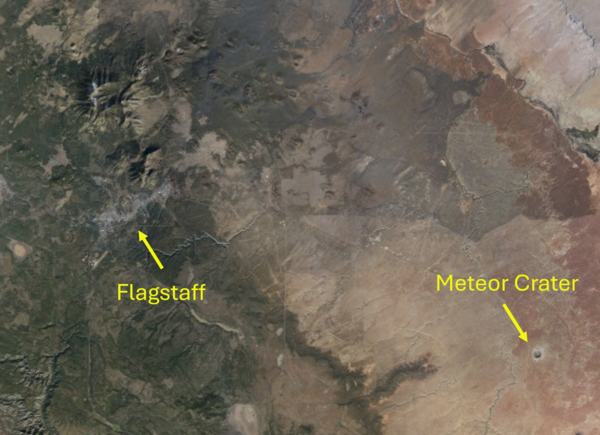
Flagstaff, Arizona and Meteor Crater
Aerial imagery showing the location of Flagstaff, Arizona and Meteor Crater. Arrows point to Flagstaff on the left and Meteor Crater on the right.
Aerial imagery showing the location of Flagstaff, Arizona and Meteor Crater. Arrows point to Flagstaff on the left and Meteor Crater on the right.

Meteor Crater drill cutting sample storage boxes
Small cardboard boxes that are used to store and archive drill cuttings from Meteor Crater.
Small cardboard boxes that are used to store and archive drill cuttings from Meteor Crater.
Videos

USGS Astrogeology - Planetary Defense (AD)
When most people think about asteroid impacts, they think of science fiction—Hollywood disasters and blockbuster movies. But asteroid impacts aren’t fiction. They’re a real part of Earth’s history—and a real hazard scientists study today.
When most people think about asteroid impacts, they think of science fiction—Hollywood disasters and blockbuster movies. But asteroid impacts aren’t fiction. They’re a real part of Earth’s history—and a real hazard scientists study today.
USGS Astrogeology Making Craters - Mare Tranquillitatis in Flagstaff Arizona (AD)
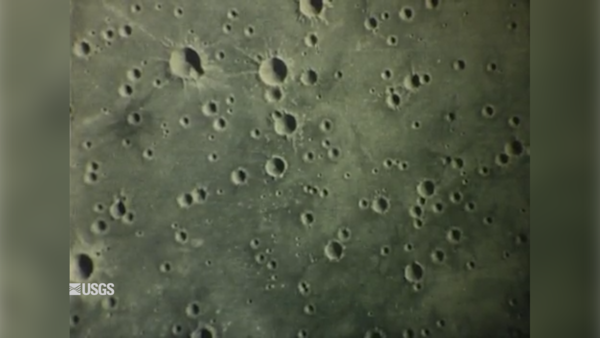
USGS Astrogeology Making Craters - Mare Tranquillitatis in Flagstaff Arizona (AD)The moon's Mare Tranquillitatis is an ancient plain of volcanic rock pocked with craters and coated with fine dust. In the 1960s, engineers and scientists in the U.S.
USGS Astrogeology Making Craters - Mare Tranquillitatis in Flagstaff Arizona (AD)
USGS Astrogeology Making Craters - Mare Tranquillitatis in Flagstaff Arizona (AD)The moon's Mare Tranquillitatis is an ancient plain of volcanic rock pocked with craters and coated with fine dust. In the 1960s, engineers and scientists in the U.S.
USGS Astrogeology Making Craters - Mare Tranquillitatis in Flagstaff Arizona
USGS Astrogeology Making Craters - Mare Tranquillitatis in Flagstaff ArizonaThe moon's Mare Tranquillitatis is an ancient plain of volcanic rock pocked with craters and coated with fine dust. In the 1960s, engineers and scientists in the U.S.
USGS Astrogeology Making Craters - Mare Tranquillitatis in Flagstaff Arizona
USGS Astrogeology Making Craters - Mare Tranquillitatis in Flagstaff ArizonaThe moon's Mare Tranquillitatis is an ancient plain of volcanic rock pocked with craters and coated with fine dust. In the 1960s, engineers and scientists in the U.S.
USGS Astrogeology - Planetary Defense
When most people think about asteroid impacts, they think of science fiction—Hollywood disasters and blockbuster movies. But asteroid impacts aren’t fiction. They’re a real part of Earth’s history—and a real hazard scientists study today.
When most people think about asteroid impacts, they think of science fiction—Hollywood disasters and blockbuster movies. But asteroid impacts aren’t fiction. They’re a real part of Earth’s history—and a real hazard scientists study today.

Creating and editing Geologic Units using the PGM Toolbox
Creating and editing Geologic Units using the PGM ToolboxIn this demonstration video, you will learn how to create and update geologic unit polygons using the PGM Toolbox Build Polygons tool. The PGM toolbox is online.
Creating and editing Geologic Units using the PGM Toolbox
Creating and editing Geologic Units using the PGM ToolboxIn this demonstration video, you will learn how to create and update geologic unit polygons using the PGM Toolbox Build Polygons tool. The PGM toolbox is online.

The disruption of two planets in a giant impact
Computer simulation of two planets undergoing a disruptive giant impact. Disruptive collisions are not expected to be common in Solar System formation and due to numerical effects, the amount of disruption shown here is likely overestimated. The larger (target) body is one tenth the mass of the Earth and the smaller (impactor) body is 70% the mass of the target.
Computer simulation of two planets undergoing a disruptive giant impact. Disruptive collisions are not expected to be common in Solar System formation and due to numerical effects, the amount of disruption shown here is likely overestimated. The larger (target) body is one tenth the mass of the Earth and the smaller (impactor) body is 70% the mass of the target.
Audio

Terrestrial Analog - Meet Lauren
I'm Lauren Edgar. I'm a research geologist at the USGS astrogeology Science Center here in Flagstaff AZ
I'm Lauren Edgar. I'm a research geologist at the USGS astrogeology Science Center here in Flagstaff AZ
Terrestrial Analog - Meet Kristen
My name is Kristen Bennett. I'm at the Astrogeology Science Center and I've been there since 2018.
My name is Kristen Bennett. I'm at the Astrogeology Science Center and I've been there since 2018.