



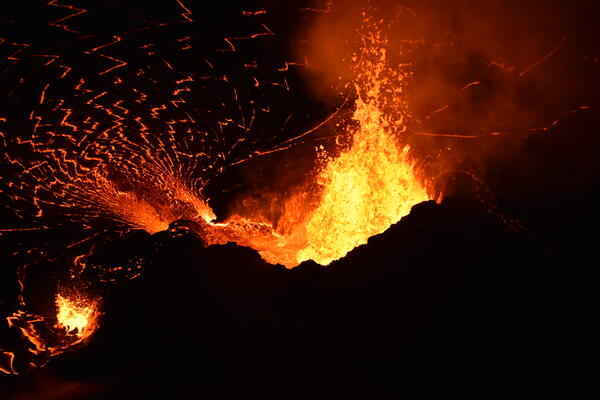
This overview photo of the Halema‘uma‘u lava lake was captured around noon on Friday, October 15, 2021, from the northwest rim of the crater. The western fissure (lower right) continues to erupt lava into the west side of the lava lake (right). The east side of the lake (left) is mostly stagnated and solidified on the surface.
Images
Explore our planet through photography and imagery, including climate change and water all the way back to the 1800s when the USGS was surveying the country by horse and buggy.
Filter Total Items: 21364

Kīlauea summit eruption - October 15, 2021
This overview photo of the Halema‘uma‘u lava lake was captured around noon on Friday, October 15, 2021, from the northwest rim of the crater. The western fissure (lower right) continues to erupt lava into the west side of the lava lake (right). The east side of the lake (left) is mostly stagnated and solidified on the surface.

Research Vessel Annie and Remotely Operated Vehicle Yogi
Research Vessel Annie and Remotely Operated Vehicle YogiResearch Vessel Annie and Remotely Operated Vehicle Yogi. a) R/V Annie on Yellowstone Lake operated by the Global Foundation for Ocean Exploration. Image Rob Harris, OSU. b) ROV Yogi with GFOE President Dave Lovalvo. Image Todd Gregory, GFOE. C) ROV Yogi and 1-m heat flow probe. This pr
Research Vessel Annie and Remotely Operated Vehicle Yogi
Research Vessel Annie and Remotely Operated Vehicle YogiResearch Vessel Annie and Remotely Operated Vehicle Yogi. a) R/V Annie on Yellowstone Lake operated by the Global Foundation for Ocean Exploration. Image Rob Harris, OSU. b) ROV Yogi with GFOE President Dave Lovalvo. Image Todd Gregory, GFOE. C) ROV Yogi and 1-m heat flow probe. This pr

Scientist collects data—Kīlauea eruption overflight—Oct. 15, 2021
Scientist collects data—Kīlauea eruption overflight—Oct. 15, 2021Hawaiian Volcano Observatory scientists make observations and collect data during Kīlauea eruption overflights. The data collected is used to construct updated topographic and thermal maps of the lava lake surface and surrounding area.
Scientist collects data—Kīlauea eruption overflight—Oct. 15, 2021
Scientist collects data—Kīlauea eruption overflight—Oct. 15, 2021Hawaiian Volcano Observatory scientists make observations and collect data during Kīlauea eruption overflights. The data collected is used to construct updated topographic and thermal maps of the lava lake surface and surrounding area.

West vent and lava lake islands—October 15, 2021
In this photo taken during a helicopter overflight of Halema‘uma‘u crater on October 15, lava can be seen fountaining within the western vent cone and flowing down a short spillway into the lava lake. The main island created in the initial stages of the Dec. 2020–May 2021 eruption is in the foreground and continues to rise with the lake surface.
In this photo taken during a helicopter overflight of Halema‘uma‘u crater on October 15, lava can be seen fountaining within the western vent cone and flowing down a short spillway into the lava lake. The main island created in the initial stages of the Dec. 2020–May 2021 eruption is in the foreground and continues to rise with the lake surface.

West vent in Halema‘uma‘u, Kīlauea summit eruption—Oct. 15 2021
West vent in Halema‘uma‘u, Kīlauea summit eruption—Oct. 15 2021A close-up view of the west vent on the western crater wall of Halema‘uma‘u, at Kīlauea summit. Fountaining and lava spatter has built a cone around the vent. Lava pools in the cone and then pours into the lava lake through a small spillway. This photo was taken during a monitoring helicopter overflight on October 15, 2021. USGS photo by N. Deligne.
West vent in Halema‘uma‘u, Kīlauea summit eruption—Oct. 15 2021
West vent in Halema‘uma‘u, Kīlauea summit eruption—Oct. 15 2021A close-up view of the west vent on the western crater wall of Halema‘uma‘u, at Kīlauea summit. Fountaining and lava spatter has built a cone around the vent. Lava pools in the cone and then pours into the lava lake through a small spillway. This photo was taken during a monitoring helicopter overflight on October 15, 2021. USGS photo by N. Deligne.

West vent in Halema‘uma‘u, Kīlauea summit eruption—Oct. 15 2021
West vent in Halema‘uma‘u, Kīlauea summit eruption—Oct. 15 2021A telephoto view of the west vent supplying lava to the lava lake in Halema‘uma‘u, at Kīlauea summit. In the bottom right, the western fissure complex from the Dec. 2020–May 2021 eruption is visible as a spiny dull dark brown and red feature.
West vent in Halema‘uma‘u, Kīlauea summit eruption—Oct. 15 2021
West vent in Halema‘uma‘u, Kīlauea summit eruption—Oct. 15 2021A telephoto view of the west vent supplying lava to the lava lake in Halema‘uma‘u, at Kīlauea summit. In the bottom right, the western fissure complex from the Dec. 2020–May 2021 eruption is visible as a spiny dull dark brown and red feature.

Yellowstone Lake map showing the location of the Deep Hole vent field
Yellowstone Lake map showing the location of the Deep Hole vent fieldYellowstone Lake bathymetry showing the location of the Deep Hole vent field. Inset shows locations of heat-flux measurements (red dots) in the Deep Hole vent field.
Yellowstone Lake map showing the location of the Deep Hole vent field
Yellowstone Lake map showing the location of the Deep Hole vent fieldYellowstone Lake bathymetry showing the location of the Deep Hole vent field. Inset shows locations of heat-flux measurements (red dots) in the Deep Hole vent field.

Kenna Grubb measuring on the Holston River
Photo Contest Winner | September 2021 | Honorable Mention 1
Kenna Grubb measuring on the Holston River
Photo Contest Winner | September 2021 | Honorable Mention 1
Kenna Grubb measuring on the Holston River

Lava fountaining at the west vent—October 14, 2021
Lava fountaining at the west vent—October 14, 2021A close-up photo of the vent in the western wall of Halema‘uma‘u, taken during the ongoing eruption at Kīlauea summit. The top of the 5–6 m (16–20 ft) tall lava fountain could be seen from the west crater rim on October 14, at 2:05 p.m. The lava fountains continue to build up a spatter cone around the vent.
Lava fountaining at the west vent—October 14, 2021
Lava fountaining at the west vent—October 14, 2021A close-up photo of the vent in the western wall of Halema‘uma‘u, taken during the ongoing eruption at Kīlauea summit. The top of the 5–6 m (16–20 ft) tall lava fountain could be seen from the west crater rim on October 14, at 2:05 p.m. The lava fountains continue to build up a spatter cone around the vent.

October 13, 2021 — Kīlauea summit eruption
A view of the western portion of the lava lake within Halema‘uma‘u, at the summit of Kīlauea. This photo, taken from the west crater rim, shows the active west vent (lower right), the main island (upper left), and the old west vent from the Dec. 2020–May 2021 eruption (lower left).
A view of the western portion of the lava lake within Halema‘uma‘u, at the summit of Kīlauea. This photo, taken from the west crater rim, shows the active west vent (lower right), the main island (upper left), and the old west vent from the Dec. 2020–May 2021 eruption (lower left).
Kīlauea summit eruption - October 12, 2021
Lava fountains from the western vent within Halema‘uma‘u continue to supply lava into the lava lake through a short spillway. Consistent fountain heights of 10–15 meters (30–50 ft) were interrupted by frequent larger busts of spatter exceeding the height of the cone (30 m or 100 ft). USGS photo taken by B. Carr on October 12, 2021.
Lava fountains from the western vent within Halema‘uma‘u continue to supply lava into the lava lake through a short spillway. Consistent fountain heights of 10–15 meters (30–50 ft) were interrupted by frequent larger busts of spatter exceeding the height of the cone (30 m or 100 ft). USGS photo taken by B. Carr on October 12, 2021.

Kīlauea summit eruption - October 12, 2021
A view of the fountaining at the west vent in Halema‘uma‘u crater, at the summit of Kīlauea. The photo was taken from the west rim, looking down upon the vent. Low fountaining and roiling within the cone supplied lava to the lake via a narrow spillway. Lava spreading out into the lake develops a zig-zag pattern in the surface crust. USGS photo by M.
A view of the fountaining at the west vent in Halema‘uma‘u crater, at the summit of Kīlauea. The photo was taken from the west rim, looking down upon the vent. Low fountaining and roiling within the cone supplied lava to the lake via a narrow spillway. Lava spreading out into the lake develops a zig-zag pattern in the surface crust. USGS photo by M.

Kīlauea summit eruption - October 12, 2021
A wide view of the ongoing eruption at Kīlauea summit, from the south rim of Halema‘uma‘u. A vent on the western crater wall (left) continues to supply lava to the active west half of the lava lake.
A wide view of the ongoing eruption at Kīlauea summit, from the south rim of Halema‘uma‘u. A vent on the western crater wall (left) continues to supply lava to the active west half of the lava lake.

Kīlauea summit eruption - October 12, 2021
Associated with an increase in fountaining activity at the main western vent in Halema‘uma‘u, a short-lived vent opened just to the north (right). Activity at this vent lasted about 10 hours with low-level fountaining about 3 meters (10 ft) high.
Associated with an increase in fountaining activity at the main western vent in Halema‘uma‘u, a short-lived vent opened just to the north (right). Activity at this vent lasted about 10 hours with low-level fountaining about 3 meters (10 ft) high.

October 11, 2021 — Kīlauea
This zoomed-in view of the western fissure within Halema‘uma‘u, at the summit of Kīlauea, was captured on October 11, 2021, through the lens of a laser rangefinder. A prominent horseshoe-shaped spatter cone, measured to be standing 28 m (92 ft) above the adjacent lava lake, surrounds a roiling lava pond which also hosts taller fountains at times.
This zoomed-in view of the western fissure within Halema‘uma‘u, at the summit of Kīlauea, was captured on October 11, 2021, through the lens of a laser rangefinder. A prominent horseshoe-shaped spatter cone, measured to be standing 28 m (92 ft) above the adjacent lava lake, surrounds a roiling lava pond which also hosts taller fountains at times.

October 11, 2021 — Kīlauea
This zoomed-in view of the northwest side of the main island within the Halema‘uma‘u lava lake shows a "rootless lava flow" (silver) that formed in the early stages of the eruption on September 29, 2021.
This zoomed-in view of the northwest side of the main island within the Halema‘uma‘u lava lake shows a "rootless lava flow" (silver) that formed in the early stages of the eruption on September 29, 2021.

October 10, 2021 — Kīlauea, Halema‘uma‘u lava lake at dusk
October 10, 2021 — Kīlauea, Halema‘uma‘u lava lake at duskLava fountaining activity continues from the western vent in Halema‘uma‘u, within Kīlauea summit caldera, viewed at dusk on October 10, 2021, from the west rim of the crater. Only the western half of the lake surface is active; the eastern half is covered by a cooling, solidified crust. USGS image by B. Carr.
October 10, 2021 — Kīlauea, Halema‘uma‘u lava lake at dusk
October 10, 2021 — Kīlauea, Halema‘uma‘u lava lake at duskLava fountaining activity continues from the western vent in Halema‘uma‘u, within Kīlauea summit caldera, viewed at dusk on October 10, 2021, from the west rim of the crater. Only the western half of the lake surface is active; the eastern half is covered by a cooling, solidified crust. USGS image by B. Carr.

October 10, 2021 — Kīlauea, lava fountaining in Halema‘uma‘u
October 10, 2021 — Kīlauea, lava fountaining in Halema‘uma‘uFountaining at the western vent in Halema‘uma‘u crater, at Kīlauea volcano's summit, was approximately 15 meters (50 feet) high on the evening of October 10, 2021. Spatter from the fountaining would occasionally land on the wall of the vent cone and cool (visible on the right).
October 10, 2021 — Kīlauea, lava fountaining in Halema‘uma‘u
October 10, 2021 — Kīlauea, lava fountaining in Halema‘uma‘uFountaining at the western vent in Halema‘uma‘u crater, at Kīlauea volcano's summit, was approximately 15 meters (50 feet) high on the evening of October 10, 2021. Spatter from the fountaining would occasionally land on the wall of the vent cone and cool (visible on the right).

October 9, 2021 — Kīlauea, summit eruptive vent
HVO scientists captured this zoomed-in photo of the western fissure within Halema‘uma‘u through the lens of a laser rangefinder on October 9, 2021. The fissure has formed a horseshoe-shaped spatter cone around its source, with an opening on the east (right) side allowing lava to flow into the active lava lake.
HVO scientists captured this zoomed-in photo of the western fissure within Halema‘uma‘u through the lens of a laser rangefinder on October 9, 2021. The fissure has formed a horseshoe-shaped spatter cone around its source, with an opening on the east (right) side allowing lava to flow into the active lava lake.

Economist coloring page
Natural Resource Economist coloring page.
By
Natural Resource Economist coloring page.
By

October 8, 2021 — Kīlauea summit eruption
In this overflight photo of the Halema‘uma‘u lava lake, captured on October 8, 2021 and looking from the northeast, two western fissures are visible: one inactive from the December 2020–May 2021 Kīlauea summit eruption (center), and another actively feeding lava into the lake at this time (upper-right).
In this overflight photo of the Halema‘uma‘u lava lake, captured on October 8, 2021 and looking from the northeast, two western fissures are visible: one inactive from the December 2020–May 2021 Kīlauea summit eruption (center), and another actively feeding lava into the lake at this time (upper-right).