
U.S. flag

An official website of the United States government

Energy Production Materials in the Environment

Filter Total Items: 33

Powering Progress: How Science Can Fuel the Energy Resources Life Cycle

Energy is essential to modern life, and accessing it involves a complex lifecycle, from resource discovery to extraction, use, and eventual remediation and reclamation. The USGS Ecosystems Mission Area supports this process by conducting research and providing scientific insights to guide decision-making at each stage. By collaborating with resource management agencies and stakeholders, we analyze...
Powering Progress: How Science Can Fuel the Energy Resources Life Cycle

Powering Progress: How Science Can Fuel the Energy Resources Life Cycle

Energy is essential to modern life, and accessing it involves a complex lifecycle, from resource discovery to extraction, use, and eventual remediation and reclamation. The USGS Ecosystems Mission Area supports this process by conducting research and providing scientific insights to guide decision-making at each stage. By collaborating with resource management agencies and stakeholders, we analyze...
Learn More

USGS Environmental Health Program: Integrating Science for Public Health and Resource Management

The USGS Environmental Health Program seeks to understand how environmental factors, especially contaminants and pathogens, influence human health and ecosystems. It focuses on studying the distribution and effects of toxic substances, environmental stressors, and their pathways. The program prioritizes collaboration with State, Federal and local governments; Tribes; non-government organizations...
USGS Environmental Health Program: Integrating Science for Public Health and Resource Management

USGS Environmental Health Program: Integrating Science for Public Health and Resource Management

The USGS Environmental Health Program seeks to understand how environmental factors, especially contaminants and pathogens, influence human health and ecosystems. It focuses on studying the distribution and effects of toxic substances, environmental stressors, and their pathways. The program prioritizes collaboration with State, Federal and local governments; Tribes; non-government organizations...
Learn More

Oil and Gas Wastewater Exposure Pathways: What We Know and What Remains Unanswered

Produced water is a complex waste byproduct from oil and gas development that can be repurposed for beneficial uses. Understanding its applications, how it moves through the environment, and its potential effects on human health is essential. USGS researchers, in collaboration with Health Effects Institute (HEI) Energy, reviewed and analyzed existing literature to identify knowledge gaps about...
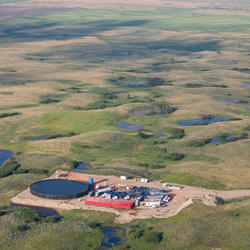
Oil and Gas Wastewater Exposure Pathways: What We Know and What Remains Unanswered

Oil and Gas Wastewater Exposure Pathways: What We Know and What Remains Unanswered

Produced water is a complex waste byproduct from oil and gas development that can be repurposed for beneficial uses. Understanding its applications, how it moves through the environment, and its potential effects on human health is essential. USGS researchers, in collaboration with Health Effects Institute (HEI) Energy, reviewed and analyzed existing literature to identify knowledge gaps about...
Learn More

Energy Resources Life Cycle Integrated Science Team

The Energy Resources Life Cycle Integrated Science Team focuses on the potential for environmental contaminant exposures that might originate from energy resource activities including extraction, production, transportation, storage, waste management, and restoration. Perceived health risks to humans and other organisms will be distinguished from actual risks, if any. If actual risks are identified...
Energy Resources Life Cycle Integrated Science Team

Energy Resources Life Cycle Integrated Science Team

The Energy Resources Life Cycle Integrated Science Team focuses on the potential for environmental contaminant exposures that might originate from energy resource activities including extraction, production, transportation, storage, waste management, and restoration. Perceived health risks to humans and other organisms will be distinguished from actual risks, if any. If actual risks are identified...
Learn More

Behavioral Toxicology Core Technology Team

About the Research. The Environmental Health Program supports scientists in the Behavioral Toxicology Core Technology Team (CTT) at the Columbia Environmental Research Center. The scientists identify how contaminants alter the behavior of organisms and what implication those changes may have on individuals, populations, and communities.
Behavioral Toxicology Core Technology Team

Behavioral Toxicology Core Technology Team

About the Research. The Environmental Health Program supports scientists in the Behavioral Toxicology Core Technology Team (CTT) at the Columbia Environmental Research Center. The scientists identify how contaminants alter the behavior of organisms and what implication those changes may have on individuals, populations, and communities.
Learn More

Microbial Biogeochemistry Core Technology Team

About the Research The Microbial Biogeochemistry Laboratory Core Technology Team (CTT) as part of the Environmental Health Program focuses on environmental questions in aquatic systems (sediment and water) involving the linkages between major biogeochemical cycles (those involving carbon, sulfur, iron and nitrogen) and those associated with contaminants of concern.
Microbial Biogeochemistry Core Technology Team

Microbial Biogeochemistry Core Technology Team

About the Research The Microbial Biogeochemistry Laboratory Core Technology Team (CTT) as part of the Environmental Health Program focuses on environmental questions in aquatic systems (sediment and water) involving the linkages between major biogeochemical cycles (those involving carbon, sulfur, iron and nitrogen) and those associated with contaminants of concern.
Learn More

Hydrogeophysics Core Technology Team

About the Research. The Hydrogeophysics Core Technology Team (CTT) as part of the Environmental Health Program specializes in locating and quantifying exchanges of groundwater and surface water, along with characterizing geologic structure and mapping hydrologic connectivity across varied landscapes.
Hydrogeophysics Core Technology Team

Hydrogeophysics Core Technology Team

About the Research. The Hydrogeophysics Core Technology Team (CTT) as part of the Environmental Health Program specializes in locating and quantifying exchanges of groundwater and surface water, along with characterizing geologic structure and mapping hydrologic connectivity across varied landscapes.
Learn More

Geospatial Analyses and Applications Core Technology Team

About the Research The Geospatial Analyses and Applications Core Technology Team (CTT) as part of the Environmental Health Program collaborates with teams across USGS to develop and apply geospatial analytical methods to answer broad-scale questions about source-sink and cause-effect relationships between contaminants and vulnerable communities.
Geospatial Analyses and Applications Core Technology Team

Geospatial Analyses and Applications Core Technology Team

About the Research The Geospatial Analyses and Applications Core Technology Team (CTT) as part of the Environmental Health Program collaborates with teams across USGS to develop and apply geospatial analytical methods to answer broad-scale questions about source-sink and cause-effect relationships between contaminants and vulnerable communities.
Learn More

Framework for Examining Stream Ecosystem Health in Areas of Shale Gas Development—A Multi-Parameter Watershed-Based Case Study in Pennsylvania

In a case study of 25 headwater streams in Pennsylvania, no statistically significant associations were determined between shale gas development and geochemical tracers of produced waters or measures of microbial and macroinvertebrate community composition. Although the results are specific to the region studied, the integrated biological and geochemical framework provides a tool for examining...
Framework for Examining Stream Ecosystem Health in Areas of Shale Gas Development—A Multi-Parameter Watershed-Based Case Study in Pennsylvania

Framework for Examining Stream Ecosystem Health in Areas of Shale Gas Development—A Multi-Parameter Watershed-Based Case Study in Pennsylvania

In a case study of 25 headwater streams in Pennsylvania, no statistically significant associations were determined between shale gas development and geochemical tracers of produced waters or measures of microbial and macroinvertebrate community composition. Although the results are specific to the region studied, the integrated biological and geochemical framework provides a tool for examining...
Learn More

Amphibians Exposed to Oil and Gas Co-Produced Wastewaters: Differentiating the Actual and the Perceived Inorganic Contaminant Hazards — Prairie Pothole Region

Chloride and metals in oil and gas co-produced wastewaters (often referred to as brines) are commonly perceived as contaminant hazards for biota. Amphibian abundance in the Prairie Pothole Region affected by historic oil and gas co-produced wastewaters was lower in wetlands with high concentrations of chloride indicating an actual contaminant hazard. Metals detected in sediments and amphibian...
Amphibians Exposed to Oil and Gas Co-Produced Wastewaters: Differentiating the Actual and the Perceived Inorganic Contaminant Hazards — Prairie Pothole Region

Amphibians Exposed to Oil and Gas Co-Produced Wastewaters: Differentiating the Actual and the Perceived Inorganic Contaminant Hazards — Prairie Pothole Region

Chloride and metals in oil and gas co-produced wastewaters (often referred to as brines) are commonly perceived as contaminant hazards for biota. Amphibian abundance in the Prairie Pothole Region affected by historic oil and gas co-produced wastewaters was lower in wetlands with high concentrations of chloride indicating an actual contaminant hazard. Metals detected in sediments and amphibian...
Learn More

Variability in Composition of an Oil Spill after more than 30 Years of Natural Attenuation

More than thirty years after an oil spill, hydrocarbons measured in groundwater near Bemidji, Minnesota, have been depleted between 25 and 85 percent. However, some components have remained for many decades and some are expected to remain longer indicating that natural attenuation is an effective but slow process. Compounds that are sufficiently soluble and resistant to biodegradation provide a...
Variability in Composition of an Oil Spill after more than 30 Years of Natural Attenuation

Variability in Composition of an Oil Spill after more than 30 Years of Natural Attenuation

More than thirty years after an oil spill, hydrocarbons measured in groundwater near Bemidji, Minnesota, have been depleted between 25 and 85 percent. However, some components have remained for many decades and some are expected to remain longer indicating that natural attenuation is an effective but slow process. Compounds that are sufficiently soluble and resistant to biodegradation provide a...
Learn More

Can There be Unintended Benefits when Wastewater Treatment Infrastructure is Upgraded?

Science from the U.S. Geological Survey (USGS) and other entities has shown that a mixture of natural and synthetic estrogens and other similar chemicals are discharged from wastewater treatment plants (WWTPs) to streams and rivers.
Can There be Unintended Benefits when Wastewater Treatment Infrastructure is Upgraded?

Can There be Unintended Benefits when Wastewater Treatment Infrastructure is Upgraded?

Science from the U.S. Geological Survey (USGS) and other entities has shown that a mixture of natural and synthetic estrogens and other similar chemicals are discharged from wastewater treatment plants (WWTPs) to streams and rivers.
Learn More
Was this page helpful?