U.S. flag

An official website of the United States government

Images

Images of Yellowstone.

Filter Total Items: 687
Photo of the Roosevelt Arch at the north entrance of Yellowstone National Park at night with comet NEOWISE in the background
Comet NEOWISE and the Roosevelt Arch at Yellowstone National Park

Comet NEOWISE is seen with the Roosevelt Arch in the foreground at the north Entrance of Yellowstone National Park.  The town of Gardiner, Montana, is in the background.

150 year Comparison of Giant and Castle Geysers, Yellowstone

Comparison of photos from Giant and Castle Geysers separated by almost 150 years. These images suggest almost no changes to the geyser structure implying that large geysers form over thousands of years. 

Comparison of photos from Giant and Castle Geysers separated by almost 150 years. These images suggest almost no changes to the geyser structure implying that large geysers form over thousands of years. 

Panorama of Hayden Valley, Yellowstone National Park

Panoramic photo of Hayden Valley looking east toward the Yellowstone River from the Mary Mountain trail.

Violet Creek in Hayden Valley, Yellowstone National Park
Photo of volcaniclastic units of the Absaroka volcanic province in northeastern Yellowstone National Park

Photo of geologic units of the Absaroka volcanic province in northeastern Yellowstone National Park that shows volcaniclastic sandstones grading up into a conglomerate, followed by another sequence of sandstone to conglomerate. These repeating layers of the same-looking material make it difficult to assign them to a specific volcanic group.

Photo of geologic units of the Absaroka volcanic province in northeastern Yellowstone National Park that shows volcaniclastic sandstones grading up into a conglomerate, followed by another sequence of sandstone to conglomerate. These repeating layers of the same-looking material make it difficult to assign them to a specific volcanic group.

Absaroka Mountains in northeastern Yellowstone National Park

A view into the Absaroka Mountains in northeastern Yellowstone National Park. While the Absarokas of today look a little different due to glacial activity, these are the same mountains that existed over the last 53 million years, well before the arrival of the Yellowstone hot spot.

A view into the Absaroka Mountains in northeastern Yellowstone National Park. While the Absarokas of today look a little different due to glacial activity, these are the same mountains that existed over the last 53 million years, well before the arrival of the Yellowstone hot spot.

Map and stratigraphy of ashflow sheets from Yellowstone Hotspot

Newly identified ash flow sheets within the Yellowstone–Snake River Plain volcanic province (Y-SRP).  The small inset in the center shows the track of the Yellowstone hotspot and its associated eruptive centers in light gray (M—McDermitt; OH—Owyhee-Humboldt; BJ—Bruneau-Jarbidge; TF—Twin Falls; P—Picabo; H—Heise; Y—Yellowstone).

Newly identified ash flow sheets within the Yellowstone–Snake River Plain volcanic province (Y-SRP).  The small inset in the center shows the track of the Yellowstone hotspot and its associated eruptive centers in light gray (M—McDermitt; OH—Owyhee-Humboldt; BJ—Bruneau-Jarbidge; TF—Twin Falls; P—Picabo; H—Heise; Y—Yellowstone).

Geologists from Montana State University study an outcrop of diorite.
Geologists from Montana State University study an outcrop of diorite

Geologists from Montana State University study an outcrop of diorite (a silicic igneous rock that cooled slowly beneath the ground). An outcrop of this size is important because it is easier to see any structural relations along with rock composition.

Geologists from Montana State University study an outcrop of diorite (a silicic igneous rock that cooled slowly beneath the ground). An outcrop of this size is important because it is easier to see any structural relations along with rock composition.

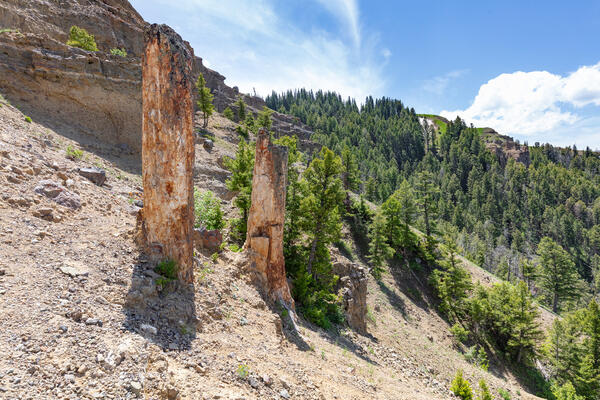
Petrified trees on Specimen Ridge, Yellowstone National Park
Simplified Geologic Map of Yellowstone National Park

Simplified Geologic Map of Yellowstone, modified from USGS I-711 by Marli Miller, University of Oregon. All rock material resulting from the major caldera-forming eruptions are labelled at Qt, where the dashed caldera boundary highlights the scale of these events. Older volcanic, sedimentary and metamorphic rocks are found outside of this boundary.

Simplified Geologic Map of Yellowstone, modified from USGS I-711 by Marli Miller, University of Oregon. All rock material resulting from the major caldera-forming eruptions are labelled at Qt, where the dashed caldera boundary highlights the scale of these events. Older volcanic, sedimentary and metamorphic rocks are found outside of this boundary.

Screen captures of the WGS digital mapping service Yellowstone

Geology of Yellowstone Map zoomed into the Lower Geyser Basin. This view shows a park-wide geologic map overlaid on a shaded relief layer from a digital elevation model. Red diamonds and black circles show geysers and gas sample locations, respectively.

Geology of Yellowstone Map zoomed into the Lower Geyser Basin. This view shows a park-wide geologic map overlaid on a shaded relief layer from a digital elevation model. Red diamonds and black circles show geysers and gas sample locations, respectively.

Screen captures of the WGS digital mapping service Yellowstone

A Light Detection and Ranging (LiDAR) shaded relief image overlaid on an aerial imagery basemap. The Sulphur Hills, part of the Sour Creek Resurgent Dome, are visible in the upper half of the image, while the floodplain and meanders of Pelican Creek are visible at the bottom.

A Light Detection and Ranging (LiDAR) shaded relief image overlaid on an aerial imagery basemap. The Sulphur Hills, part of the Sour Creek Resurgent Dome, are visible in the upper half of the image, while the floodplain and meanders of Pelican Creek are visible at the bottom.

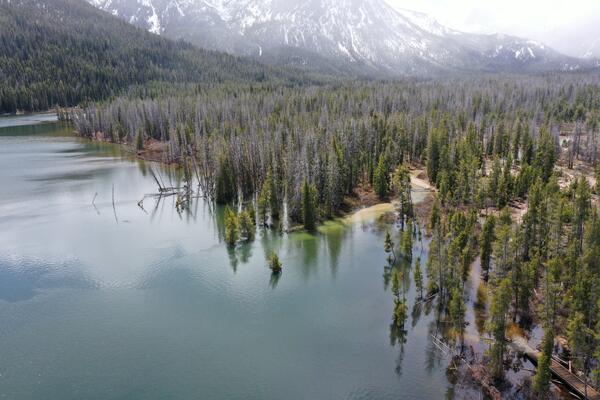
Lake shore with some submerged trees.  Mountains in the background.
Submerged trees at the inlet delta of Stanley Lake, Idaho, due to March 31, 2020, earthquake

Submerged trees at the inlet delta of Stanley Lake, Idaho. Liquefaction during shaking from the March 31, 2020, Stanley earthquake caused ground subsidence and collapse of the delta. Photo by Zach Lifton, Idaho Geological Survey, May 2020.

Grand Prismatic Spring in Midway Geyser Basin Yellowstone
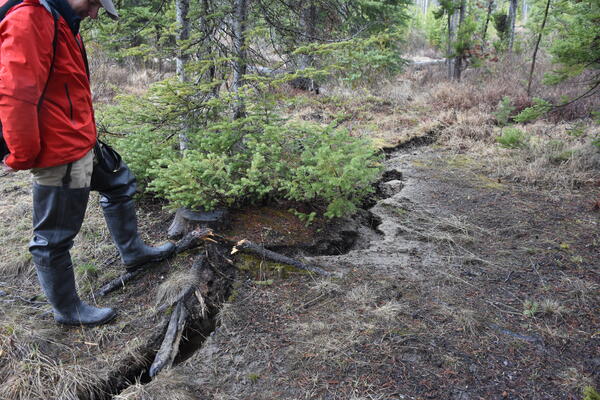
A person stands next to a ground fissure, several feet long and a few inches wide, in a forested area
Ground fissure along the shore of Stanley Lake, Idaho, resulting from March 31, 2020, earthquake

Ground fissure along the shore of Stanley Lake, Idaho, cause by liquefaction during shaking from the March 31, 2020, Stanley earthquake. Photo by Zach Lifton, Idaho Geological Survey, May 2020.

relationship between isotopes in hydrothermal gases from Yellowstone and Iceland
Hydrothermal isotopes from Yellowstone and Iceland

The relationship between Δ30 and N2/3He ratios in hydrothermal gases from Iceland and Yellowstone. Δ30 and N2/3He ratios are shown for samples collected from gases in Iceland (yellow circles) and Yellowstone (red circles). The Yellowstone mantle-endmember is arguably indistinguishable in terms of N2/3He from the convecting upper mantle (grey diamonds).

The relationship between Δ30 and N2/3He ratios in hydrothermal gases from Iceland and Yellowstone. Δ30 and N2/3He ratios are shown for samples collected from gases in Iceland (yellow circles) and Yellowstone (red circles). The Yellowstone mantle-endmember is arguably indistinguishable in terms of N2/3He from the convecting upper mantle (grey diamonds).

Was this page helpful?