



Sediment Cores from Wildcat Lake, California
By Ecosystems Land Change Science Program
November 2021 (approx.)


Detailed Description
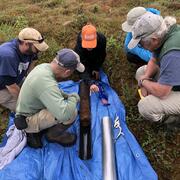
After many days of coring, eight meters of lake sediment were obtained from Wildcat Lake by a group of scientists including Clarke Knight and Marie Champagne (left to right). (Photo Credit: Lysanna Anderson)
Sources/Usage
Public Domain.
Related
Paleoscience for Partners: Reconstructing the Past to Prepare for the Future
Scientists from the USGS Ecosystems Land Change Science Program are at the forefront of unraveling mysteries of the past to help partners prepare for future environmental conditions.

Drivers and Impacts of North Pacific Climate Variability
Climate model forecasts indicate an increase in extreme hydrologic events, including floods and droughts, for California and the western U.S. in the future. To better understand what the consequences of this future change in climate may be, USGS scientists are studying the frequency, magnitude, and impacts of past hydroclimate variability and extremes in the region. This project produces well...
Related
Paleoscience for Partners: Reconstructing the Past to Prepare for the Future
Scientists from the USGS Ecosystems Land Change Science Program are at the forefront of unraveling mysteries of the past to help partners prepare for future environmental conditions.
Drivers and Impacts of North Pacific Climate Variability
Climate model forecasts indicate an increase in extreme hydrologic events, including floods and droughts, for California and the western U.S. in the future. To better understand what the consequences of this future change in climate may be, USGS scientists are studying the frequency, magnitude, and impacts of past hydroclimate variability and extremes in the region. This project produces well...