



For a behavioral study of Crossarchus obscurus, the long-nosed cusimanse, in Tiwai Island Wildlife Sanctuary, Sierra Leone, West Africa, fishing nets were the most successful method of capturing an entire group of these mongooses, compared to baited live-traps and thatch fences (which channeled animals into live traps, and which were moderately successful).
Images
See our science through the images below.
Filter Total Items: 3543

Stringing Nets to Catch Mongooses
For a behavioral study of Crossarchus obscurus, the long-nosed cusimanse, in Tiwai Island Wildlife Sanctuary, Sierra Leone, West Africa, fishing nets were the most successful method of capturing an entire group of these mongooses, compared to baited live-traps and thatch fences (which channeled animals into live traps, and which were moderately successful).

Bird Migration Card - 1937
Image scan of a historical bird migration card.
Image scan of a historical bird migration card.

Bird Migration Card - 1933
Image scan of a historical bird migration card.
Image scan of a historical bird migration card.

Bird Migration Card - 1922
Image scan of a historical bird migration card.
Image scan of a historical bird migration card.

Historical Bird Migration Card
Image scan of a historical bird migration card (1904).
Image scan of a historical bird migration card (1904).

Historic photo by Nims on Stanton's Colorado River survey trip taken at Lees Ferry
Historic photo by Nims on Stanton's Colorado River survey trip taken at Lees FerryThis image was taken in 1889 by Nims on Stanton's Colorado River survey trip.
Historic photo by Nims on Stanton's Colorado River survey trip taken at Lees Ferry
Historic photo by Nims on Stanton's Colorado River survey trip taken at Lees FerryThis image was taken in 1889 by Nims on Stanton's Colorado River survey trip.
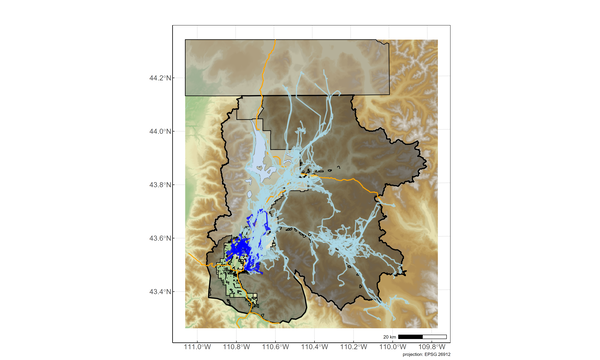
Jackson elk migrations near the National Elk Refuge
Jackson elk migrations near the National Elk RefugeJackson elk herd migrations around the National Elk Refuge are shown in dark blue (short-distant migrants) and light blue (long-distant migrants). Elk migrations cross federal, state, and public lands. The map was generated by the USGS using data from the USGS Data Release Kauffman and others, 2020.
Jackson elk migrations near the National Elk Refuge
Jackson elk migrations near the National Elk RefugeJackson elk herd migrations around the National Elk Refuge are shown in dark blue (short-distant migrants) and light blue (long-distant migrants). Elk migrations cross federal, state, and public lands. The map was generated by the USGS using data from the USGS Data Release Kauffman and others, 2020.

Smallmouth Bass
A curious smallmouth bass following behind scuba divers in Sparkling Lake, Vilas County, Wis.
A curious smallmouth bass following behind scuba divers in Sparkling Lake, Vilas County, Wis.

Red and Bonita Mine
Red and Bonita Mine located approximately .4 miles from the Gold King Mine.
Red and Bonita Mine located approximately .4 miles from the Gold King Mine.

Honey Bees Make Life Sweet
Honey bees live and work in highly collaborative, social colonies with a sole reproducing queen, and they make honey by storing nectar from flowering plants in their hives for use during food scarcities.
Honey bees live and work in highly collaborative, social colonies with a sole reproducing queen, and they make honey by storing nectar from flowering plants in their hives for use during food scarcities.

USGS Honey Bee Research
The USGS researches land use and honey bee health in the northern Great Plains. This research will be useful in equipping land managers and policy makers with the best-available science to improve forage and habitat for pollinators in a part of the country that is undergoing rapid land-use change.
The USGS researches land use and honey bee health in the northern Great Plains. This research will be useful in equipping land managers and policy makers with the best-available science to improve forage and habitat for pollinators in a part of the country that is undergoing rapid land-use change.

Eggs in Sparrow Nest
Clay-colored sparrow nest.

Bird Migration Cards
Volunteers Derek Smith (white shirt) and Reuben Anderson sort through migration cards in the Bird Phenology Program Office.
Volunteers Derek Smith (white shirt) and Reuben Anderson sort through migration cards in the Bird Phenology Program Office.

Black-Tailed Prairie Dog
Black-tailed prairie dogs are quite susceptible to sylvatic plague, but a new plague vaccine put in their food shows significant promise in the laboratory. The prairie dogs transmit the disease to endangered black-footed ferrets, who eat the prairie dogs and are also quite susceptible to the disease.
Black-tailed prairie dogs are quite susceptible to sylvatic plague, but a new plague vaccine put in their food shows significant promise in the laboratory. The prairie dogs transmit the disease to endangered black-footed ferrets, who eat the prairie dogs and are also quite susceptible to the disease.

Bats and Wind Energy
USGS biologist Paul Cryan examines the carcass of a hoary bat (Lasiurus cinereus) found beneath a wind turbine. By examining the casualties, biologists hope to learn more about why migratory bats are so susceptible to wind turbines.
USGS biologist Paul Cryan examines the carcass of a hoary bat (Lasiurus cinereus) found beneath a wind turbine. By examining the casualties, biologists hope to learn more about why migratory bats are so susceptible to wind turbines.

Beni Anaconda (Eunectes beniensis)
Beni or Bolivian Anaconda (Eunectes beniensis). Photo by Lutz Dirksen, www.anakondas.de. Used with permission.
Beni or Bolivian Anaconda (Eunectes beniensis). Photo by Lutz Dirksen, www.anakondas.de. Used with permission.

Southern African Python
Southern African Python (Python natalensis). The snake pictured is a representative of a species discussed in the USGS snake risk assessment. This snake was photographed in its native range.
Southern African Python (Python natalensis). The snake pictured is a representative of a species discussed in the USGS snake risk assessment. This snake was photographed in its native range.

Bat with Radio Transmitter
USGS biologist Paul Cryan releases a bat carrying a miniature radio transmitter. Researchers are increasingly turning to high-tech methods to try to learn more about the mysterious lives of bats.
USGS biologist Paul Cryan releases a bat carrying a miniature radio transmitter. Researchers are increasingly turning to high-tech methods to try to learn more about the mysterious lives of bats.

Dave Mech Following Wolves
Late in the evening, two wolves make use of the trail that leads to the head of the fiord. Studying wolves in the High Arctic allows scientists to follow the wolves during their travels, assuming the scientists can keep up. All-terrain vehicles are needed, and the 24-hour daylight at this time of year is critical.
Late in the evening, two wolves make use of the trail that leads to the head of the fiord. Studying wolves in the High Arctic allows scientists to follow the wolves during their travels, assuming the scientists can keep up. All-terrain vehicles are needed, and the 24-hour daylight at this time of year is critical.

Brutus the North Pole Wolf
USGS biologist Dave Mech has spent more than 20 summers studying Arctic wolves on Ellesmere Island, where they are unafraid of humans and can be observed at close range.
USGS biologist Dave Mech has spent more than 20 summers studying Arctic wolves on Ellesmere Island, where they are unafraid of humans and can be observed at close range.

Massachusetts inner continental shelf
Massachusetts inner continental shelf bottom photograph showing seafloor life.
Massachusetts inner continental shelf bottom photograph showing seafloor life.