



Bow Compass with Case. Also known as a Drop Bow Pen or Spring Bow, serial #760 C. This instrument was made by Eugene Dietzgen & Company, Chicago and New York and used by the U.S. Geological Survey Topographic Branch after 1945-1960s.
Object ID: USGS-000645
Images
Images
Filter Total Items: 96
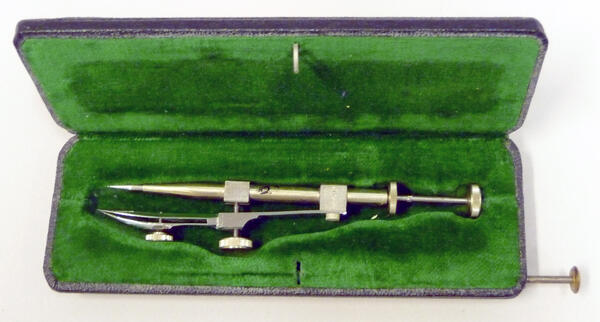
Bow Compass with Case
Bow Compass with Case. Also known as a Drop Bow Pen or Spring Bow, serial #760 C. This instrument was made by Eugene Dietzgen & Company, Chicago and New York and used by the U.S. Geological Survey Topographic Branch after 1945-1960s.
Object ID: USGS-000645

Surveying Compass with Leather Case
The cardinal points are lettered N, W, S and E, graduated to degrees and numbered every ten degrees to 360. The connecting sights fold away for storage. Manufactured by Keuffel & Esser, New York.
Object ID: USGS-000162
The cardinal points are lettered N, W, S and E, graduated to degrees and numbered every ten degrees to 360. The connecting sights fold away for storage. Manufactured by Keuffel & Esser, New York.
Object ID: USGS-000162
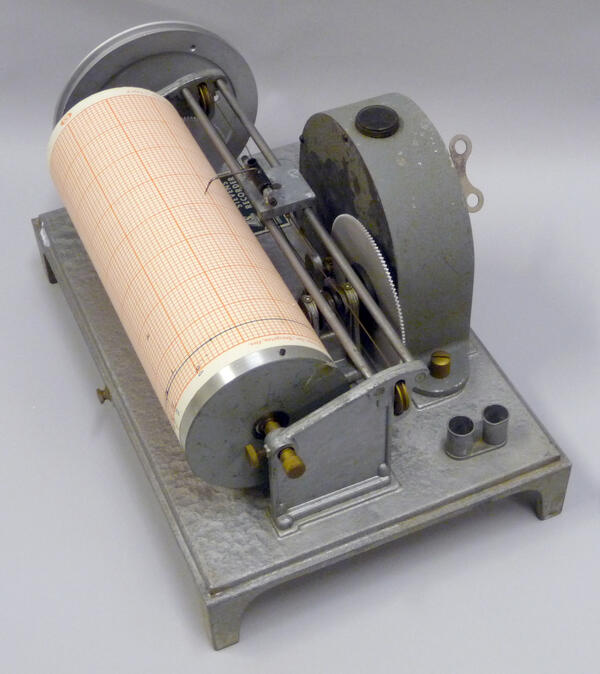
Stevens Type F Weekly Water Recorder
This drum recorder with a weekly paper chart was used to record the levels of water in ground water wells.
Object ID: USGS-000452
This drum recorder with a weekly paper chart was used to record the levels of water in ground water wells.
Object ID: USGS-000452
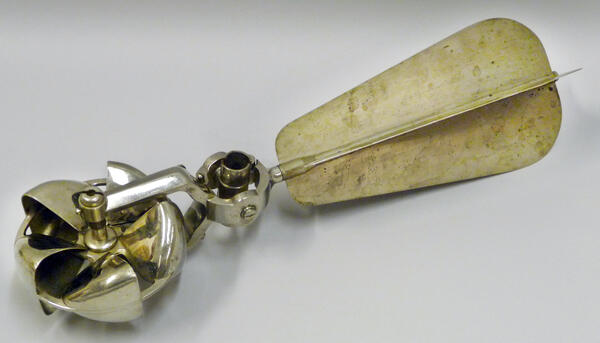
Price Current Meter
Developed in the early 1900s and modified many times prior to 1930. Purchased from the W. & L. E. Gurley Company, Troy, New York.
Object ID: USGS-000458
Developed in the early 1900s and modified many times prior to 1930. Purchased from the W. & L. E. Gurley Company, Troy, New York.
Object ID: USGS-000458
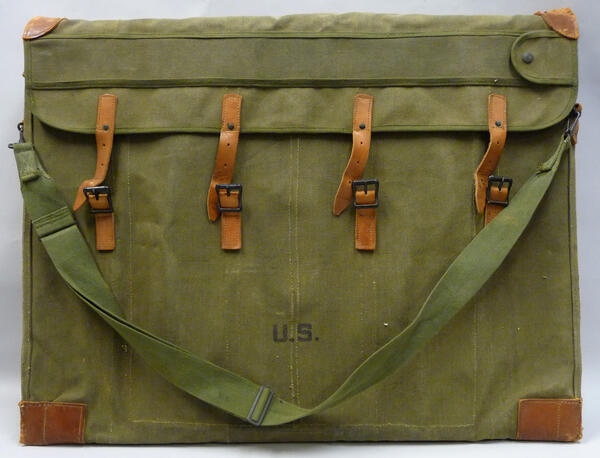
Drawing Board with Case
Drawing board with mount for a tripod. Used in field survey work. This is a particularly fine example in pristine condition.
Object ID: USGS-Temp47
Drawing board with mount for a tripod. Used in field survey work. This is a particularly fine example in pristine condition.
Object ID: USGS-Temp47
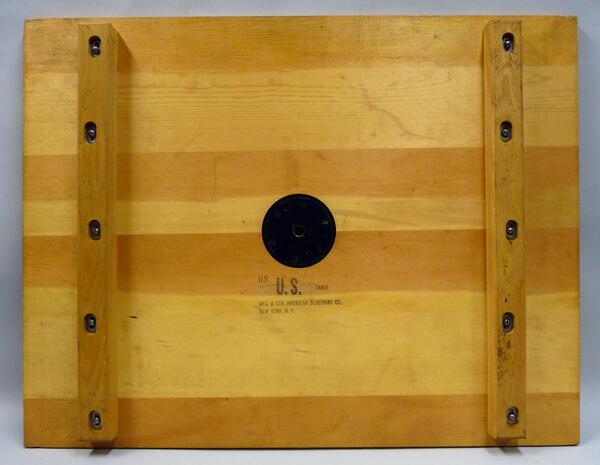
Drawing Board with Case
Drawing board with mount for a tripod. Used in field survey work. This is a particularly fine example in pristine condition.
Object ID: USGS-Temp47
Drawing board with mount for a tripod. Used in field survey work. This is a particularly fine example in pristine condition.
Object ID: USGS-Temp47
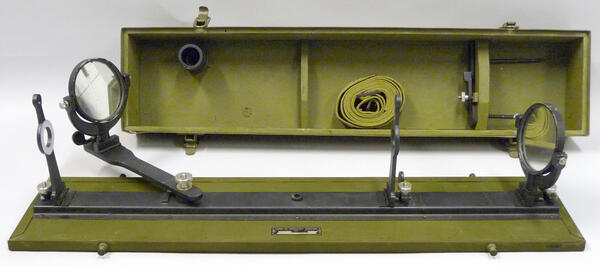
Heliotrope
Manufactured by American Instrument Company. Survey instrument to take measurements from the Sun.
Object ID: USGS-000471
Manufactured by American Instrument Company. Survey instrument to take measurements from the Sun.
Object ID: USGS-000471
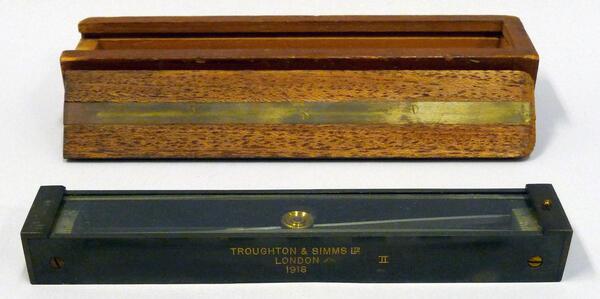
Trough Compass with Case, 1916
The storage case has a sliding lid. The compass is marked Troughton & Simms Ltd, London, 1916, No.9214. A trough compass is used with either a plane table or a theodolite. The needle is a long magnetized bar of steel which is pointed at both ends.
Object ID: USGS-000824
The storage case has a sliding lid. The compass is marked Troughton & Simms Ltd, London, 1916, No.9214. A trough compass is used with either a plane table or a theodolite. The needle is a long magnetized bar of steel which is pointed at both ends.
Object ID: USGS-000824
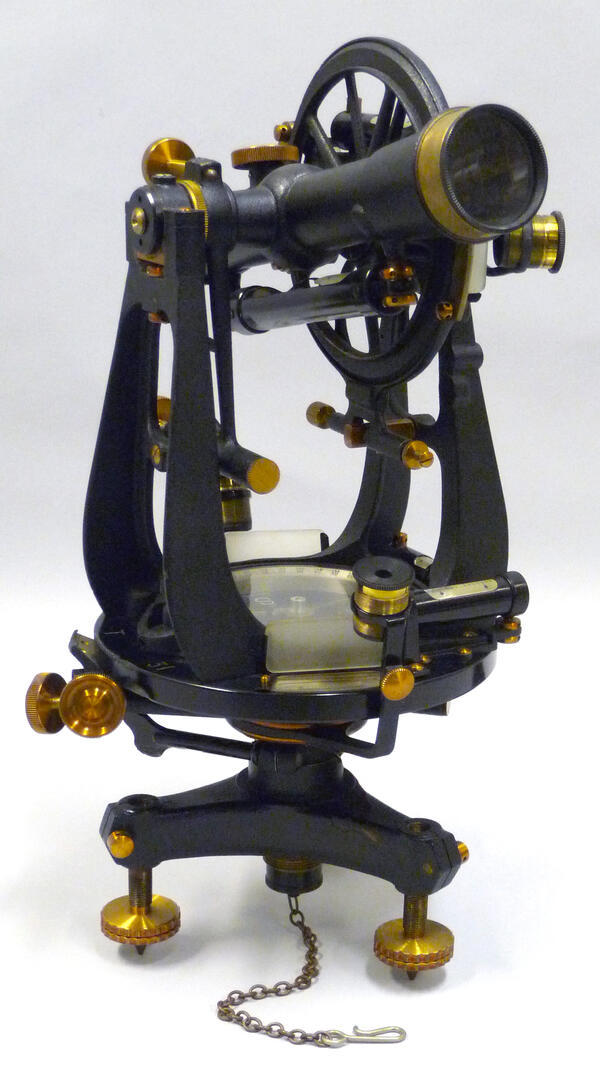
Engineer's and Surveyor's Transit
Manufactured by C.L. Berger & Sons, Boston, Massachusetts, serial #27124. The company was founded by Christian Louis Berger (1842-1922) who was born at Stuttgart, Germany and moved to Boston in 1866. In 1871 he joined with George Louis Buff, and began trading as Buff & Berger.
Manufactured by C.L. Berger & Sons, Boston, Massachusetts, serial #27124. The company was founded by Christian Louis Berger (1842-1922) who was born at Stuttgart, Germany and moved to Boston in 1866. In 1871 he joined with George Louis Buff, and began trading as Buff & Berger.
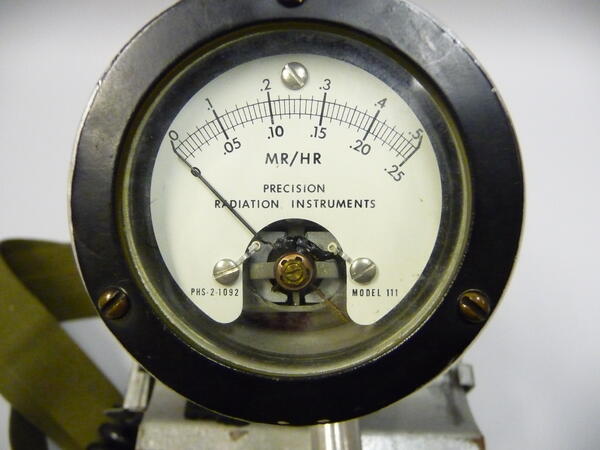
Geiger Counter
Manufactured by Precision Radiation Instruments, Los Angeles, California, 1950s. The instrument was used in the Rocky Mountain States, as well as by the Ohio Department of Natural Resources, Division of Geological Survey in the 1960s.
Object ID: USGS-000667
Manufactured by Precision Radiation Instruments, Los Angeles, California, 1950s. The instrument was used in the Rocky Mountain States, as well as by the Ohio Department of Natural Resources, Division of Geological Survey in the 1960s.
Object ID: USGS-000667
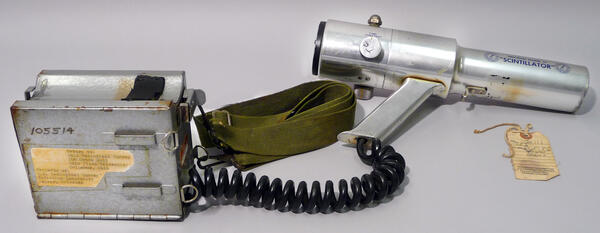
Geiger Counter
Manufactured by Precision Radiation Instruments, Los Angeles, California, 1950s. The instrument was used in the Rocky Mountain States, as well as by the Ohio Department of Natural Resources, Division of Geological Survey in the 1960s.
Object ID: USGS-000667
Manufactured by Precision Radiation Instruments, Los Angeles, California, 1950s. The instrument was used in the Rocky Mountain States, as well as by the Ohio Department of Natural Resources, Division of Geological Survey in the 1960s.
Object ID: USGS-000667

Bamboo Pointer belonging to Levi F. Noble
The pointer is a souvenir from the Third Pan-Pacific Science Congress held in Tokyo in 1926. A prominent geologist, Noble (1882-1965) spent his entire career with the U.S. Geological Survey.
The pointer is a souvenir from the Third Pan-Pacific Science Congress held in Tokyo in 1926. A prominent geologist, Noble (1882-1965) spent his entire career with the U.S. Geological Survey.
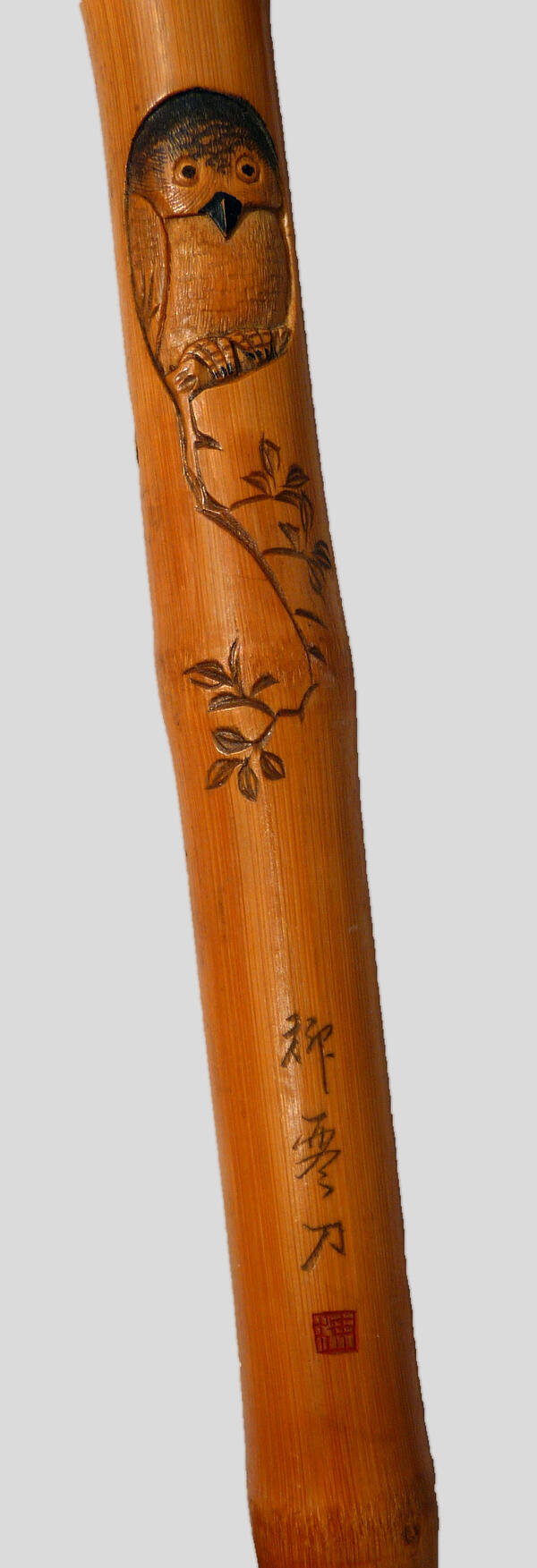
Bamboo Pointer belonging to Levi F. Noble
The pointer is a souvenir from the Third Pan-Pacific Science Congress held in Tokyo in 1926. A prominent geologist, Noble (1882-1965) spent his entire career with the U.S. Geological Survey.
The pointer is a souvenir from the Third Pan-Pacific Science Congress held in Tokyo in 1926. A prominent geologist, Noble (1882-1965) spent his entire career with the U.S. Geological Survey.
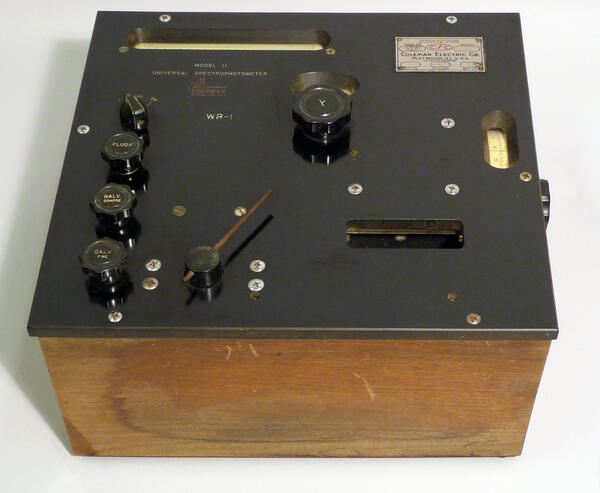
Universal Spectrophotometer
Manufactured by Coleman Electric Company, Inc., Maywood, Illinois; serial #9171, 1940s. This instrument was used in the U.S. Geological Survey Water-Quality office/laboratory in Worland, Wyoming which opened in 1946 and closed in 1982. It was used to measure how much color spectra was absorbed by water.
Manufactured by Coleman Electric Company, Inc., Maywood, Illinois; serial #9171, 1940s. This instrument was used in the U.S. Geological Survey Water-Quality office/laboratory in Worland, Wyoming which opened in 1946 and closed in 1982. It was used to measure how much color spectra was absorbed by water.

Engineer's and Surveyor's Transit
Manufactured by C.L. Berger & Sons, Boston, Massachusetts, serial #27124. The company was founded by Christian Louis Berger (1842-1922) who was born at Stuttgart, Germany and moved to Boston in 1866. In 1871 he joined with George Louis Buff, and began trading as Buff & Berger.
Manufactured by C.L. Berger & Sons, Boston, Massachusetts, serial #27124. The company was founded by Christian Louis Berger (1842-1922) who was born at Stuttgart, Germany and moved to Boston in 1866. In 1871 he joined with George Louis Buff, and began trading as Buff & Berger.
Open-sight Alidades
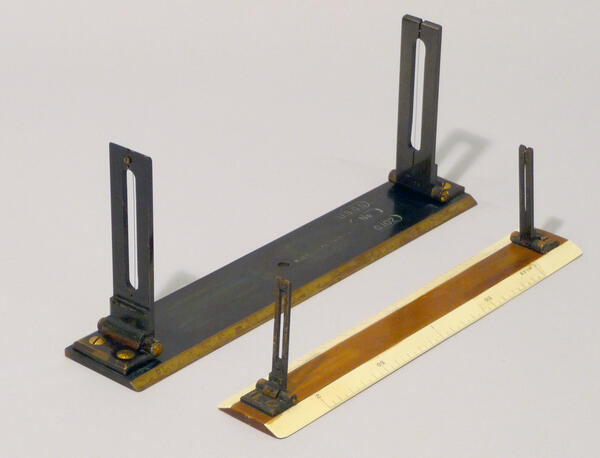
Open-sight Alidades. This type of alidade is a straightedge with a sighting device parallel to the edge. Early alidades were simple bars with open sights on either end, while telescopic alidades were introduced in the early 1800s. The examples here of solid brass and an early plastic/wood combination.
Object ID: USGS-000629, USGS-000631
Open-sight Alidades. This type of alidade is a straightedge with a sighting device parallel to the edge. Early alidades were simple bars with open sights on either end, while telescopic alidades were introduced in the early 1800s. The examples here of solid brass and an early plastic/wood combination.
Object ID: USGS-000629, USGS-000631
Saddle Blanket
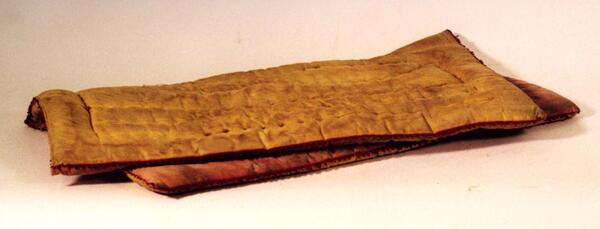
This is one of many saddle blankets from Dr. J.D. Love. The blanket has some felt decoration along the edges and is in particularily good condition. Saddle Blankets were used under saddles or pack saddles to provide comfort for animals used to carry equipment.
Object ID: USGS-000011
This is one of many saddle blankets from Dr. J.D. Love. The blanket has some felt decoration along the edges and is in particularily good condition. Saddle Blankets were used under saddles or pack saddles to provide comfort for animals used to carry equipment.
Object ID: USGS-000011
Field Table
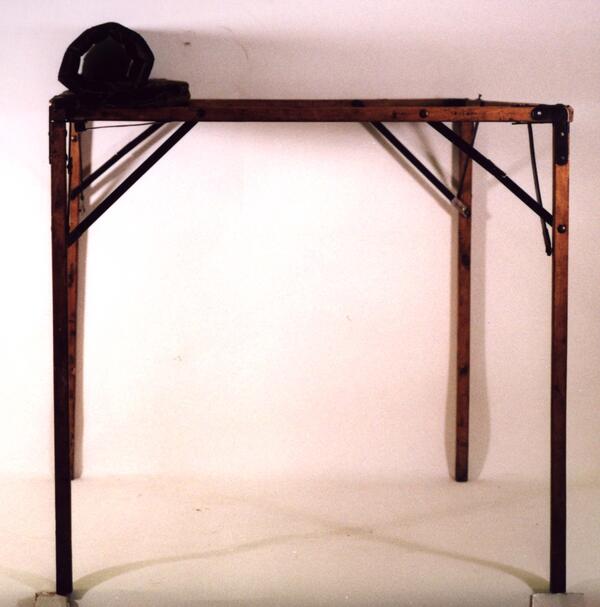
This is a rolltop table used by Arnold Hague. The table top is made of oilcloth and rolls up. The table, legs and frame can be collapsed for easy travel and the package can then be carried on a wooden pack saddle.
Object ID: USGS-000023
This is a rolltop table used by Arnold Hague. The table top is made of oilcloth and rolls up. The table, legs and frame can be collapsed for easy travel and the package can then be carried on a wooden pack saddle.
Object ID: USGS-000023
Rema Stove
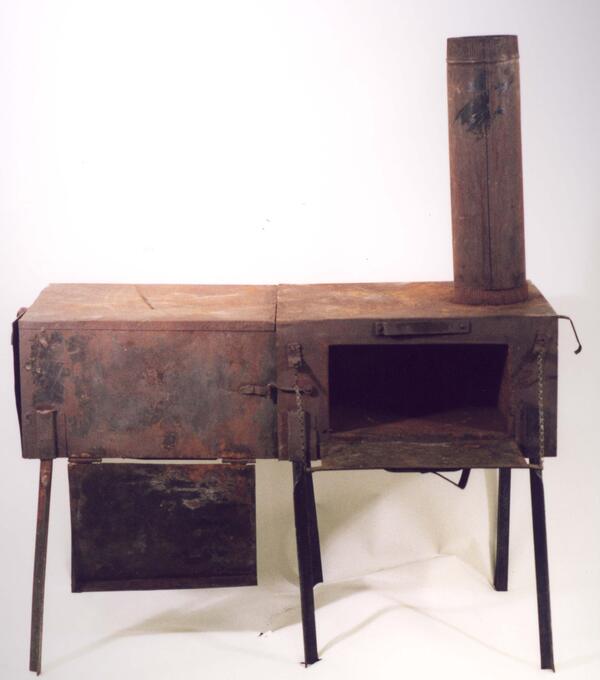
This is a "Rema Stove." It was invented by Bill Rema and the design was never patented. This is likely the only remaining stove of its kind. Dr. J. D. Love added a few elements, but it is essentially built to the original specifications. This stove was used extensively by USGS field scientists.
Object ID: USGS-000034
This is a "Rema Stove." It was invented by Bill Rema and the design was never patented. This is likely the only remaining stove of its kind. Dr. J. D. Love added a few elements, but it is essentially built to the original specifications. This stove was used extensively by USGS field scientists.
Object ID: USGS-000034
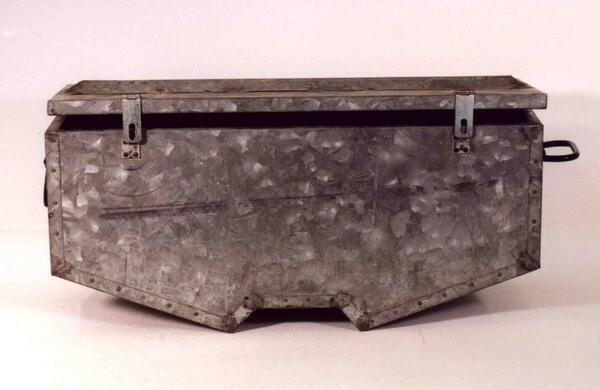
Aluminum Pannier
This aluminum pannier was made for the storage of meat, vegetables and other food products. The pannier could be buried in the ground or placed in water in order to keep the contents cool. It was designed by Dr. J. D. Love and made for him in 1945.
This aluminum pannier was made for the storage of meat, vegetables and other food products. The pannier could be buried in the ground or placed in water in order to keep the contents cool. It was designed by Dr. J. D. Love and made for him in 1945.
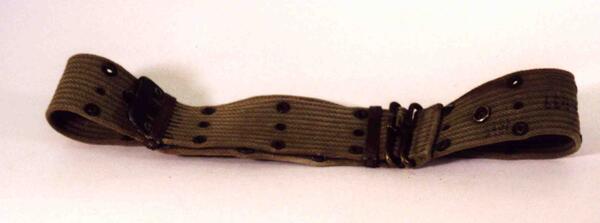
Tool Belt
This belt is one of many personal items included in the geological collection. It may have been used with clips to hold equipment for easy access in the field.
Object ID: USGS-000093
This belt is one of many personal items included in the geological collection. It may have been used with clips to hold equipment for easy access in the field.
Object ID: USGS-000093