



Views Kīlauea's summit were often obscured by fog and rain today, but a break in the weather around 2:00 p.m. HST allowed HVO's webcam to capture this image of the gas and steam plume being emitted from Halema‘uma‘u.
Images
Hawaiian Volcano Observatory images of eruptive activity, field work, and more.
Filter Total Items: 4163

Kīlauea Volcano — Summit Plume
Views Kīlauea's summit were often obscured by fog and rain today, but a break in the weather around 2:00 p.m. HST allowed HVO's webcam to capture this image of the gas and steam plume being emitted from Halema‘uma‘u.

Kīlauea Volcano —
Fissure 8 reactivated on the afternoon of May 28, when, at times, lava fountains were reaching heights of 200 feet and feeding a lava flow&
Fissure 8 reactivated on the afternoon of May 28, when, at times, lava fountains were reaching heights of 200 feet and feeding a lava flow&

Kīlauea Volcano — Weak Ocean Entry
Scientists on the early morning overflight of Kīlauea Volcano's lower East Rift Zone documented a very weak ocean entry. For the easternmost lobe, only a few small finger channels of lava were entering the ocean.
Scientists on the early morning overflight of Kīlauea Volcano's lower East Rift Zone documented a very weak ocean entry. For the easternmost lobe, only a few small finger channels of lava were entering the ocean.

Kīlauea Volcano — Tephra on Leilani Street
Tephra (airborne lava fragments) erupted by the high lava fountains of fissure 8 was carried downwind, where the frothy rock fragments fell on Leilani Street, just past Kupono Street, in the Leilani Estates subdivision.
Tephra (airborne lava fragments) erupted by the high lava fountains of fissure 8 was carried downwind, where the frothy rock fragments fell on Leilani Street, just past Kupono Street, in the Leilani Estates subdivision.
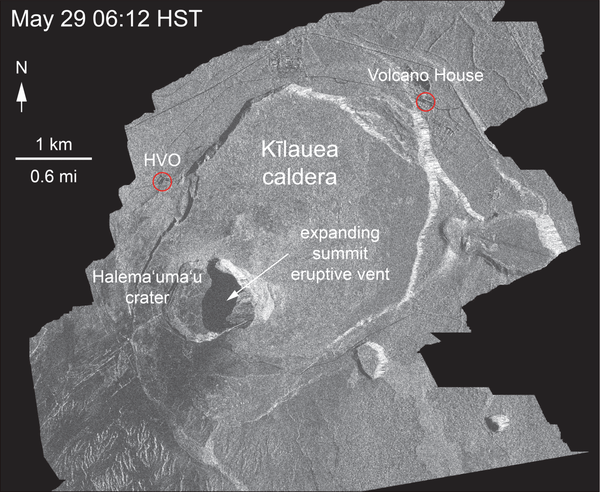
Kīlauea Volcano — Animation of Summit Enlargement
This animated GIF shows a sequence of radar amplitude images that were acquired by the Italian Space Agency's Cosmo-SkyMed satellite system. The series shows changes to the caldera area of Kīlauea Volcano that occurred over May 5 at 6:12 a.m. HST, May 17 at 6:12 a.m.
This animated GIF shows a sequence of radar amplitude images that were acquired by the Italian Space Agency's Cosmo-SkyMed satellite system. The series shows changes to the caldera area of Kīlauea Volcano that occurred over May 5 at 6:12 a.m. HST, May 17 at 6:12 a.m.

Overflight confirms weak ocean entry, in Kīlauea's LERZ
Overflight confirms weak ocean entry, in Kīlauea's LERZScientists on the early morning overflight of Kīlauea Volcano's lower East Rift Zone documented a very weak ocean entry. For the easternmost lobe, only a few small finger channels of lava were entering the ocean.
Overflight confirms weak ocean entry, in Kīlauea's LERZ
Overflight confirms weak ocean entry, in Kīlauea's LERZScientists on the early morning overflight of Kīlauea Volcano's lower East Rift Zone documented a very weak ocean entry. For the easternmost lobe, only a few small finger channels of lava were entering the ocean.

Kīlauea LERZ Fissures and Flows, May 29, 6:00 p.m.
Kīlauea LERZ Fissures and Flows, May 29, 6:00 p.m.Map as of 6:00 p.m. HST, May 29, 2018. Given the dynamic nature of Kīlauea's lower East Rift Zone eruption, with changing vent locations, fissures starting and stopping, and varying rates of lava effusion, map details shown here are accurate as of the date/time noted—and could have changed rapidly since that time.
Kīlauea LERZ Fissures and Flows, May 29, 6:00 p.m.
Kīlauea LERZ Fissures and Flows, May 29, 6:00 p.m.Map as of 6:00 p.m. HST, May 29, 2018. Given the dynamic nature of Kīlauea's lower East Rift Zone eruption, with changing vent locations, fissures starting and stopping, and varying rates of lava effusion, map details shown here are accurate as of the date/time noted—and could have changed rapidly since that time.

Kīlauea Volcano — Lava Channel and Fountains
Close view of lava channel in middle of the lava flow erupting from fissure 8 during this morning's overflight at about 7 a.m. HST. The tallest lava fountain is fissure 8, active since yesterday evening. The eruption rate at fissure 8 diminished significantly later in the morning.
Close view of lava channel in middle of the lava flow erupting from fissure 8 during this morning's overflight at about 7 a.m. HST. The tallest lava fountain is fissure 8, active since yesterday evening. The eruption rate at fissure 8 diminished significantly later in the morning.

Kilauea Volcano — Ocean Entry Aerial
Close view of weak ocean entry at about 1:05 p.m. HST. Only small and intermittent "laze" plumes have been observed today.
Close view of weak ocean entry at about 1:05 p.m. HST. Only small and intermittent "laze" plumes have been observed today.

Kilauea Volcano — Pohoiki Road Lava Flow
View of the now-sluggish lava flow that crossed Pohoiki Road earlier today; the flow originated from fissure 8. This fissure was very active overnight, slowed this morning, and stopped by about noon.
View of the now-sluggish lava flow that crossed Pohoiki Road earlier today; the flow originated from fissure 8. This fissure was very active overnight, slowed this morning, and stopped by about noon.

Kīlauea LERZ Fissures and Flows, May 28, 3:00 p.m.
Kīlauea LERZ Fissures and Flows, May 28, 3:00 p.m.Map as of 3:00 p.m. HST, May 28, 2018. Shaded purple areas indicate lava flows erupted in 1840, 1955, 1960, and 2014-2015.
Kīlauea LERZ Fissures and Flows, May 28, 3:00 p.m.
Kīlauea LERZ Fissures and Flows, May 28, 3:00 p.m.Map as of 3:00 p.m. HST, May 28, 2018. Shaded purple areas indicate lava flows erupted in 1840, 1955, 1960, and 2014-2015.

Kīlauea Volcano — Lava Flow Crossing Pohoiki Road
Aerial view of active lava flow crossing Pohoiki Road during an overflight this morning about 7 a.m. HST. Pohoiki Road cuts through middle of photograph.
Aerial view of active lava flow crossing Pohoiki Road during an overflight this morning about 7 a.m. HST. Pohoiki Road cuts through middle of photograph.

Kīlauea Volcano — Fissure Complex
View of the fissurecomplex is toward the southeast during this afternoon's overflight of the lower East Rift Zone at about 1:15 p.m. HST. The lava channel in middle of photograph is filling with lava erupted from fissure 22.
View of the fissurecomplex is toward the southeast during this afternoon's overflight of the lower East Rift Zone at about 1:15 p.m. HST. The lava channel in middle of photograph is filling with lava erupted from fissure 22.

Kīlauea Volcano — Fissure Complex
View of the fissure complex looking toward the southwest (uprift) during this afternoon's overflight at about 1:15 p.m. HST. The small lava flows spreading to the southeast from the fissure complex (lower middle) originate in the area of between fissures 16 and 18.
View of the fissure complex looking toward the southwest (uprift) during this afternoon's overflight at about 1:15 p.m. HST. The small lava flows spreading to the southeast from the fissure complex (lower middle) originate in the area of between fissures 16 and 18.

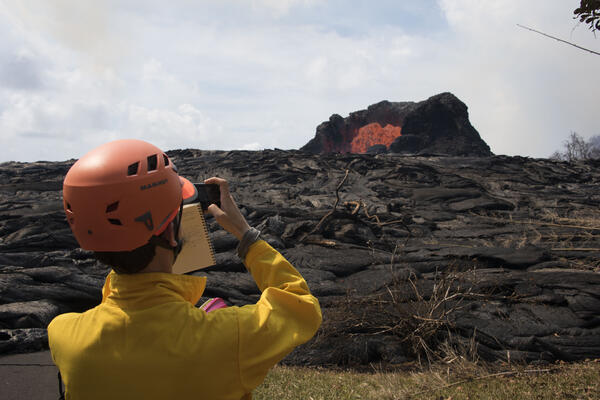
A volcanologist observes a lava fountain during the 2018 Kilauea eruption
A volcanologist observes a lava fountain during the 2018 Kilauea eruptionU.S. Geological Survey Volcanologist Matthew Patrick photographs and observes a lava fountain in the Leilani Estates near Hilo, Hawai`i on Sunday, May 27, 2018.
A volcanologist observes a lava fountain during the 2018 Kilauea eruption
A volcanologist observes a lava fountain during the 2018 Kilauea eruptionU.S. Geological Survey Volcanologist Matthew Patrick photographs and observes a lava fountain in the Leilani Estates near Hilo, Hawai`i on Sunday, May 27, 2018.

Kīlauea Volcano — Pāhoehoe Lava Advancement
Pāhoehoe lava advancing west from fissure 7 (lava fountain in background) on Leilani Avenue. Fissure 7 activity increased overnig
Pāhoehoe lava advancing west from fissure 7 (lava fountain in background) on Leilani Avenue. Fissure 7 activity increased overnig

Fountaining fissure documentation at the Kilauea eruption
Fountaining fissure documentation at the Kilauea eruptionUSGS scientist in the Lower East Rift Zone documenting the spectacular ~50 m tall fissure 7 lava fountain to the east which had lit up the sky in a red hue.
Fountaining fissure documentation at the Kilauea eruption
Fountaining fissure documentation at the Kilauea eruptionUSGS scientist in the Lower East Rift Zone documenting the spectacular ~50 m tall fissure 7 lava fountain to the east which had lit up the sky in a red hue.

Kīlauea Volcano — Ocean Entry
Aerial view of the ocean-entry areas at about 12:30 p.m. HST. Lava flowing into the ocean diminished overnight and this morning (note lack of obvious plume at the entry areas). View is toward the northwest.
Aerial view of the ocean-entry areas at about 12:30 p.m. HST. Lava flowing into the ocean diminished overnight and this morning (note lack of obvious plume at the entry areas). View is toward the northwest.

Kīlauea Volcano — Enlargement of Summit Eruptive Event
Kīlauea Volcano — Enlargement of Summit Eruptive EventThis image shows radar data acquired by the European Space Agency's Sentinel-1 satellite over Kīlauea Volcano on May 19 at 6:30 PM HST (left) compared to May 25 at 6:30 PM HST (right). The satellite transmits a radar signal toward the surface and measures the strength of the return, with bright areas indicating a strong return and dark areas a weak return.
Kīlauea Volcano — Enlargement of Summit Eruptive Event
Kīlauea Volcano — Enlargement of Summit Eruptive EventThis image shows radar data acquired by the European Space Agency's Sentinel-1 satellite over Kīlauea Volcano on May 19 at 6:30 PM HST (left) compared to May 25 at 6:30 PM HST (right). The satellite transmits a radar signal toward the surface and measures the strength of the return, with bright areas indicating a strong return and dark areas a weak return.

Kīlauea Volcano — Aerial of Eastern-Most Fissure Complex
Kīlauea Volcano — Aerial of Eastern-Most Fissure ComplexAerial view of the eastern-most end of the fissure complex (top right) and active lava channels and inactive flows south of the fissures (toward left side of photo) at about 12:30 p.m. HST; the ocean is out of view left side of photo. In this view, fissure 22 in top right is supplying most of the lava to the active channel.
Kīlauea Volcano — Aerial of Eastern-Most Fissure Complex
Kīlauea Volcano — Aerial of Eastern-Most Fissure ComplexAerial view of the eastern-most end of the fissure complex (top right) and active lava channels and inactive flows south of the fissures (toward left side of photo) at about 12:30 p.m. HST; the ocean is out of view left side of photo. In this view, fissure 22 in top right is supplying most of the lava to the active channel.