U.S. flag

An official website of the United States government

Ecology of Invasive Species

Filter Total Items: 17

How to catch a vector: Mosquito monitoring for avian malaria control

USGS researchers are combatting avian malaria by improving the trapping and tracking of mosquitoes in endangered Hawaiian bird habitats.
How to catch a vector: Mosquito monitoring for avian malaria control

How to catch a vector: Mosquito monitoring for avian malaria control

USGS researchers are combatting avian malaria by improving the trapping and tracking of mosquitoes in endangered Hawaiian bird habitats.
Learn More

eDNA to Inform Invasive Mosquito Distribution

We are using environmental DNA samples to assess habitat occupancy of the invasive southern house mosquito in Kīpahulu Valley, Maui. An understanding of mosquito distribution is critical to developing and implementing tools to prevent the transmission of avian malaria, a primary threat to Hawaiian forest birds.
eDNA to Inform Invasive Mosquito Distribution

eDNA to Inform Invasive Mosquito Distribution

We are using environmental DNA samples to assess habitat occupancy of the invasive southern house mosquito in Kīpahulu Valley, Maui. An understanding of mosquito distribution is critical to developing and implementing tools to prevent the transmission of avian malaria, a primary threat to Hawaiian forest birds.
Learn More

Brown Treesnake Project

The brown treesnake is an invasive species that decimated many of Guam’s native vertebrate species. Under the leadership of the Pacific Island Ecosystems Research Center (Hawaii) and co-located with U.S. Fish and Wildlife Service at the Guam National Wildlife Refuge, the brown treesnake team works to prevent snakes spreading to other islands, develop and test tools for control efforts on Guam, and...
Brown Treesnake Project

Brown Treesnake Project

The brown treesnake is an invasive species that decimated many of Guam’s native vertebrate species. Under the leadership of the Pacific Island Ecosystems Research Center (Hawaii) and co-located with U.S. Fish and Wildlife Service at the Guam National Wildlife Refuge, the brown treesnake team works to prevent snakes spreading to other islands, develop and test tools for control efforts on Guam, and...
Learn More

Brown Treesnake Rapid Response Team

The Brown Treesnake Rapid Response Team (RRT) evaluates snake sightings and quickly deploys when sightings are credible and match a brown treesnake. The RRT is an interagency partnership that cooperatively prevents the spread of brown treesnakes in the United States and territories.
Brown Treesnake Rapid Response Team

Brown Treesnake Rapid Response Team

The Brown Treesnake Rapid Response Team (RRT) evaluates snake sightings and quickly deploys when sightings are credible and match a brown treesnake. The RRT is an interagency partnership that cooperatively prevents the spread of brown treesnakes in the United States and territories.
Learn More

Developing and evaluating a point-of-use environmental DNA test for rapid field detection of highly invasive brown treesnakes

New terrestrial environmental DNA (eDNA) sampling techniques are sensitive tools for early detection of the highly invasive brown treesnakes (BTS). In a new collaborative research effort involving four USGS science centers, scientists have initiated the development of an innovative point-of-use (POU) assay for BTS. POU assays are tests that can be run in the field with minimal equipment and no...
Developing and evaluating a point-of-use environmental DNA test for rapid field detection of highly invasive brown treesnakes

Developing and evaluating a point-of-use environmental DNA test for rapid field detection of highly invasive brown treesnakes

New terrestrial environmental DNA (eDNA) sampling techniques are sensitive tools for early detection of the highly invasive brown treesnakes (BTS). In a new collaborative research effort involving four USGS science centers, scientists have initiated the development of an innovative point-of-use (POU) assay for BTS. POU assays are tests that can be run in the field with minimal equipment and no...
Learn More

Guam power lines and brown treesnakes are an electric mix

Of all the economic impacts to Guam due to the introduction of the brown treesnake ( Boiga irregularis), the effects on the power infrastructure are the easiest to understand.
Guam power lines and brown treesnakes are an electric mix

Guam power lines and brown treesnakes are an electric mix

Of all the economic impacts to Guam due to the introduction of the brown treesnake ( Boiga irregularis), the effects on the power infrastructure are the easiest to understand.
Learn More

Modeling First Records to Guide Invasive Species Biosurveillance in Hawai‘i

Early detection of invasive species can enable their successful eradication. With climate change and dynamic patterns of global trade, it is difficult to predict which new invasive species will next get introduced and where introduction and establishment will occur. We are analyzing where non-native species have first established in Hawai‘i to develop mapped predictions of the relative risk of new...
Modeling First Records to Guide Invasive Species Biosurveillance in Hawai‘i

Modeling First Records to Guide Invasive Species Biosurveillance in Hawai‘i

Early detection of invasive species can enable their successful eradication. With climate change and dynamic patterns of global trade, it is difficult to predict which new invasive species will next get introduced and where introduction and establishment will occur. We are analyzing where non-native species have first established in Hawai‘i to develop mapped predictions of the relative risk of new...
Learn More

Climatic and Ecological Scenarios to Guide Development of a Spatial Resist-Accept-Direct Portfolio at Nāpuʻu, Hawaiʻi

Climate change and invasive species are transforming ecosystems. The Resist-Accept-Direct (RAD) framework organizes management objectives into those that seek to Resist change and maintain historical ecological communities, those that Accept some or all aspects of ecological transformation, and those that Direct an ecological community to a preferred state. We are evaluating risks posed by climate...
Climatic and Ecological Scenarios to Guide Development of a Spatial Resist-Accept-Direct Portfolio at Nāpuʻu, Hawaiʻi

Climatic and Ecological Scenarios to Guide Development of a Spatial Resist-Accept-Direct Portfolio at Nāpuʻu, Hawaiʻi

Climate change and invasive species are transforming ecosystems. The Resist-Accept-Direct (RAD) framework organizes management objectives into those that seek to Resist change and maintain historical ecological communities, those that Accept some or all aspects of ecological transformation, and those that Direct an ecological community to a preferred state. We are evaluating risks posed by climate...
Learn More

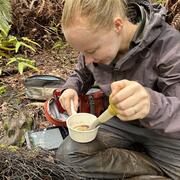
Identifying Genetic Diversity of Wolbachia Bacteria for Mosquito Control

We are sequencing the DNA of Wolbachia bacteria found in mosquito populations in Hawai’i and those used for mosquito control. We are also developing sample processing techniques to increase the efficiency and accuracy of monitoring mosquito control efforts to help long-term survival and restoration of Hawaiian forest bird populations.
Identifying Genetic Diversity of Wolbachia Bacteria for Mosquito Control

Identifying Genetic Diversity of Wolbachia Bacteria for Mosquito Control

We are sequencing the DNA of Wolbachia bacteria found in mosquito populations in Hawai’i and those used for mosquito control. We are also developing sample processing techniques to increase the efficiency and accuracy of monitoring mosquito control efforts to help long-term survival and restoration of Hawaiian forest bird populations.
Learn More

Mapping Vegetation on Lāna‘i

We are combining high-resolution spatial imagery with ground-collected data to create detailed classification maps of native and non-native plants on Lāna‘i. We are also using the high-resolution maps, historical satellite and aerial imagery to analyze changes in ‘ua‘u—Hawaiian petrel—nesting habitat. For the first time at island scales in Hawai’i, this species-level mapping uses high resolution...
Mapping Vegetation on Lāna‘i

Mapping Vegetation on Lāna‘i

We are combining high-resolution spatial imagery with ground-collected data to create detailed classification maps of native and non-native plants on Lāna‘i. We are also using the high-resolution maps, historical satellite and aerial imagery to analyze changes in ‘ua‘u—Hawaiian petrel—nesting habitat. For the first time at island scales in Hawai’i, this species-level mapping uses high resolution...
Learn More

Monitoring Bird and Rat Behavior to Improve Invasive Species Management

Introduced rats are notorious predators of birds and their nests worldwide, but especially on remote islands. Rats ( Rattus exulans) first arrived in Hawai‘i with Polynesian colonists about 1,000 years ago, resulting in deleterious consequences for native birds and ecosystems. Since Western contact in 1778, two additional rat species have become established in Hawai‘i, including the highly...
Monitoring Bird and Rat Behavior to Improve Invasive Species Management

Monitoring Bird and Rat Behavior to Improve Invasive Species Management

Introduced rats are notorious predators of birds and their nests worldwide, but especially on remote islands. Rats ( Rattus exulans) first arrived in Hawai‘i with Polynesian colonists about 1,000 years ago, resulting in deleterious consequences for native birds and ecosystems. Since Western contact in 1778, two additional rat species have become established in Hawai‘i, including the highly...
Learn More

Climate and Management Effects on Soil Infiltration and Runoff in Hawaiian Forests

Hawai‘i's precipitation is greatest in upland areas that are typically forested. This precipitation provides water for both people and ecosystems. Precipitation can either run off and contribute to streamflow, or infiltrate into the ground and provide water for plants, base flow to streams, or recharge to aquifers. The exact routing that water takes is controlled by many factors, including the...
Climate and Management Effects on Soil Infiltration and Runoff in Hawaiian Forests

Climate and Management Effects on Soil Infiltration and Runoff in Hawaiian Forests

Hawai‘i's precipitation is greatest in upland areas that are typically forested. This precipitation provides water for both people and ecosystems. Precipitation can either run off and contribute to streamflow, or infiltrate into the ground and provide water for plants, base flow to streams, or recharge to aquifers. The exact routing that water takes is controlled by many factors, including the...
Learn More
Was this page helpful?