



On December 26th, 2004, a massive 9.1 magnitude earthquake struck off the west coast of northern Sumatra, Indonesia. The third largest earthquake ever recorded lifted the sea floor several meters, causing tsunami waves to ripple out in all directions and race across the ocean. Banda Aceh bore the brunt of the waves just 15 to 20 minutes after the earthquake.
All Multimedia
Access all multimedia to include images, video, audio, webcams, before-after imagery, and more. Filter and explore with filtering options to refine search.
Filter Total Items: 24923

Image of the Week - 2004 Indian Ocean Tsunami
On December 26th, 2004, a massive 9.1 magnitude earthquake struck off the west coast of northern Sumatra, Indonesia. The third largest earthquake ever recorded lifted the sea floor several meters, causing tsunami waves to ripple out in all directions and race across the ocean. Banda Aceh bore the brunt of the waves just 15 to 20 minutes after the earthquake.

Photographs of lungs from a mallard duck found dead in Idaho
Photographs of lungs from a mallard duck found dead in IdahoPhotographs from a mallard duck (Anas platyrhynchos) found dead in Idaho, USA. (A) The lungs are dark red and have multifocal 1-3 mm diameter white to tan nodules disseminated throughout (arrows). (B) Cut section of the lung showing the nodules within the parenchyma (arrows).
Photographs of lungs from a mallard duck found dead in Idaho
Photographs of lungs from a mallard duck found dead in IdahoPhotographs from a mallard duck (Anas platyrhynchos) found dead in Idaho, USA. (A) The lungs are dark red and have multifocal 1-3 mm diameter white to tan nodules disseminated throughout (arrows). (B) Cut section of the lung showing the nodules within the parenchyma (arrows).

Photomicrographs of lung from a mallard duck
Photomicrographs from a mallard duck (Anas platyrhynchos) found dead in Idaho, USA. (A) Multiple granulomas (*) with eosinophilic necrotic centers efface the lung. H&E stain. (B) Granulomas contain many degenerate heterophils and a few multinucleated giant cells (arrows). H&E stain.
Photomicrographs from a mallard duck (Anas platyrhynchos) found dead in Idaho, USA. (A) Multiple granulomas (*) with eosinophilic necrotic centers efface the lung. H&E stain. (B) Granulomas contain many degenerate heterophils and a few multinucleated giant cells (arrows). H&E stain.

What’s happening at Kīlauea Volcano?
On December 20, 2020, an eruption began in Halema‘uma‘u at Kīlauea Volcano’s summit, ending a two-year eruptive pause. The water lake that appeared at the bottom of Halema‘uma‘u in late July 2019, which had grown to be over 50 meters (55 yards) deep and more than 10 acres in surface area, quickly vaporized and was replaced by a growing lava lake.
On December 20, 2020, an eruption began in Halema‘uma‘u at Kīlauea Volcano’s summit, ending a two-year eruptive pause. The water lake that appeared at the bottom of Halema‘uma‘u in late July 2019, which had grown to be over 50 meters (55 yards) deep and more than 10 acres in surface area, quickly vaporized and was replaced by a growing lava lake.

Lava lake on the evening of January 19, 2021
This photo, taken at just after 6 p.m. HST on January 19, shows that the western fissure continues to send lava into Halemʻaumaʻu crater through an open channel into the lava lake. The western side of the lava lake has an incandescent surface, while the eastern portion is more crusted over.
This photo, taken at just after 6 p.m. HST on January 19, shows that the western fissure continues to send lava into Halemʻaumaʻu crater through an open channel into the lava lake. The western side of the lava lake has an incandescent surface, while the eastern portion is more crusted over.

Small collapses of Kīlauea's western fissure continue
Small collapses of Kīlauea's western fissure continueThe western fissure at Kīlauea's summit continues to send lava into Halemʻaumaʻu crater through an open channel into the lava lake. Around sunset on the evening of January 19, field crews observed a minor collapse event of the spatter rampart on its northern rim and the channel margins at 5:46 p.m. HST.
Small collapses of Kīlauea's western fissure continue
Small collapses of Kīlauea's western fissure continueThe western fissure at Kīlauea's summit continues to send lava into Halemʻaumaʻu crater through an open channel into the lava lake. Around sunset on the evening of January 19, field crews observed a minor collapse event of the spatter rampart on its northern rim and the channel margins at 5:46 p.m. HST.

Halema‘uma‘u lava lake - 01/18/2021
A close up of the southwest portion of the lava lake within Halema‘uma‘u, just south of the west fissure. The lava lake at Kīlauea's summit is perched, and is contained by a steep levee 2-3 meters (yards) high. USGS photo by M. Patrick.
A close up of the southwest portion of the lava lake within Halema‘uma‘u, just south of the west fissure. The lava lake at Kīlauea's summit is perched, and is contained by a steep levee 2-3 meters (yards) high. USGS photo by M. Patrick.

Kīlauea — Recent Change in Vent Configuration (Jan 18, 2021)
Kīlauea — Recent Change in Vent Configuration (Jan 18, 2021)This video shows the two main vents active at the western fissure in Halema‘uma‘u at Kīlauea's summit, with both supplying lava to the lava lake. Low fountaining was present at each vent.
Kīlauea — Recent Change in Vent Configuration (Jan 18, 2021)
Kīlauea — Recent Change in Vent Configuration (Jan 18, 2021)This video shows the two main vents active at the western fissure in Halema‘uma‘u at Kīlauea's summit, with both supplying lava to the lava lake. Low fountaining was present at each vent.

Recent change in Halema‘uma‘u vent configuration - 01/18/2021
Recent change in Halema‘uma‘u vent configuration - 01/18/2021A close up of the vent area at the western fissure within Halema‘uma‘u at Kīlauea's summit. The two main vents were exhibiting low fountaining while a small vent in the middle had sporadic, weak spattering. USGS photo by M. Patrick.
Recent change in Halema‘uma‘u vent configuration - 01/18/2021
Recent change in Halema‘uma‘u vent configuration - 01/18/2021A close up of the vent area at the western fissure within Halema‘uma‘u at Kīlauea's summit. The two main vents were exhibiting low fountaining while a small vent in the middle had sporadic, weak spattering. USGS photo by M. Patrick.

Recent change in Halema‘uma‘u vent configuration - 01/18/2021
Recent change in Halema‘uma‘u vent configuration - 01/18/2021On the evening of January 17, the vent on the north side of the western fissure in Halema‘uma‘u at Kīlauea's summit activated and seemed to become the dominant vent overnight. This vent is the one on the right in this photo. The vent on the left, which was the dominant vent over the past week, seemed less energetic today. USGS photo by M. Patrick.
Recent change in Halema‘uma‘u vent configuration - 01/18/2021
Recent change in Halema‘uma‘u vent configuration - 01/18/2021On the evening of January 17, the vent on the north side of the western fissure in Halema‘uma‘u at Kīlauea's summit activated and seemed to become the dominant vent overnight. This vent is the one on the right in this photo. The vent on the left, which was the dominant vent over the past week, seemed less energetic today. USGS photo by M. Patrick.

Kīlauea — Low Fountaining Continues at Western Fissure (Jan 15, 2021)
Kīlauea — Low Fountaining Continues at Western Fissure (Jan 15, 2021)Low fountaining remains active in the western fissure, supplying lava to the lava lake in Halema‘uma‘u crater, at the summit of Kīlauea. Spatter deposits have built up a spatter cone around the vent.
Kīlauea — Low Fountaining Continues at Western Fissure (Jan 15, 2021)
Kīlauea — Low Fountaining Continues at Western Fissure (Jan 15, 2021)Low fountaining remains active in the western fissure, supplying lava to the lava lake in Halema‘uma‘u crater, at the summit of Kīlauea. Spatter deposits have built up a spatter cone around the vent.

Low fountaining continues at the western fissure in Kīlauea's summit
Low fountaining continues at the western fissure in Kīlauea's summitSunlight interacts with volcanic gas from Kīlauea's summit lava lake and western fissure in this late afternoon view. The western fissure has built a spatter cone on the steep walls of Halema‘uma‘u, with lava spilling into the active lake, which forms the lower right portion of the photo.
Low fountaining continues at the western fissure in Kīlauea's summit
Low fountaining continues at the western fissure in Kīlauea's summitSunlight interacts with volcanic gas from Kīlauea's summit lava lake and western fissure in this late afternoon view. The western fissure has built a spatter cone on the steep walls of Halema‘uma‘u, with lava spilling into the active lake, which forms the lower right portion of the photo.

Low fountaining continues at the western fissure in Kīlauea's summit
Low fountaining continues at the western fissure in Kīlauea's summitA closer view of the low fountaining at the western fissure in Halema‘uma‘u at Kīlauea's summit. The rim of the cone is built from accumulated deposits of spatter, and large chunks of the cone rim were observed to collapse from time to time. USGS photo by M. Patrick
Low fountaining continues at the western fissure in Kīlauea's summit
Low fountaining continues at the western fissure in Kīlauea's summitA closer view of the low fountaining at the western fissure in Halema‘uma‘u at Kīlauea's summit. The rim of the cone is built from accumulated deposits of spatter, and large chunks of the cone rim were observed to collapse from time to time. USGS photo by M. Patrick

Low fountaining continues at the western fissure in Kīlauea's summit
Low fountaining continues at the western fissure in Kīlauea's summitLow fountaining continues at the western fissure, supplying lava to the lava lake in Halema‘uma‘u crater, at the summit of Kīlauea. The vent has formed a spatter cone around the fountaining, with lava spilling into an open channel that plunges into the lake.
Low fountaining continues at the western fissure in Kīlauea's summit
Low fountaining continues at the western fissure in Kīlauea's summitLow fountaining continues at the western fissure, supplying lava to the lava lake in Halema‘uma‘u crater, at the summit of Kīlauea. The vent has formed a spatter cone around the fountaining, with lava spilling into an open channel that plunges into the lake.
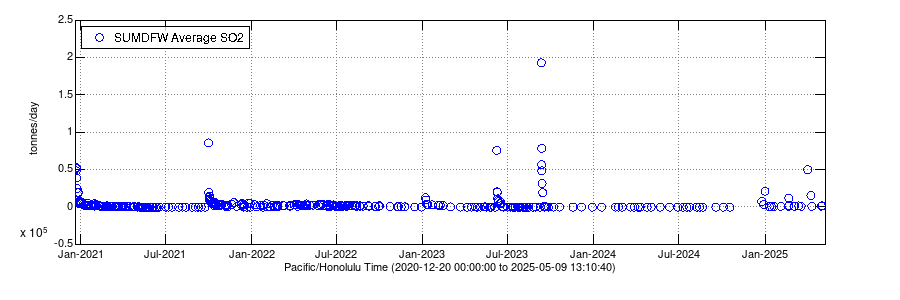
Average measurements of SO2 from Kilauea summit since 21 December 2020
Average measurements of SO2 from Kilauea summit since 21 December 2020Sulfur dioxide (SO2) emission rates measured using an upward-looking ultraviolet spectrometer. These data are collected by traversing the gas plume in a vehicle or helicopter, downwind of Halema‘uma‘u, generally within and/or southwest of Kīlauea caldera.
Average measurements of SO2 from Kilauea summit since 21 December 2020
Average measurements of SO2 from Kilauea summit since 21 December 2020Sulfur dioxide (SO2) emission rates measured using an upward-looking ultraviolet spectrometer. These data are collected by traversing the gas plume in a vehicle or helicopter, downwind of Halema‘uma‘u, generally within and/or southwest of Kīlauea caldera.

Drilling through Ice
Drilling through ice on the Green River.
Drilling through ice on the Green River.

Kīlauea summit eruption overflight (Jan 12, 2021)
A helicopter overflight on the morning of January 12, provided airborne views of the lava lake and active fissure within Halema‘uma‘u, at the summit of Kīlauea. Low fountaining was present at the western fissure, with active surface lava limited to the western portion of the lava lake.
A helicopter overflight on the morning of January 12, provided airborne views of the lava lake and active fissure within Halema‘uma‘u, at the summit of Kīlauea. Low fountaining was present at the western fissure, with active surface lava limited to the western portion of the lava lake.

Kīlauea Volcano— Ongoing Eruption; West Vent (Jan 12, 2021)
Kīlauea Volcano— Ongoing Eruption; West Vent (Jan 12, 2021)This video taken on January 12, 2021, shows the west vent within Halema'uma'u crater at the summit of Kīlauea. Low fountaining of about 5 m (16 ft) high is visible inside the spatter cone that has formed. The fountain is producing a cascade of lava—about 35 m (115 ft)—down to the lava lake.
Kīlauea Volcano— Ongoing Eruption; West Vent (Jan 12, 2021)
Kīlauea Volcano— Ongoing Eruption; West Vent (Jan 12, 2021)This video taken on January 12, 2021, shows the west vent within Halema'uma'u crater at the summit of Kīlauea. Low fountaining of about 5 m (16 ft) high is visible inside the spatter cone that has formed. The fountain is producing a cascade of lava—about 35 m (115 ft)—down to the lava lake.

Mudpot located near Mud Volcano in Yellowstone National Park
Mudpot located near Mud Volcano in Yellowstone National ParkMudpot located in the Mud Volcano thermal area of Yellowstone National Park. This type of thermal feature indicates an acid-sulfate system.
Mudpot located near Mud Volcano in Yellowstone National Park
Mudpot located near Mud Volcano in Yellowstone National ParkMudpot located in the Mud Volcano thermal area of Yellowstone National Park. This type of thermal feature indicates an acid-sulfate system.

Steam vents along the Yellowstone River near Mud Volcano thermal area
Steam vents along the Yellowstone River near Mud Volcano thermal areaSteam vents along the Yellowstone River near Mud Volcano thermal area, Yellowstone National Park.
Steam vents along the Yellowstone River near Mud Volcano thermal area
Steam vents along the Yellowstone River near Mud Volcano thermal areaSteam vents along the Yellowstone River near Mud Volcano thermal area, Yellowstone National Park.

Structure 77 on the Caloosahatchee River at Moore Haven, Florid
Structure 77 on the Caloosahatchee River at Moore Haven, FloridStructure 77 (S-77) on the Caloosahatchee River at Moore Haven, Florida.
Structure 77 on the Caloosahatchee River at Moore Haven, Florid
Structure 77 on the Caloosahatchee River at Moore Haven, FloridStructure 77 (S-77) on the Caloosahatchee River at Moore Haven, Florida.