



At 1:38 p.m. HST, ash falls from the plume southwest from Halema‘uma‘u crater onto the Kau desert. The northeast tradewinds were persistent today at the summit of Kīlauea Volcano, so ash was only blown southwest.
Images
Explore our planet through photography and imagery, including climate change and water all the way back to the 1800s when the USGS was surveying the country by horse and buggy.
Filter Total Items: 21351

Kīlauea Volcano — Ash Falls onto Kau Desert
At 1:38 p.m. HST, ash falls from the plume southwest from Halema‘uma‘u crater onto the Kau desert. The northeast tradewinds were persistent today at the summit of Kīlauea Volcano, so ash was only blown southwest.

WFRC nPCR test for detection of Renibacterium salmoninarum
WFRC nPCR test for detection of Renibacterium salmoninarumNested polymerase chain reaction (nPCR) for the detection of Renibacterium salmoninarum. Agarose gel electrophoresis is used for size separation and visualization of amplified DNA sequences.
WFRC nPCR test for detection of Renibacterium salmoninarum
WFRC nPCR test for detection of Renibacterium salmoninarumNested polymerase chain reaction (nPCR) for the detection of Renibacterium salmoninarum. Agarose gel electrophoresis is used for size separation and visualization of amplified DNA sequences.

WFRC nPCR test for detection of Renibacterium salmoninarum
WFRC nPCR test for detection of Renibacterium salmoninarumNested polymerase chain reaction (nPCR) for the detection of Renibacterium salmoninarum. Following two rounds of PCR amplification, samples are pipetted into an agarose gel for electrophoresis.
WFRC nPCR test for detection of Renibacterium salmoninarum
WFRC nPCR test for detection of Renibacterium salmoninarumNested polymerase chain reaction (nPCR) for the detection of Renibacterium salmoninarum. Following two rounds of PCR amplification, samples are pipetted into an agarose gel for electrophoresis.

An Electrical Barrier used to block sea lamprey, Black Mallard River
An Electrical Barrier used to block sea lamprey, Black Mallard RiverAn electrical barrier used to block sea lamprey passage in the Black Mallard River, 2018
An Electrical Barrier used to block sea lamprey, Black Mallard River
An Electrical Barrier used to block sea lamprey, Black Mallard RiverAn electrical barrier used to block sea lamprey passage in the Black Mallard River, 2018

Fissure 17 — active ‘a‘ā flow spreading from fissure
Fissure 17 — active ‘a‘ā flow spreading from fissureAt 8:44 a.m., HST. Aerial view of the active ‘a‘ā flow spreading from fissure 17 (the fissure's low lava fountains can be seen in middle of photo). Highway 132 can be seen on right side of photograph. View is toward the west.
Fissure 17 — active ‘a‘ā flow spreading from fissure
Fissure 17 — active ‘a‘ā flow spreading from fissureAt 8:44 a.m., HST. Aerial view of the active ‘a‘ā flow spreading from fissure 17 (the fissure's low lava fountains can be seen in middle of photo). Highway 132 can be seen on right side of photograph. View is toward the west.

Fissure 17 — continues down slope
At 2:30 p.m. HST, the flow front of Fissure 17 continues down slope. The barren, brown area to the right in the photograph is a lobe of the Kii Flow from the eruption of 1955. The Fissure 17 flow front is located approximately .7 miles makai of Highway 132 and is 1.4 miles mauka of Hwy 137.
At 2:30 p.m. HST, the flow front of Fissure 17 continues down slope. The barren, brown area to the right in the photograph is a lobe of the Kii Flow from the eruption of 1955. The Fissure 17 flow front is located approximately .7 miles makai of Highway 132 and is 1.4 miles mauka of Hwy 137.

Fissure 17 — early morning view

Fissure 17 — steam jet appears
Around 2:30 p.m. HST, a steam jet appears on fissure 17, above the area with active fountaining. Steam jets at this location were repeating about once a minute.
Around 2:30 p.m. HST, a steam jet appears on fissure 17, above the area with active fountaining. Steam jets at this location were repeating about once a minute.

Scientist Sitting Next to a Biological Safety Cabinet in a Laboratory
Scientist Sitting Next to a Biological Safety Cabinet in a LaboratoryA U.S.

Snow covered Heaven's Peak
Examples of glide avalanches on Heaven's Peak, Glacier National Park.
Examples of glide avalanches on Heaven's Peak, Glacier National Park.

Threatened Giant Gartersnake (Thamnophis gigas)
Threatened giant gartersnake (Thamnophis gigas). This semi-aquatic snake lives in rice fields and the remaining wetlands of California's Central Valley.
Threatened giant gartersnake (Thamnophis gigas). This semi-aquatic snake lives in rice fields and the remaining wetlands of California's Central Valley.

Cable Car
USGS staff member positioned in a cable car, ready to collect streamflow data on Pine Creek near Pinedale, Wyoming.
USGS staff member positioned in a cable car, ready to collect streamflow data on Pine Creek near Pinedale, Wyoming.

Fissure 17 — Marking cracks in roadway
At 10:31 a.m. HST. Cracks on Hwy 132 marked with orange spray paint to track changes through time.
At 10:31 a.m. HST. Cracks on Hwy 132 marked with orange spray paint to track changes through time.

Fissure 17 — slow sticky a'a flow emerges
At 8:00 a.m. HST. A slow sticky a'a flow emerges from a new fissure just over a half mile northeast of the end of Hinalo Street. The new fissure - fissure 17 - is about one half mile south of Hwy 132. Some reports have referred to this fissure as number 18 but that is not correct. Fissure 18 had not erupted by this time.
At 8:00 a.m. HST. A slow sticky a'a flow emerges from a new fissure just over a half mile northeast of the end of Hinalo Street. The new fissure - fissure 17 - is about one half mile south of Hwy 132. Some reports have referred to this fissure as number 18 but that is not correct. Fissure 18 had not erupted by this time.

Fissure 18 - small outbreak
At 2:00 p.m. HST. This photo reveals a small pad of lava between Fissures 16 and 17 which did not appear in photos of the same scene taken this morning. (Red arrow points to the lava pad.) From the photo it appears that this fissure had stagnated. We have designated this small outbreak as Fissure 18.
At 2:00 p.m. HST. This photo reveals a small pad of lava between Fissures 16 and 17 which did not appear in photos of the same scene taken this morning. (Red arrow points to the lava pad.) From the photo it appears that this fissure had stagnated. We have designated this small outbreak as Fissure 18.

Kīlauea LERZ Fissures, May 13 at 9:00 a.m.
Map as of 9:00 a.m. HST, May 13, shows the location of fissure 17, which opened this morning at approximately 4:30 a.m. HST. NOTE: This new fissure was initially referred to as fissure 18 in early reports, but that is incorrect (what was called fissure 17 yesterday did not erupt lava, so this morning's erupting fissure is actually 17).
Map as of 9:00 a.m. HST, May 13, shows the location of fissure 17, which opened this morning at approximately 4:30 a.m. HST. NOTE: This new fissure was initially referred to as fissure 18 in early reports, but that is incorrect (what was called fissure 17 yesterday did not erupt lava, so this morning's erupting fissure is actually 17).
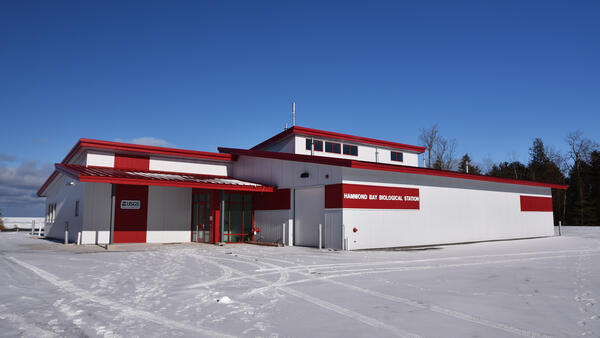
The new Hammond Bay Biological Station laboratory building
The new Hammond Bay Biological Station laboratory buildingThe new Hammond Bay Biological Station laboratory building completed in 2019.
The new Hammond Bay Biological Station laboratory building
The new Hammond Bay Biological Station laboratory buildingThe new Hammond Bay Biological Station laboratory building completed in 2019.

5/12/18, 12:57 p.m. HST - Lava was slowly advancing from fissure 16.
5/12/18, 12:57 p.m. HST - Lava was slowly advancing from fissure 16.5/12/18, 12:57 p.m. HST - Lava was slowly advancing from fissure 16.
5/12/18, 12:57 p.m. HST - Lava was slowly advancing from fissure 16.
5/12/18, 12:57 p.m. HST - Lava was slowly advancing from fissure 16.5/12/18, 12:57 p.m. HST - Lava was slowly advancing from fissure 16.

An aerial view of fissure 16
5/12/18, 08:27 a.m. HST - An aerial view of fissure 16, located about 1.3 km (0.8 miles) northeast of fissure 15 (top left). The fissure is located 500 m northeast of the Puna Geothermal Venture site (top right). Photograph courtesy of Hawai`i County Fire Department.
5/12/18, 08:27 a.m. HST - An aerial view of fissure 16, located about 1.3 km (0.8 miles) northeast of fissure 15 (top left). The fissure is located 500 m northeast of the Puna Geothermal Venture site (top right). Photograph courtesy of Hawai`i County Fire Department.

Kīlauea LERZ Fissures, May 12 at 12:00 p.m.
Main map shows the location of fissure 16, as well as earlier fissures, lava flows, and steaming areas, as of 12:00 p.m. HST, May 12. Inset map shows fissures in Leilani Estates in the order they occurred since May 3. Shaded purple areas indicate lava flows erupted in 1840, 1955, 1960, and 2014-2015.
Main map shows the location of fissure 16, as well as earlier fissures, lava flows, and steaming areas, as of 12:00 p.m. HST, May 12. Inset map shows fissures in Leilani Estates in the order they occurred since May 3. Shaded purple areas indicate lava flows erupted in 1840, 1955, 1960, and 2014-2015.

High water mark sign at Yellowstone River at Carters Bridge
High water mark sign at Yellowstone River at Carters BridgeHigh water mark sign at Yellowstone River at Carters Bridge
High water mark sign at Yellowstone River at Carters Bridge
High water mark sign at Yellowstone River at Carters BridgeHigh water mark sign at Yellowstone River at Carters Bridge