



The rim of Kīlauea Volcano’s summit caldera, normally clear on trade-wind days (left), became nearly obscured by vog (right) on some non-trade wind days beginning in 2008, when sulfur dioxide emissions from the volcano’s summit increased to unusually high levels. (This photo has been edited.)
Images
Volcano Hazard Program images.
Filter Total Items: 6274

Vog from Kilauea
The rim of Kīlauea Volcano’s summit caldera, normally clear on trade-wind days (left), became nearly obscured by vog (right) on some non-trade wind days beginning in 2008, when sulfur dioxide emissions from the volcano’s summit increased to unusually high levels. (This photo has been edited.)

North Sister volcano's east face (750 m, 2460 ft high) consists of ...
North Sister volcano's east face (750 m, 2460 ft high) consists of ...East face of North Sister, 750 m high. Consists of about 100 thin mafic lava flows and intercalated layers of red scoria, capped by thick summit lava flows. Remnant of Thayer Glacier feeds cirque lake. Pervasively altered yellow-orange buttress on right, 250 m thick, consists of east-dipping, palagonitized, ash-rich fragmental flow deposits.
North Sister volcano's east face (750 m, 2460 ft high) consists of ...
North Sister volcano's east face (750 m, 2460 ft high) consists of ...East face of North Sister, 750 m high. Consists of about 100 thin mafic lava flows and intercalated layers of red scoria, capped by thick summit lava flows. Remnant of Thayer Glacier feeds cirque lake. Pervasively altered yellow-orange buttress on right, 250 m thick, consists of east-dipping, palagonitized, ash-rich fragmental flow deposits.

Hydrothermal system and water flow in the subsurface beneath Long V...
Hydrothermal system and water flow in the subsurface beneath Long V...Hydrothermal system and water flow in the subsurface beneath Long Valley Caldera, California. Cartoon Illustration from USGS FS 2007-3045.
Hydrothermal system and water flow in the subsurface beneath Long V...
Hydrothermal system and water flow in the subsurface beneath Long V...Hydrothermal system and water flow in the subsurface beneath Long Valley Caldera, California. Cartoon Illustration from USGS FS 2007-3045.

South Sister's northwest summit, basaltic andesite lava and scoria cap the volcano.
South Sister's northwest summit, basaltic andesite lava and scoria cap the volcano.Lost Creek Glacier and its cirque are in the center, and Eugene Glacier and its cirque are toward the bottom left. Fingerlike lobes of dacite lava dribble down northwest ridge atop fragmental deposit and beneath capping agglutinate. The entire edifice visible here was built between 30 and 20 ka.
South Sister's northwest summit, basaltic andesite lava and scoria cap the volcano.
South Sister's northwest summit, basaltic andesite lava and scoria cap the volcano.Lost Creek Glacier and its cirque are in the center, and Eugene Glacier and its cirque are toward the bottom left. Fingerlike lobes of dacite lava dribble down northwest ridge atop fragmental deposit and beneath capping agglutinate. The entire edifice visible here was built between 30 and 20 ka.

South Sister volcano's northeast face with stacks of andesite lava flows and oxidized (red colored) scoria.
South Sister volcano's northeast face with stacks of andesite lava flows and oxidized (red colored) scoria.Prouty Glacier headwall on the northeast face of South Sister. Dipping stacks of lava and scoria were excavated by Prouty Glacier, exposing cross-sectional views of the last 33,000 years of summit activity. The 350-m-thick (11,500-ft) lava stacks are truncated at about 3000 m (9,800 ft) elevation, forming the ragged rim of a broad paleocrater.
South Sister volcano's northeast face with stacks of andesite lava flows and oxidized (red colored) scoria.
South Sister volcano's northeast face with stacks of andesite lava flows and oxidized (red colored) scoria.Prouty Glacier headwall on the northeast face of South Sister. Dipping stacks of lava and scoria were excavated by Prouty Glacier, exposing cross-sectional views of the last 33,000 years of summit activity. The 350-m-thick (11,500-ft) lava stacks are truncated at about 3000 m (9,800 ft) elevation, forming the ragged rim of a broad paleocrater.
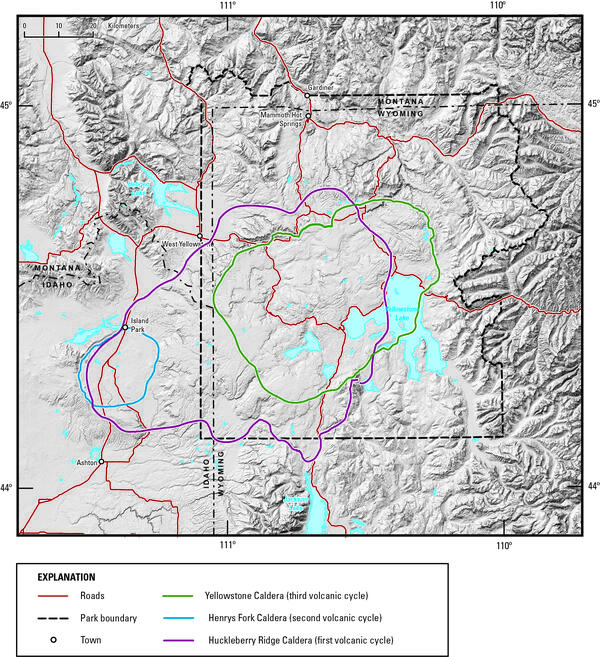
Digital elevation model of Yellowstone National Park and vicinity
Digital elevation model of Yellowstone National Park and vicinityDigital elevation model of Yellowstone National Park and vicinity, showing the location of the calderas formed during each of Yellowstone’s three most recent volcanic cycles. The youngest caldera-forming eruption produced Yellowstone Caldera (green line), located within Yellowstone National Park.
Digital elevation model of Yellowstone National Park and vicinity
Digital elevation model of Yellowstone National Park and vicinityDigital elevation model of Yellowstone National Park and vicinity, showing the location of the calderas formed during each of Yellowstone’s three most recent volcanic cycles. The youngest caldera-forming eruption produced Yellowstone Caldera (green line), located within Yellowstone National Park.

South, Middle, and North Sister volcanoes,Three Sisters OR.
South, Middle, and North Sister volcanoes,Three Sisters OR.South, Middle, and North Sister volcanoes viewed aerially from the south, Three Sisters Oregon.
South, Middle, and North Sister volcanoes,Three Sisters OR.
South, Middle, and North Sister volcanoes,Three Sisters OR.South, Middle, and North Sister volcanoes viewed aerially from the south, Three Sisters Oregon.

Broken Top volcano, inactive since 150 ka or longer, viewed to NW. ...
Broken Top volcano, inactive since 150 ka or longer, viewed to NW. ...Radially dipping strata of the cone include subequal proportions of lava flows and flow breccias and of proximal agglutinate and scoria falls, nearly all having 54 to 56 percent SiO2. Numerous mafic dikes and sills intrude the cone, and an apron of compositionally similar mafic lavas extends far outward from the cone.
Broken Top volcano, inactive since 150 ka or longer, viewed to NW. ...
Broken Top volcano, inactive since 150 ka or longer, viewed to NW. ...Radially dipping strata of the cone include subequal proportions of lava flows and flow breccias and of proximal agglutinate and scoria falls, nearly all having 54 to 56 percent SiO2. Numerous mafic dikes and sills intrude the cone, and an apron of compositionally similar mafic lavas extends far outward from the cone.

Lava cascades out of perched lava channel into lower channel, Pu‘u ...
Lava cascades out of perched lava channel into lower channel, Pu‘u ...On July 21, 2007, an erupting fissure opened on the east flank of Pu‘u ‘Ō‘ō and propagated eastward toward Kupaianaha.
Lava cascades out of perched lava channel into lower channel, Pu‘u ...
Lava cascades out of perched lava channel into lower channel, Pu‘u ...On July 21, 2007, an erupting fissure opened on the east flank of Pu‘u ‘Ō‘ō and propagated eastward toward Kupaianaha.

Contact between Huckleberry Ridge Tuff ignimbrite members B and C
Contact between Huckleberry Ridge Tuff ignimbrite members B and CThe contact (red arrow) between Huckleberry Ridge Tuff ignimbrite members B and C is marked by a time break of probably years to a few decades.
Contact between Huckleberry Ridge Tuff ignimbrite members B and C
Contact between Huckleberry Ridge Tuff ignimbrite members B and CThe contact (red arrow) between Huckleberry Ridge Tuff ignimbrite members B and C is marked by a time break of probably years to a few decades.

Mount Shasta, CA
Aerial photo of Mount Shasta's southwestern flank in a low-snow period. The Hotlum cone is on the right, while the Shastina dome is to the left.
Aerial photo of Mount Shasta's southwestern flank in a low-snow period. The Hotlum cone is on the right, while the Shastina dome is to the left.

Glacier Peak volcano, WA, viewed from the east.
Glacier Peak volcano, Washington, viewed from the east.
Glacier Peak volcano, Washington, viewed from the east.

Glacier Peak volcano, WA, viewed from the east.
Glacier Peak volcano, Washington, viewed from the east.
Glacier Peak volcano, Washington, viewed from the east.

Loowit Falls and channel flowing toward the north through the east ...
Loowit Falls and channel flowing toward the north through the east ...Loowit Falls and channel flowing toward the north through the east side of Mount St. Helen's breach.
Loowit Falls and channel flowing toward the north through the east ...
Loowit Falls and channel flowing toward the north through the east ...Loowit Falls and channel flowing toward the north through the east side of Mount St. Helen's breach.

Glacier Peak volcano, WA, viewed from the east.
Glacier Peak volcano, Washington, viewed from the east.
Glacier Peak volcano, Washington, viewed from the east.

Western edge of Sherman Crater in the foreground of the Mount Baker...
Western edge of Sherman Crater in the foreground of the Mount Baker...Western edge of Sherman Crater in the foreground of the Mount Baker Summit, Washington, view slightly northwestward.
Western edge of Sherman Crater in the foreground of the Mount Baker...
Western edge of Sherman Crater in the foreground of the Mount Baker...Western edge of Sherman Crater in the foreground of the Mount Baker Summit, Washington, view slightly northwestward.

Scientist observing Mount St. Helens' crater and dome
Scientist observing Mount St. Helens' crater and domeUSGS scientist observing Mount St. Helens' crater and dome from the Brutus Camera station.
Scientist observing Mount St. Helens' crater and dome
Scientist observing Mount St. Helens' crater and domeUSGS scientist observing Mount St. Helens' crater and dome from the Brutus Camera station.

Morning overflight view to the south. The Cape Kumukahi Light can be seen in amo
Morning overflight view to the south. The Cape Kumukahi Light can be seen in amoMorning overflight view to the south. The Cape Kumukahi Light can be seen in amongst the flows in the lower portion of the photograph. Ocean entry is still present just offshore of Kapoho with a more robust entry to the south (larger steam plume) near Ahalanui Beach Park.
Morning overflight view to the south. The Cape Kumukahi Light can be seen in amo
Morning overflight view to the south. The Cape Kumukahi Light can be seen in amoMorning overflight view to the south. The Cape Kumukahi Light can be seen in amongst the flows in the lower portion of the photograph. Ocean entry is still present just offshore of Kapoho with a more robust entry to the south (larger steam plume) near Ahalanui Beach Park.

Mount Baker and Bellingham, WA on Bellingham Bay.
Mount Baker and Bellingham, Washington on Bellingham Bay.
Mount Baker and Bellingham, Washington on Bellingham Bay.

Mount Adams western profile as seen from Mount St. Helens.
Mount Adams western profile as seen from Mount St. Helens.Mount Adams western profile as seen from Mount St. Helens.
Mount Adams western profile as seen from Mount St. Helens.
Mount Adams western profile as seen from Mount St. Helens.Mount Adams western profile as seen from Mount St. Helens.

Summit of Glacier Peak, WA, view toward the east.
Summit of Glacier Peak, Washington, view toward the east.
Summit of Glacier Peak, Washington, view toward the east.