U.S. flag

An official website of the United States government

Images

Volcano Hazard Program images.

Filter Total Items: 6273
Seismic/GPS station YOCR, at Mount Hood

A Cascades Volcano Observatory field team completes the installation of the combined seismic/GPS station YOCR, at Mount Hood.

GPS mast installed at station LSON, on Mount Hood
CVO geophysicist installs a GPS mast at station LSON, Mount Hood

USGS Cascades Volcano Observatory Geophysicist Rebecca Kramer works on the installation of the GPS mast at new station LSON, at Mount Hood. The GPS measures subtle ground deformation that can occur in response to magma entering or leaving the magma reservoir several miles below the summit.

USGS Cascades Volcano Observatory Geophysicist Rebecca Kramer works on the installation of the GPS mast at new station LSON, at Mount Hood. The GPS measures subtle ground deformation that can occur in response to magma entering or leaving the magma reservoir several miles below the summit.

Combined seismic/GPS station LSON on Mount Hood

Combined seismic/GPS station LSON, on Mount Hood, installed at the end of September 2020. LSON is one of three new stations that enhance the existing monitoring network at this high-threat volcano.

Combined seismic/GPS station LSON, on Mount Hood, installed at the end of September 2020. LSON is one of three new stations that enhance the existing monitoring network at this high-threat volcano.

4 images showing boxes of equipment with wires being put into the ground in a forest setting.
Scientists installing a lahar monitoring station.

Lahar monitoring equipment is housed in a secure box with multiple types of instruments to detect approaching lahars.  

Volcano monitoring station BRSP, on the north flank of Mount Hood

View of the combined seismic/GPS station BRSP, on the north flank of Mount Hood, Oregon. Mount Hood is pictured in the distance.

Color photograph of two scientists sampling a volcanic fumarole
HVO gas scientists collected helium samples

As part of routine monitoring efforts, HVO gas scientists collected helium samples from fumaroles in the Sulphur Banks, or Ha‘akulamanu, area of Hawai‘i Volcanoes National Park on September 30, 2020. Helium can pass through the glass of typical gas sampling bottles, so copper tubing is necessary for the specialized sample.

As part of routine monitoring efforts, HVO gas scientists collected helium samples from fumaroles in the Sulphur Banks, or Ha‘akulamanu, area of Hawai‘i Volcanoes National Park on September 30, 2020. Helium can pass through the glass of typical gas sampling bottles, so copper tubing is necessary for the specialized sample.

Color photograph of native sulfur crystals
Crystals of pure native sulfur at sites of degassing called fumaroles

Different sulfur gases, including sulfur dioxide (SO2) and hydrogen sulfide (H2S), can react with each other to deposit crystals of pure native sulfur at sites of degassing called fumaroles. The crystals picture here formed within a Sulphur Banks area fumarole in Hawai‘i Volcanoes National Park. USGS photo by T. Elias.

Different sulfur gases, including sulfur dioxide (SO2) and hydrogen sulfide (H2S), can react with each other to deposit crystals of pure native sulfur at sites of degassing called fumaroles. The crystals picture here formed within a Sulphur Banks area fumarole in Hawai‘i Volcanoes National Park. USGS photo by T. Elias.

Helicopter delivers equipment to station BRSP on Mount Hood

A USGS Cascades Volcano Observatory field team waits on this remote north flank of Mount Hood, as a helicopter delivers supplies and equipment to station BRSP. The station was installed with minimal impact on the environment. A helicopter delivered equipment via external sling load and USGS personnel accessed the site by foot.

A USGS Cascades Volcano Observatory field team waits on this remote north flank of Mount Hood, as a helicopter delivers supplies and equipment to station BRSP. The station was installed with minimal impact on the environment. A helicopter delivered equipment via external sling load and USGS personnel accessed the site by foot.

Installation of GPS mast at station BRSP on Mount Hood

USGS Cascades Volcano Observatory Geophysicist Emily Montgomery-Brown uses a drill to create a small hole in volcanic rock that will support a GPS mast. The effort was part of a three-station installation project at Mount Hood in 2020. This station location is called BRSP.

USGS Cascades Volcano Observatory Geophysicist Emily Montgomery-Brown uses a drill to create a small hole in volcanic rock that will support a GPS mast. The effort was part of a three-station installation project at Mount Hood in 2020. This station location is called BRSP.

Installing a seismometer at station BRSP on Mount Hood

Volcano Disaster Assistance Program Geophysicist Jeremy Pesicek digs a hole for a seismometer at station BRSP, on the north flank of Mount Hood. The seismometer, which detects earthquakes, is buried at a depth of at least 1 meter (3 feet).

Volcano Disaster Assistance Program Geophysicist Jeremy Pesicek digs a hole for a seismometer at station BRSP, on the north flank of Mount Hood. The seismometer, which detects earthquakes, is buried at a depth of at least 1 meter (3 feet).

Color photograph of yellow native sulfur crystals
Close-up image of native sulfur crystals

A close-up image of native sulfur crystals that formed within fumaroles at the Sulphur Banks in Hawai‘i Volcanoes National Park. In addition to sulfur species and other gases, volcanoes emit water vapor. Here, some of the vapor has condensed to liquid water and formed droplets visible on the sulfur crystals. USGS photo by P. Nadeau. 

A close-up image of native sulfur crystals that formed within fumaroles at the Sulphur Banks in Hawai‘i Volcanoes National Park. In addition to sulfur species and other gases, volcanoes emit water vapor. Here, some of the vapor has condensed to liquid water and formed droplets visible on the sulfur crystals. USGS photo by P. Nadeau. 

Photograph of tubing inserted into a fumarole
Tubing inserted into a fumarole

Tubing inserted into a fumarole at the Sulphur Banks in Hawai‘i Volcanoes National Park allows HVO gas scientists to sample gas. The gas travels through the tube into gas sampling bottles for later analyses. USGS photo by M. Warren.

Tubing inserted into a fumarole at the Sulphur Banks in Hawai‘i Volcanoes National Park allows HVO gas scientists to sample gas. The gas travels through the tube into gas sampling bottles for later analyses. USGS photo by M. Warren.

New seismic/GPS station (LSON) installed at Mount Hood

USGS Cascades Volcano Observatory Geophysicist Wes Thelen, removes ropes from new station LSON, at Mount Hood (Mount Hood is pictured in the distance).

Panoramic view of Pocket Basin, Yellowstone National Park

Panoramic photo of Pocket Basin, a hydrothermal explosion crater in Yellowstone National Park's Lower Geyser Basin, taken from the northeast rim looking southwest into the crater. Pocket Basin is a U-shaped crater that is dissected on the SW edge by the Firehole River, visible on the far-right of the photo.

Panoramic photo of Pocket Basin, a hydrothermal explosion crater in Yellowstone National Park's Lower Geyser Basin, taken from the northeast rim looking southwest into the crater. Pocket Basin is a U-shaped crater that is dissected on the SW edge by the Firehole River, visible on the far-right of the photo.

Photograph of gravimeter in caldera
Kīlauea summit gravity survey - September 23, 2020

A gravimeter makes a measurement at a benchmark situated among lava flows erupted in 1919. The strength of gravity varies with both elevation and the amount of mass beneath the instrument. Changes in mass can indicate changes in the amount of magma entering Kīlauea's magma reservoirs. USGS photo by A. Flinders.

A gravimeter makes a measurement at a benchmark situated among lava flows erupted in 1919. The strength of gravity varies with both elevation and the amount of mass beneath the instrument. Changes in mass can indicate changes in the amount of magma entering Kīlauea's magma reservoirs. USGS photo by A. Flinders.

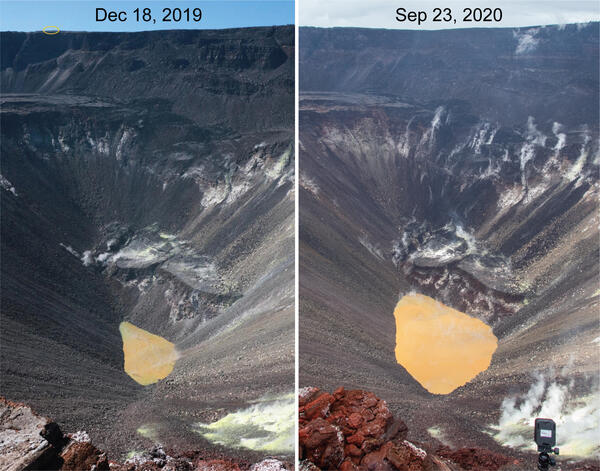
Color photographs of volcanic crater lake
Kīlauea's summit water lake comparison - September 23, 2020

HVO geologists made observations of Kīlauea's summit water lake from the east rim of Halema‘uma‘u. This view point is on the large downdropped block that subsided during the 2018 collapse events. From this spot, a view of the entire lake is possible, providing a new perspective on the growth of the lake.

HVO geologists made observations of Kīlauea's summit water lake from the east rim of Halema‘uma‘u. This view point is on the large downdropped block that subsided during the 2018 collapse events. From this spot, a view of the entire lake is possible, providing a new perspective on the growth of the lake.

Photograph of material floating on volcanic crater lake
Floating material on Kīlauea's summit water lake on September 23, 2020

Small patches of light-colored floating material were seen drifting on the surface of Kīlauea's summit water lake on September 23, 2020. The composition of this material is unknown, but future water sampling missions may provide insight. USGS photo by M. Patrick.

Small patches of light-colored floating material were seen drifting on the surface of Kīlauea's summit water lake on September 23, 2020. The composition of this material is unknown, but future water sampling missions may provide insight. USGS photo by M. Patrick.

Photograph of scientists surveying caldera
Kīlauea summit gravity survey - September 23, 2020

On September 23, 2020, Hawaiian Volcano Observatory geophysicists and a geologist conducted a gravity survey of Kīlauea summit, as part of HVO's regular monitoring program. In this photo, scientists are carrying survey equipment westward along the remnants of the Halema‘uma‘u Trail on the down-dropped block of Kīlauea caldera.

On September 23, 2020, Hawaiian Volcano Observatory geophysicists and a geologist conducted a gravity survey of Kīlauea summit, as part of HVO's regular monitoring program. In this photo, scientists are carrying survey equipment westward along the remnants of the Halema‘uma‘u Trail on the down-dropped block of Kīlauea caldera.

Photograph of scientists surveying caldera
Kīlauea summit gravity survey - September 23, 2020

During a gravity survey, HVO scientists measure the relative strength of gravity (gravimeter, bottom left corner of photo) between benchmarks. High-precision vertical positions from kinematic Global Positioning System (GPS, tripod and antenna middle of photo) help correct the gravity measurement for the effects of elevation changes.

During a gravity survey, HVO scientists measure the relative strength of gravity (gravimeter, bottom left corner of photo) between benchmarks. High-precision vertical positions from kinematic Global Positioning System (GPS, tripod and antenna middle of photo) help correct the gravity measurement for the effects of elevation changes.

Color photograph of road and crater lake
Kīlauea’s summit water lake and Crater Rim Drive - September 23, 2020

Portions of Crater Rim Drive, within Hawai‘i Volcanoes National Park, appear cracked, offset, and down-dropped in this photo, taken during an overflight of Kīlauea’s summit on September 23, 2020. To the north, Kīlauea’s summit water lake, within Halema‘uma‘u, is visible. USGS photo by K. Mulliken.

Portions of Crater Rim Drive, within Hawai‘i Volcanoes National Park, appear cracked, offset, and down-dropped in this photo, taken during an overflight of Kīlauea’s summit on September 23, 2020. To the north, Kīlauea’s summit water lake, within Halema‘uma‘u, is visible. USGS photo by K. Mulliken.

Color photograph of steam vents
Wahinekapu (Steaming Bluff) and the Steam Vents area

The weather was overcast during an overflight of Kīlauea's summit on September 23, 2020. This view shows Wahinekapu (Steaming Bluff) and the Steam Vents area within Hawai‘i Volcanoes National Park. Extensive cracks in the area allow heated groundwater to escape from underground.

The weather was overcast during an overflight of Kīlauea's summit on September 23, 2020. This view shows Wahinekapu (Steaming Bluff) and the Steam Vents area within Hawai‘i Volcanoes National Park. Extensive cracks in the area allow heated groundwater to escape from underground.

Was this page helpful?