U.S. flag

An official website of the United States government

Images

Volcano Hazard Program images.

Filter Total Items: 6262
Photo looking north from the north shore of Yellowstone Lake at lake terraces.
Photo looking north from the north shore of Yellowstone Lake

Photo looking north from the north shore of Yellowstone Lake. The photo was taken from a level bench, or terrace, which marks a previous high stand of the lake.  In the middle distance (between the two red lines), the ground slopes up to second, higher-level terrace that indicates an even higher past lake level.

Photo looking north from the north shore of Yellowstone Lake. The photo was taken from a level bench, or terrace, which marks a previous high stand of the lake.  In the middle distance (between the two red lines), the ground slopes up to second, higher-level terrace that indicates an even higher past lake level.

image related to volcanoes. See description
Water was in Kīlauea caldera before the 2018 summit collapse

Black streak on caldera wall (center) is about 50 m (yards) long, and white steam plume (lower right) rises from northwestern part of Halema‘uma‘u. Photo from Volcano House Hotel on July 4, 2018. The configuration of this area changed considerably after the photo was taken, as collapse continued into early August. USGS photo.

Black streak on caldera wall (center) is about 50 m (yards) long, and white steam plume (lower right) rises from northwestern part of Halema‘uma‘u. Photo from Volcano House Hotel on July 4, 2018. The configuration of this area changed considerably after the photo was taken, as collapse continued into early August. USGS photo.

image related to volcanoes. See description
Rainbow over Halema‘uma‘u and the water lake

The KWcam webcam at Kīlauea's summit captured a rainbow over the water lake in Halema‘uma‘u this afternoon, as light mist moved across the caldera.

The KWcam webcam at Kīlauea's summit captured a rainbow over the water lake in Halema‘uma‘u this afternoon, as light mist moved across the caldera.

Monitoring for volcanic gases at Newberry Volcano
A MultiGAS instrument measures gases at Newberry Volcano

Scientists use a MultiGAS instrument (gray, hard-shell case) to measure gas compositions from the East Lake hot spring in the Newberry caldera. The photo was taken on August 3, 2020 just after sunrise. The vapor above the hot spring and lake is typical for cool mornings and is not visible later in the day.

Scientists use a MultiGAS instrument (gray, hard-shell case) to measure gas compositions from the East Lake hot spring in the Newberry caldera. The photo was taken on August 3, 2020 just after sunrise. The vapor above the hot spring and lake is typical for cool mornings and is not visible later in the day.

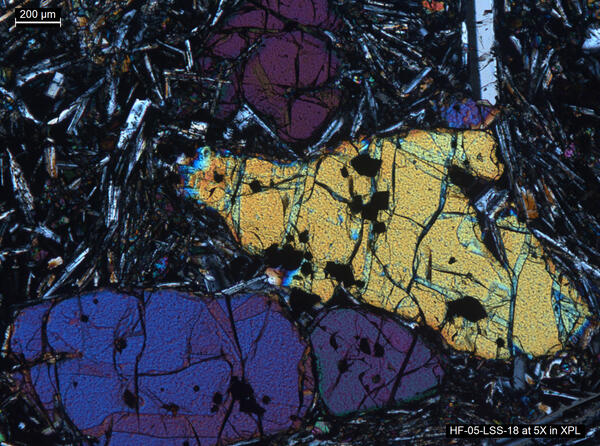
Thin section image of a lava sample from Yellowstone using a polarizing microscope.
Thin section image of a lava sample from Yellowstone

Thin section image of a lava sample from Yellowstone using a polarizing microscope. The mineral assemblage is representative of many of Yellowstone’s basaltic rocks. The three large and colored crystals (known as phenocrysts) in the center of the image are the mineral olivine.

Thin section image of a lava sample from Yellowstone using a polarizing microscope. The mineral assemblage is representative of many of Yellowstone’s basaltic rocks. The three large and colored crystals (known as phenocrysts) in the center of the image are the mineral olivine.

image related to volcanoes. See description
Timelapse showing typical activity at Kīlauea's summit water lake

This timelapse video at Kīlauea's summit covers approximately 30 minutes and shows the dynamic nature of the water lake in Halema‘uma‘u crater. Steam from the hot water surface is constantly shifting in the winds, while the migrating color boundaries on the water surface appear to show circulation in the lake. USGS video by M. Patrick.

This timelapse video at Kīlauea's summit covers approximately 30 minutes and shows the dynamic nature of the water lake in Halema‘uma‘u crater. Steam from the hot water surface is constantly shifting in the winds, while the migrating color boundaries on the water surface appear to show circulation in the lake. USGS video by M. Patrick.

image related to volcanoes. See description
Kīlauea Volcano's summit water lake is one-year old

Plot showing rise of Kīlauea's summit crater lake over the past year, during which laser rangefinder measurements of lake level were made 2–3 times per week. Photos compare the lake on August 27, 2019, when it was ~22 ft (7 m) deep, to July 7, 2020, when it was ~130 ft (40 m) deep. USGS photos.

Plot showing rise of Kīlauea's summit crater lake over the past year, during which laser rangefinder measurements of lake level were made 2–3 times per week. Photos compare the lake on August 27, 2019, when it was ~22 ft (7 m) deep, to July 7, 2020, when it was ~130 ft (40 m) deep. USGS photos.

image related to volcanoes. See description
Continued slow rise of water in Halema‘uma‘u

Kīlauea's summit water lake, in Halema‘uma‘u, continues to slowly rise. Today, the lake colors were vibrant, with a zone of aquamarine water in the west end (lower right in photo). These greenish zones tend to be slightly hotter, and appear to be zones of water influx. USGS photo by M. Patrick.

Kīlauea's summit water lake, in Halema‘uma‘u, continues to slowly rise. Today, the lake colors were vibrant, with a zone of aquamarine water in the west end (lower right in photo). These greenish zones tend to be slightly hotter, and appear to be zones of water influx. USGS photo by M. Patrick.

Animated GIF showing rise of crater lake
Kīlauea crater lake one year anniversary

ANIMATED GIF: Saturday, July 25, marks the one year anniversary since water was first spotted at the bottom of Halema‘uma‘u, at the summit of Kīlauea. Over the past year, the summit water lake has grown to more than 270 m (885 ft) long and 131 m (430 ft) wide, with a surface area over 2.5 hectares (6 acres).

ANIMATED GIF: Saturday, July 25, marks the one year anniversary since water was first spotted at the bottom of Halema‘uma‘u, at the summit of Kīlauea. Over the past year, the summit water lake has grown to more than 270 m (885 ft) long and 131 m (430 ft) wide, with a surface area over 2.5 hectares (6 acres).

Two color photograph's of lake
Comparison of images showing growth of Kīlauea's summit water lake

Comparison of images showing growth of Kīlauea's summit water lake over the past year. The left image, taken on August 2, 2019, shows a small green pond that was approximately 6 ft (2 m) deep. The right image, taken on July 21, 2020, shows a lake more than 130 ft (40 m) deep with shades of tan to brown and a sharp color boundary often cutting across the lake.

Comparison of images showing growth of Kīlauea's summit water lake over the past year. The left image, taken on August 2, 2019, shows a small green pond that was approximately 6 ft (2 m) deep. The right image, taken on July 21, 2020, shows a lake more than 130 ft (40 m) deep with shades of tan to brown and a sharp color boundary often cutting across the lake.

Using a rangefinder to determine the height of Steamboat Geyser

In the first few minutes of Steamboat's eruptions, it has often been measured well over 300 ft. with a few exceptional eruptions measured by visitors at over 400 ft.!  In this example, done using a rangefinder by a Yellowstone National Park ranger, it comes in at 334.9 ft. For comparison, the Lower Falls of the Yellowstone is about 308 ft.

In the first few minutes of Steamboat's eruptions, it has often been measured well over 300 ft. with a few exceptional eruptions measured by visitors at over 400 ft.!  In this example, done using a rangefinder by a Yellowstone National Park ranger, it comes in at 334.9 ft. For comparison, the Lower Falls of the Yellowstone is about 308 ft.

image related to volcanoes. See description
August 2019 to July 2020 summit lake comparison
Color photograph of small electronic instrument
The Raspberry Shake 4D (RS4D)

The Raspberry Shake 4D (RS4D) is a personal seismograph with a vertical-component velocity transducer, and three-component (vertical, north-south, and east-west) accelerometer. A Raspberry Pi, which is a computer about the size of a credit card, powers the RS4D unit, which is about the size of a can of Spam.

The Raspberry Shake 4D (RS4D) is a personal seismograph with a vertical-component velocity transducer, and three-component (vertical, north-south, and east-west) accelerometer. A Raspberry Pi, which is a computer about the size of a credit card, powers the RS4D unit, which is about the size of a can of Spam.

A NPS scientist uses a camera to image Castle Geyser in Yellowstone National Park
NPS scientist collects imagery of Castle Geyser, Yellowstone

National Park Service scientist using a camera paired with a GPS receiver to obtain images of Castle Geyser, Yellowstone National Park, in June 2019.

image related to volcanoes. See description
No significant changes at Kīlauea's summit water lake

An HVO geologist collects GPS data on the western rim of Kīlauea's summit caldera. The geologist is standing upon a thick sequence of tephra deposits formed during explosive eruptions at Kīlauea's summit between about 1500 CE and the early 19th century.

An HVO geologist collects GPS data on the western rim of Kīlauea's summit caldera. The geologist is standing upon a thick sequence of tephra deposits formed during explosive eruptions at Kīlauea's summit between about 1500 CE and the early 19th century.

Photo of the Roosevelt Arch at the north entrance of Yellowstone National Park at night with comet NEOWISE in the background
Comet NEOWISE and the Roosevelt Arch at Yellowstone National Park

Comet NEOWISE is seen with the Roosevelt Arch in the foreground at the north Entrance of Yellowstone National Park.  The town of Gardiner, Montana, is in the background.

Panorama of Hayden Valley, Yellowstone National Park

Panoramic photo of Hayden Valley looking east toward the Yellowstone River from the Mary Mountain trail.

Violet Creek in Hayden Valley, Yellowstone National Park
Was this page helpful?