



This satellite image was captured by the Advanced Land Imager instrument onboard NASA's Earth Observing 1 satellite. Although this is a false-color image, the color map has been chosen to mimic what the human eye would expect to see. Bright red pixels depict areas of very high temperatures, and show active lava. White areas are clouds.
Images
Volcano Hazard Program images.
Filter Total Items: 6279

Satellite image shows update on flow activity
This satellite image was captured by the Advanced Land Imager instrument onboard NASA's Earth Observing 1 satellite. Although this is a false-color image, the color map has been chosen to mimic what the human eye would expect to see. Bright red pixels depict areas of very high temperatures, and show active lava. White areas are clouds.

shows the small explosion of spatter that occurred at Halema‘uma‘u ...
shows the small explosion of spatter that occurred at Halema‘uma‘u ...Preview image for video: shows the small explosion of spatter that occurred at Halema‘uma‘u on Sunday, October 19. Spatter landed around the Halema‘uma‘u Overlook (closed to the public).
shows the small explosion of spatter that occurred at Halema‘uma‘u ...
shows the small explosion of spatter that occurred at Halema‘uma‘u ...Preview image for video: shows the small explosion of spatter that occurred at Halema‘uma‘u on Sunday, October 19. Spatter landed around the Halema‘uma‘u Overlook (closed to the public).

Small-scale map of June 27th flow in Kīlauea's ERZ
Small-scale map of June 27th flow in Kīlauea's ERZThis small-scale map shows the June 27th lava flow in Kīlauea's East Rift Zone in relation to lower Puna. The area of the flow on October 17, 2014, at 7:40 AM is shown in pink, while widening and advancement of the flow as mapped on October 20 at 1:00 PM is shown in red.
Small-scale map of June 27th flow in Kīlauea's ERZ
Small-scale map of June 27th flow in Kīlauea's ERZThis small-scale map shows the June 27th lava flow in Kīlauea's East Rift Zone in relation to lower Puna. The area of the flow on October 17, 2014, at 7:40 AM is shown in pink, while widening and advancement of the flow as mapped on October 20 at 1:00 PM is shown in red.

Upslope from the flow front, several breakouts are active around th...
Upslope from the flow front, several breakouts are active around th...Upslope from the flow front, several breakouts are active around the crack system. These surface flows (marked by the smoke plumes) have filled in a ground crack that is immediately north of another crack. The southern crack, marked by the white dotted line, is the main crack that lava is traveling along below the surface.
Upslope from the flow front, several breakouts are active around th...
Upslope from the flow front, several breakouts are active around th...Upslope from the flow front, several breakouts are active around the crack system. These surface flows (marked by the smoke plumes) have filled in a ground crack that is immediately north of another crack. The southern crack, marked by the white dotted line, is the main crack that lava is traveling along below the surface.

Pu‘u ‘Ō‘ō remains filled with thick fume
Pu‘u ‘Ō‘ō Crater remains filled with thick fume, but recent views with the naked eye and thermal camera confirm that little change has occurred in the crater over recent weeks. The fume masks a handful of small incandescent openings on the crater floor.
Pu‘u ‘Ō‘ō Crater remains filled with thick fume, but recent views with the naked eye and thermal camera confirm that little change has occurred in the crater over recent weeks. The fume masks a handful of small incandescent openings on the crater floor.

June 27th lava flow remains active
The June 27th lava flow remains active, with no significant advancement of the flow front since Friday, Oct 17. The flow is active along the northern boundary of Kaohe Homesteads subdivision, with brush fires along the flow margins creating thick plumes of smoke.
The June 27th lava flow remains active, with no significant advancement of the flow front since Friday, Oct 17. The flow is active along the northern boundary of Kaohe Homesteads subdivision, with brush fires along the flow margins creating thick plumes of smoke.

Small explosion of spatter from the lava lake in Halema‘uma‘u
Small explosion of spatter from the lava lake in Halema‘uma‘uA collapse of rock from the wall of Halema‘uma‘u Crater occurred yesterday (Sunday, October 19) around 1:15 am, with rocks impacting the lake and triggering an explosion of spatter. The scar left by this collapse is visible as the light-colored area marked in the photo.
Small explosion of spatter from the lava lake in Halema‘uma‘u
Small explosion of spatter from the lava lake in Halema‘uma‘uA collapse of rock from the wall of Halema‘uma‘u Crater occurred yesterday (Sunday, October 19) around 1:15 am, with rocks impacting the lake and triggering an explosion of spatter. The scar left by this collapse is visible as the light-colored area marked in the photo.

Image of area around flow front
This map uses a satellite image acquired in March 2014 (provided by Digital Globe) as a base to show the area around the front of the June 27th lava flow. The area of the flow on October 17, 2014, at 7:40 AM is shown in pink, while widening and advancement of the flow as mapped on October 20 at 1:00 PM is shown in red.
This map uses a satellite image acquired in March 2014 (provided by Digital Globe) as a base to show the area around the front of the June 27th lava flow. The area of the flow on October 17, 2014, at 7:40 AM is shown in pink, while widening and advancement of the flow as mapped on October 20 at 1:00 PM is shown in red.

Large-scale map of June 27th flow in Kīlauea's ERZ
Large-scale map of June 27th flow in Kīlauea's ERZThis large-scale map shows the distal part of the June 27th flow in relation to nearby Puna communities. The area of the flow on October 17, 2014, at 7:40 AM is shown in pink, while widening and advancement of the flow as mapped on October 20 at 1:00 PM is shown in red.
Large-scale map of June 27th flow in Kīlauea's ERZ
Large-scale map of June 27th flow in Kīlauea's ERZThis large-scale map shows the distal part of the June 27th flow in relation to nearby Puna communities. The area of the flow on October 17, 2014, at 7:40 AM is shown in pink, while widening and advancement of the flow as mapped on October 20 at 1:00 PM is shown in red.

A comparison of a normal photograph of the flow front with a therma...
A comparison of a normal photograph of the flow front with a therma...A comparison of a normal photograph of the flow front with a thermal image. Although the leading edge of the flow has advanced only a slight amount over the past week (about 100 m, or 110 yards), active portions behind the flow front have moved at a faster rate.
A comparison of a normal photograph of the flow front with a therma...
A comparison of a normal photograph of the flow front with a therma...A comparison of a normal photograph of the flow front with a thermal image. Although the leading edge of the flow has advanced only a slight amount over the past week (about 100 m, or 110 yards), active portions behind the flow front have moved at a faster rate.

Small-scale map of June 27th flow in Kīlauea's ERZ
Small-scale map of June 27th flow in Kīlauea's ERZThis small-scale map shows the June 27th lava flow in Kīlauea's East Rift Zone in relation to lower Puna. The area of the flow on October 15, 2014, at 10:30 AM is shown in pink, while widening and advancement of the flow as mapped on October 17 at 7:40 AM is shown in red.
Small-scale map of June 27th flow in Kīlauea's ERZ
Small-scale map of June 27th flow in Kīlauea's ERZThis small-scale map shows the June 27th lava flow in Kīlauea's East Rift Zone in relation to lower Puna. The area of the flow on October 15, 2014, at 10:30 AM is shown in pink, while widening and advancement of the flow as mapped on October 17 at 7:40 AM is shown in red.
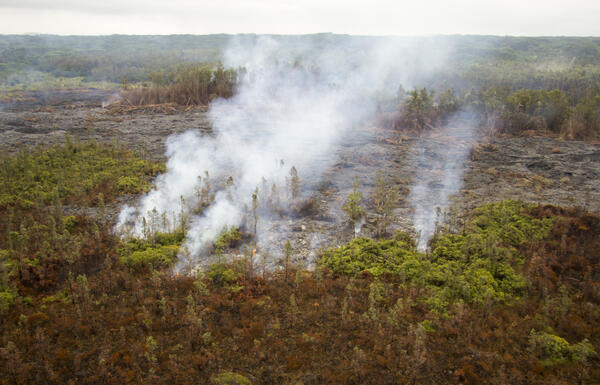
Close view of north margin of the flow, just behind the flow front
Close view of north margin of the flow, just behind the flow frontA close view of the north margin of the flow, just behind the flow front.
Close view of north margin of the flow, just behind the flow front
Close view of north margin of the flow, just behind the flow frontA close view of the north margin of the flow, just behind the flow front.
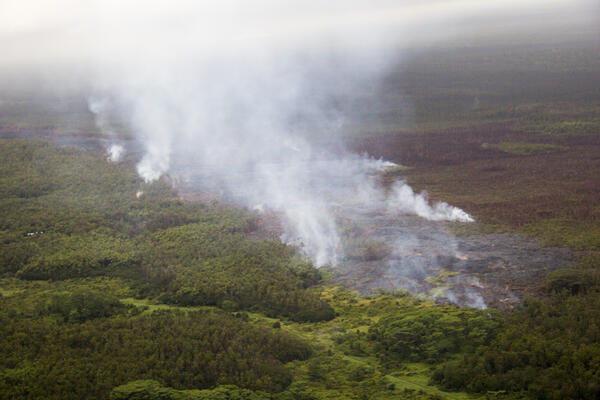
Flow front showing the leading edge moving through thick vegetation
Flow front showing the leading edge moving through thick vegetationA closer look at the flow front, showing the leading edge moving through thick vegetation.
Flow front showing the leading edge moving through thick vegetation
Flow front showing the leading edge moving through thick vegetationA closer look at the flow front, showing the leading edge moving through thick vegetation.
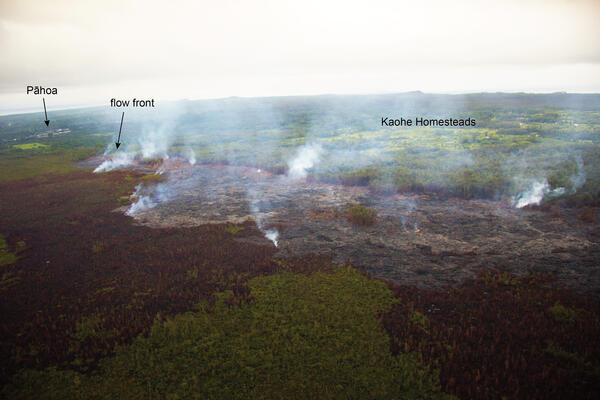
flow front, looking downslope towards Pāhoa. The smoke plumes are ...
flow front, looking downslope towards Pāhoa. The smoke plumes are ...Another view of the flow front, looking downslope towards Pāhoa. The smoke plumes are created by individual breakouts burning vegetation at the flow margin.
flow front, looking downslope towards Pāhoa. The smoke plumes are ...
flow front, looking downslope towards Pāhoa. The smoke plumes are ...Another view of the flow front, looking downslope towards Pāhoa. The smoke plumes are created by individual breakouts burning vegetation at the flow margin.

Large-scale map of June 27th flow in Kīlauea's ERZ
Large-scale map of June 27th flow in Kīlauea's ERZThis large-scale map shows the distal part of the June 27th flow in relation to nearby Puna communities. The area of the flow on October 15, 2014, at 10:30 AM is shown in pink, while widening and advancement of the flow as mapped on October 17 at 7:40 AM is shown in red.
Large-scale map of June 27th flow in Kīlauea's ERZ
Large-scale map of June 27th flow in Kīlauea's ERZThis large-scale map shows the distal part of the June 27th flow in relation to nearby Puna communities. The area of the flow on October 15, 2014, at 10:30 AM is shown in pink, while widening and advancement of the flow as mapped on October 17 at 7:40 AM is shown in red.
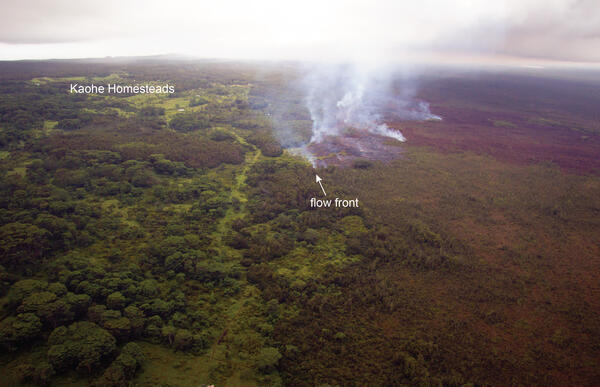
Very little advancement of the flow's leading edge
Very little advancement of the flow's leading edgeThe June 27th lava flow remains active, but has advanced only a minor distance - about 50 m (55 yards) - over the past two days. Activity persists around the flow front, however, with numerous scattered breakouts. The flow front this morning was 1.1 km (0.7 miles) from Apa‘a St., as measured along a straight line.
Very little advancement of the flow's leading edge
Very little advancement of the flow's leading edgeThe June 27th lava flow remains active, but has advanced only a minor distance - about 50 m (55 yards) - over the past two days. Activity persists around the flow front, however, with numerous scattered breakouts. The flow front this morning was 1.1 km (0.7 miles) from Apa‘a St., as measured along a straight line.
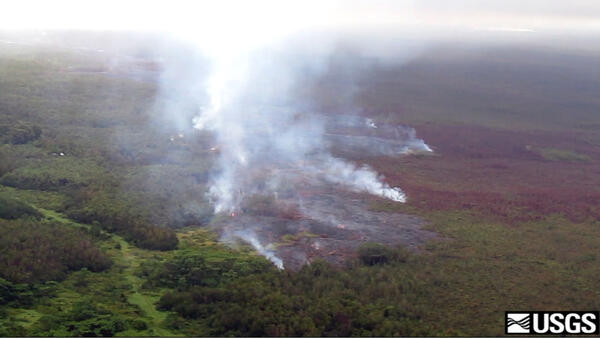
Brief aerial overview of activity at the flow front
Brief aerial overview of activity at the flow frontPreview image for video: provides a brief aerial overview of activity at the flow front.
Brief aerial overview of activity at the flow front
Brief aerial overview of activity at the flow frontPreview image for video: provides a brief aerial overview of activity at the flow front.

Image of area around flow front
This map uses a satellite image acquired in March 2014 (provided by Digital Globe) as a base to show the area around the front of the June 27th lava flow. The area of the flow on October 15, 2014, at 10:30 AM is shown in pink, while widening and advancement of the flow as mapped on October 17 at 7:40 AM is shown in red.
This map uses a satellite image acquired in March 2014 (provided by Digital Globe) as a base to show the area around the front of the June 27th lava flow. The area of the flow on October 15, 2014, at 10:30 AM is shown in pink, while widening and advancement of the flow as mapped on October 17 at 7:40 AM is shown in red.
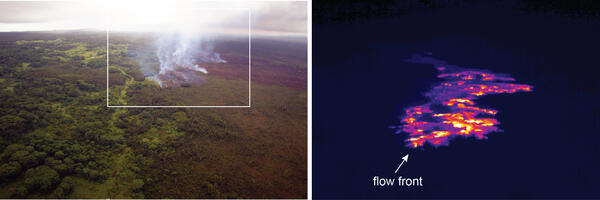
A comparison of a normal photograph of the flow front with a therma...
A comparison of a normal photograph of the flow front with a therma...A comparison of a normal photograph of the flow front with a thermal image. The white box shows the extent of the thermal image. The thermal image shows that numerous active breakouts (white and yellow areas) are scattered behind the flow front.
A comparison of a normal photograph of the flow front with a therma...
A comparison of a normal photograph of the flow front with a therma...A comparison of a normal photograph of the flow front with a thermal image. The white box shows the extent of the thermal image. The thermal image shows that numerous active breakouts (white and yellow areas) are scattered behind the flow front.

Flow front advancement slows, active breakouts persist near front
Flow front advancement slows, active breakouts persist near frontThe June 27th lava flow advancement has slowed, with the leading edge of the flow moving only a few tens of meters (yards) over the past two days. Nevertheless, active breakouts persist around the flow front, as shown in this photo by the continued burning of vegetation along the flow margins.
Flow front advancement slows, active breakouts persist near front
Flow front advancement slows, active breakouts persist near frontThe June 27th lava flow advancement has slowed, with the leading edge of the flow moving only a few tens of meters (yards) over the past two days. Nevertheless, active breakouts persist around the flow front, as shown in this photo by the continued burning of vegetation along the flow margins.
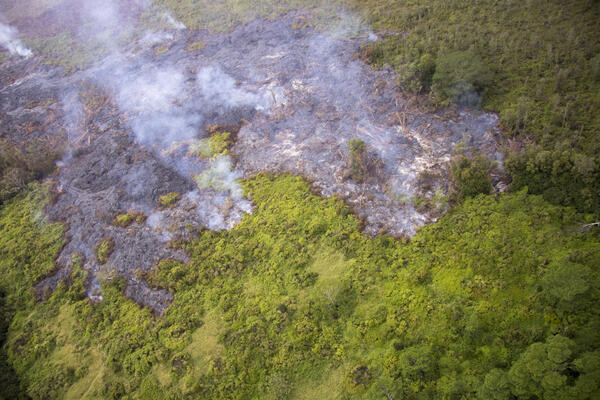
leading edge of the flow, which consisted of scattered breakouts al...
leading edge of the flow, which consisted of scattered breakouts al...A closer view of the leading edge of the flow, which consisted of scattered breakouts along the flow margin that were slowly moving through thick vegetation.
leading edge of the flow, which consisted of scattered breakouts al...
leading edge of the flow, which consisted of scattered breakouts al...A closer view of the leading edge of the flow, which consisted of scattered breakouts along the flow margin that were slowly moving through thick vegetation.