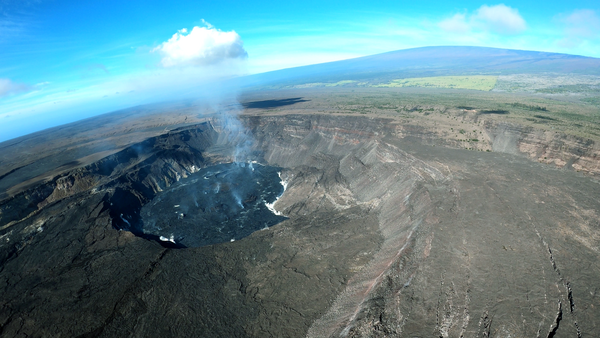
A helicopter overflight on March 17, 2022, allowed for aerial visual and thermal imagery to be collected of Halema‘uma‘u crater at the summit of Kīlauea. The active lake surface is limited to the western portion of the crater.
Images
Volcano Hazard Program images.
A helicopter overflight on March 17, 2022, allowed for aerial visual and thermal imagery to be collected of Halema‘uma‘u crater at the summit of Kīlauea. The active lake surface is limited to the western portion of the crater.
March 17, 2022 — Kīlauea summit eruption overflight
March 17, 2022 — Kīlauea summit eruption overflightA routine helicopter overflight on March 17, 2022, provided airborne views of the summit eruption in Halema‘uma‘u crater, at the summit of Kīlauea. At the start of the video, the helicopter flies over the edge of the large collapse depression formed during the 2018 eruption.
March 17, 2022 — Kīlauea summit eruption overflight
March 17, 2022 — Kīlauea summit eruption overflightA routine helicopter overflight on March 17, 2022, provided airborne views of the summit eruption in Halema‘uma‘u crater, at the summit of Kīlauea. At the start of the video, the helicopter flies over the edge of the large collapse depression formed during the 2018 eruption.
The USGS Hawaiian Volcano Observatory’s Absolute Quantum Gravimeter is undergoing set-up, testing, and calibration before installation at the summit of Kīlauea. USGS image by A. Ellis.
March 17, 2022 — Overview of Halema‘uma‘u, Kīlauea
March 17, 2022 — Overview of Halema‘uma‘u, KīlaueaA photograph taken during a helicopter overflight on the morning of March 17, 2022, shows an overview of Halema‘uma‘u and a diffuse plume rising above Kīlauea caldera.
March 17, 2022 — Overview of Halema‘uma‘u, Kīlauea
March 17, 2022 — Overview of Halema‘uma‘u, KīlaueaA photograph taken during a helicopter overflight on the morning of March 17, 2022, shows an overview of Halema‘uma‘u and a diffuse plume rising above Kīlauea caldera.
March 21, 2022—Kīlauea summit eruption reference map
March 21, 2022—Kīlauea summit eruption reference mapThis reference map depicts the ongoing Kīlauea summit eruption on March 21, 2022. One eruptive vent is intermittently active within Halema‘uma‘u, in the western end of the crater. When this vent is effusing lava, it pours into a lava lake, colored red on this map.
March 21, 2022—Kīlauea summit eruption reference map
March 21, 2022—Kīlauea summit eruption reference mapThis reference map depicts the ongoing Kīlauea summit eruption on March 21, 2022. One eruptive vent is intermittently active within Halema‘uma‘u, in the western end of the crater. When this vent is effusing lava, it pours into a lava lake, colored red on this map.
This 8 meter (26 feet) tall arch of lava was left behind during a lull in eruptive activity within Halema‘uma‘u crater, at Kīlauea's summit. This feature is located in the spillway that connects the vent of Halema‘uma‘u to the lava lake.
Telephoto view, looking east, of the lava source area for the active lava lake within Halema‘uma‘u at the summit of Kīlauea on March 11. The is supplied from the embayment which is just north (left) of the remnants of west cone area (center and right).
A view of Halema‘uma‘u at Kīlauea summit, looking east, on the morning of March 11. The active lava lake is silvery gray and is visible in the lower right. The remnants of the west vent cone area are visible to the west (bottom right) of the active lava lake, and are the source of the majority of bluish-white volcanic gas emissions. USGS image by N. Deligne.
Telephoto view looking east of the active lava lake within Halema‘uma‘u crater at the summit of Kīlauea on March 11, 2022. The craggy remains of the west vent cone, which has broken down over the past few weeks, are visible through the volcanic gas plume in the lower right.
Bursts of lava erupting from a vent in the western half of Halema‘uma‘u crater, at Kīlauea volcano summit, were reaching 15-20 meters (50-65 feet) from the top of the cone on March 4, 2022. A small channel of sluggish lava was flowing down the western side of this cone.
Kīlauea's summit eruption continues within Halema‘uma‘u crater. A number of vents are located in the western half of the crater, where the west vent cone used to be. On March 4, 2022, the highest of these features was measured at 19 meters (60 feet) in height and is shown in this photograph. USGS photo by L. Gallant.
March 4, 2022—Kīlauea summit eruption reference map
March 4, 2022—Kīlauea summit eruption reference mapThis reference map depicts the ongoing Kīlauea summit eruption on March 4, 2022. One eruptive vent is intermittently active within Halema‘uma‘u, in the western end of the crater. When this vent is effusing lava, it pours into a lava lake, colored red on this map.
March 4, 2022—Kīlauea summit eruption reference map
March 4, 2022—Kīlauea summit eruption reference mapThis reference map depicts the ongoing Kīlauea summit eruption on March 4, 2022. One eruptive vent is intermittently active within Halema‘uma‘u, in the western end of the crater. When this vent is effusing lava, it pours into a lava lake, colored red on this map.
Changes to the west vent area in Halema‘uma‘u over the past month
Changes to the west vent area in Halema‘uma‘u over the past monthThis animated gif features one V1cam image, taken around noon each day, from February 1, 2022, through March 4, 2022.
Changes to the west vent area in Halema‘uma‘u over the past month
Changes to the west vent area in Halema‘uma‘u over the past monthThis animated gif features one V1cam image, taken around noon each day, from February 1, 2022, through March 4, 2022.
The ongoing eruption in Halema‘uma‘u, at Kīlauea summit, is occurring from a number of vents in a complex located in the western half of the crater. The tallest cone in this complex measures about 19 meters (60 feet) in height and is shown in this photograph. USGS photo by L. Gallant.
March 2, 2022 — Kīlauea active lava lake distal margin
March 2, 2022 — Kīlauea active lava lake distal marginTelephoto view of the distal (east) margin of the active lava lake within Halema‘uma‘u crater at the summit of Kīlauea. Minor spattering is visible along the margin, as well as two zones of crustal foundering (a process in which more cool and dense crust at the surface sinks into the molten material below). USGS image by K. Mulliken.
March 2, 2022 — Kīlauea active lava lake distal margin
March 2, 2022 — Kīlauea active lava lake distal marginTelephoto view of the distal (east) margin of the active lava lake within Halema‘uma‘u crater at the summit of Kīlauea. Minor spattering is visible along the margin, as well as two zones of crustal foundering (a process in which more cool and dense crust at the surface sinks into the molten material below). USGS image by K. Mulliken.
Telephoto view taken on March 2, 2022, during an overflight of Halema‘uma‘u crater at the summit of Kīlauea volcano. In the center of the image, one of the spatter cones that has developed on the surface of the crater floor in recent weeks is visible.
During a routine eruption-monitoring overflight of Kīlauea's summit, Hawaiian Volcano Observatory geologists captured this view of the south caldera area. Bulldozers were used to create mounds, visible in the right center portion of the image, in an effort to prevent planes from landing in this area of Kīlauea during World War II. USGS image by F. Trusdell.
A portion of Crater Rim Drive that was damaged during Kīlauea's 2018 summit collapse events was visible during a Hawaiian Volcano Observatory monitoring overflight on March 2, 2022. Crater Rim Drive used to go around Kīlauea summit caldera within Hawai‘i Volcanoes National Park.
Aerial view of Halema‘uma‘u crater and the ongoing eruption within it. This view, to the northeast, shows one of several down-dropped blocks that formed during Kīlauea's summit collapse events in 2018.
This telephoto view, taken during a eruption monitoring overflight of Kīlauea summit on March 2, 2022, shows the west vent area within Halema‘uma‘u crater. Lava erupts from multiple locations near where the west vent cone, which has broken down over the past several weeks, was located.