



Regional Super El Niño Impacts: Northeast U.S.
Explore the forecasted impacts of the 2026 El Niño on the Northeast U.S. and its implications for the management of natural resources.
States covered: Connecticut, Delaware, Kentucky, Maine, Maryland, Massachusetts, New Hampshire, New Jersey, New York, Pennsylvania, Rhode Island, Virginia, Vermont, and West Virginia
What Does El Niño Mean for the Northeast U.S.?
Hurricanes
The strong El Niño conditions in the Pacific leads to increased vertical wind shear in the tropical Atlantic Ocean, which can limit the formation of tropical cyclones, especially in the main development region between the Caribbean Islands and Africa. Therefore, forecasters are expecting fewer tropical cyclones to form this fall. Some hurricanes could still form, and a major hurricane could still make landfall in the U.S. This strong El Niño means the odds are shifted toward fewer storms. These odds don’t necessarily suggest autumn will be dry in the northeastern U.S., but it does suggest a lower likelihood of flooding from tropical cyclones.
Learn more about El Niño and hurricanes>>
Winter Storms
Forecasters expect a stronger jet stream with deeper troughs and associated storms that track further south and east as well more frequent coastal storms and nor’easters that track along the coast. Thus, odds are increased that total precipitation this winter will be higher along the Atlantic seaboard.
The increased odds in storms along the coastal plain also increases the chances of more frequent heavy rainfall that could lead to ponding water and localized flooding. While storms during the winter don’t typically produce the kind of rainfall intensity of thunderstorms or hurricanes, saturated soils may lead to local inland flooding as storm systems move through the region.
Snow and Ice
Unfortunately, the science is not clear on whether or not this will be a big snow winter for the Northeast U.S. While higher odds of more coastal storms can also mean higher odds of increased snowfall, each individual storm needs the right track (and sufficiently cold air) to produce ice or snow. El Niño events are also often associated with overall warmer winters across the Northeast, which suggests less snow.
The details of those storm tracks matter, and there is not the same confidence in snowfall total as there is for overall precipitation. While the snowfall during El Niño events is lower on average, we don’t have many “Super El Niño” events to use as analogues. Past years have demonstrated that a few individual storms with just the right track can produce big snowfalls. Depending on how jet stream patterns stabilize, the odds can shift toward multiple big snow events over a few weeks.
Learn more about El Niño and snow>>
Comparison of Seasonal Forecast Models for 2026–2027 Winter Weather Conditions in the Northeast Region
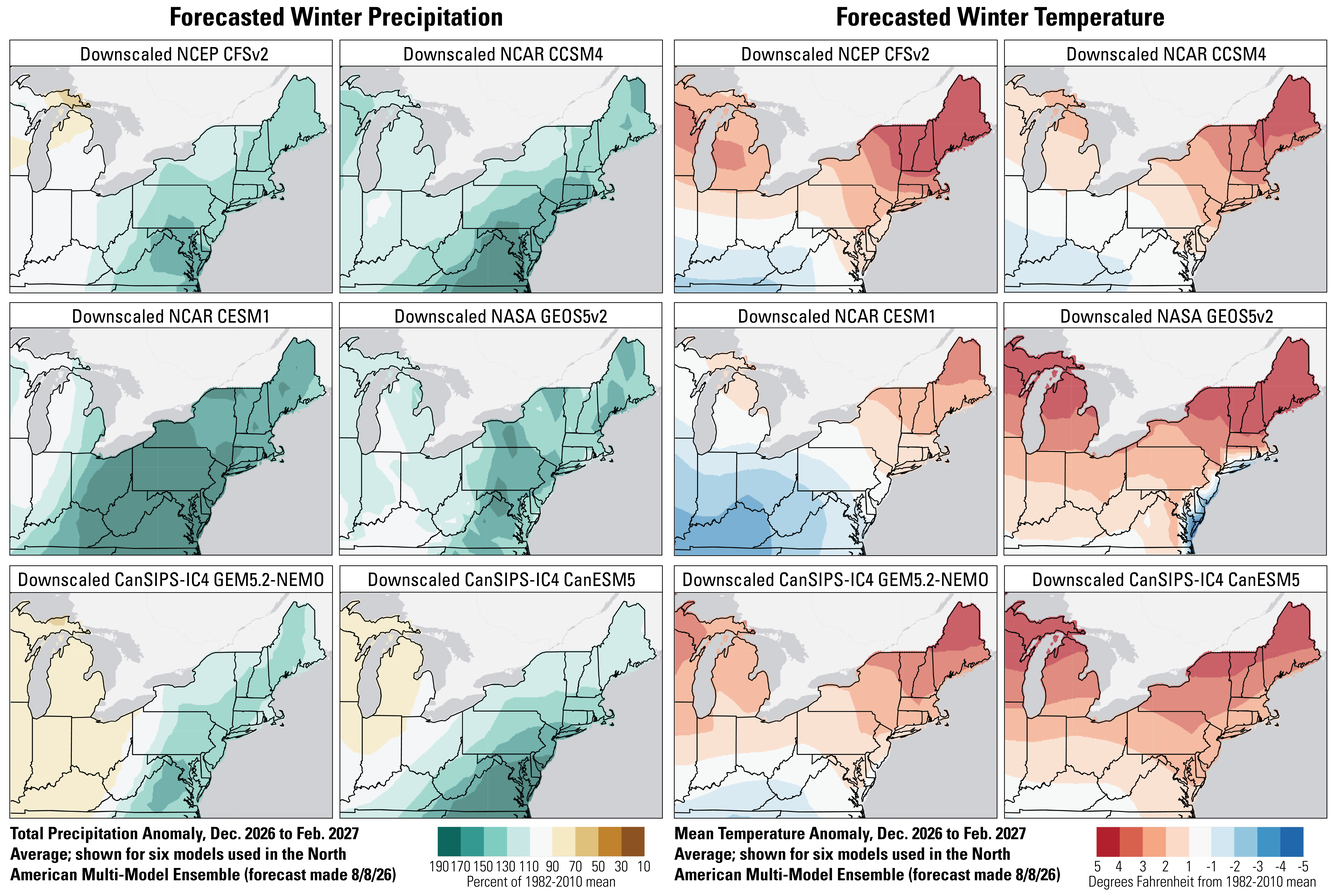
There are differences among seasonal forecast models, and in areas where those differences are larger, confidence in the forecast is lower. We don’t yet know which model will be the most accurate. Overall, the six seasonal forecast models used as part of the North American Multi-Model Ensemble suggest higher confidence of a wet winter across the Northeast region. This is consistent with the broader shift in odds during El Niño events.
These seasonal forecast models also suggest increased confidence that winter temperature, on average, will be warmer than average. The agreement among models does not mean there will definitely be reduced snow or ice, but only that the winter temperature overall is more likely to be a few degrees warmer.
What Does This Mean for the Management of Natural Resources?
Natural resource managers can start planning for how they might manage for wetter conditions, including very wet conditions that might cause ponding or flooding. While very wet conditions are not guaranteed this winter, the odds are shifted toward this outcome. In addition, coastal land managers may want to consider the potential ways to adapt to more coastal storms and nor’easters that could produce inundation and overwash events. Big snowfall events are also more likely (but not guaranteed), and some management might warrant consideration of impacts from repeated large snowfall events.
- More frequent coastal storms and nor'easters increase beach and dune erosion, tidal and salinity shifts, and saltwater intrusion into freshwater habitats.
- Increased storm frequency and heavy rainfall can increase the risk of inland flooding and runoff-driven water quality degradation, damage nesting sites for turtles, coastal birds, and damage stream habitat through sedimentation and scouring.
- Warmer winters can worsen or expand the range of invasive species, pathogens, and fungal diseases. Warmer winters can reduce cold-water refugia important for some species.
- Big snowfall events can lead to increased winter recreation (snowmobiles, skiing), which can degrade soil structure and vegetation.
- Fluctuating snowfall can lead to a loss of stable snow cover and damage the subnivean zone that protects plants, microbes, and small mammals from lethal freeze-thaw conditions.
With foresight into the increased chances of more frequent and intense storms this winter, especially coastal storms, managers can consider actions that can be taken early to more effectively manage ecological and related resources.
- Where wetter conditions or repeated storms could cause significant impacts, managers can take low-regret preparedness actions now, such as checking drainage and water-control structures, identifying vulnerable infrastructure or habitats, and preparing for temporary closures or other operational responses.
- Managers can identify key conditions to monitor, such as water levels, soil saturation, salinity, or erosion, and use those observations to guide management decisions as the winter unfolds.
- Repeated flooding, erosion, or saltwater intrusion may create cumulative impacts that are harder to reverse over time. Managers may want to watch for locations where these impacts are becoming more persistent and consider whether different management approaches may eventually be needed.
Questions?
Contact the Northeast CASC if you’d like to discuss this El Niño and adaptation strategies for management of your resources.