



Landscapes
Landscapes
Explore our projects on landscapes.
Filter Total Items: 452
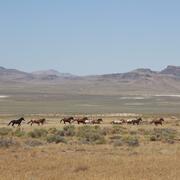
Science for management of America’s iconic wild horses and burros
Wild horses and burros are iconic wildlife of the western USA as well as a complicated management issue on tribal, state, and federal lands. Due to their history as domesticated animals, these wild equids – also called “free-roaming” or “feral” equids – can reproduce quickly, and have few natural predators, allowing their populations to grow rapidly if not managed. When populations are too large...
USGS Sagebrush Science: Supporting Public Safety and Economic Decision Making Across the West
The sagebrush biome is one of the largest ecosystems in North America. Encompassing nearly one-third of the continental U.S., it provides critical resources for millions of Americans and a home for hundreds of plants and animal species in the West. Natural resource management in sagebrush ecosystems can be complex, and science can support management decisions by providing knowledge and tools to...
By
Core Science Systems Mission Area, Ecosystems Mission Area, Land Management Research Program, Earth Resources Observation and Science (EROS) Center, Forest and Rangeland Ecosystem Science Center, Fort Collins Science Center, Northern Rocky Mountain Science Center, Southwest Biological Science Center, Western Ecological Research Center (WERC), Wildland Fire Science

Future of Species Range Shifts: Rising Seas and the Coastal Squeeze: Modeling inland range shifts of Northwest coastal species in response to sea level rise
As climate change drives sea levels higher, coastal species and habitats may adapt by migrating inland. This landward shift may be challenged, however, by the presence of human-made and natural barriers, which may result in coastal habitat loss and declines in associated fish and wildlife populations. This is commonly known as ‘coastal squeeze’. To support the resilience of Northwest...
Future of Species Range Shifts: Integrating adaptation and migration potential into forecasts of geographic range shifts with climate change
Climate change is projected to redraw the boundaries between grassland and forest ecosystems in the Midwest. However, Midwestern landscapes are among the most fragmented in the nation, and this fragmentation could impede natural range change in some species. Current models of range shifts often focus exclusively on climate variables, neglecting how land use patterns could modulate...
Future of Species Range Shifts: Quantifying and Projecting the Effects of Climate Change on the Summer Behavior and Distribution of the Porcupine Caribou Herd in Arctic Alaska
Declines in many barren-ground caribou herds across North America have coincided with the ‘greening of the Arctic’, raising concerns about the influence of changing summer habitat conditions on caribou, and the subsequent effects on Indigenous communities that rely on caribou for subsistence. These cocerns have been compounded by plans and proposals to expand energy development into...
From Water to Life: Impact of Climate Warming on Potential Wetland and First Foods Habitat in Traditional Use Areas of The Klamath Tribes
Project Overview First foods are integral components of the culture, spirituality, medicine, well-being, and health of the Klamath people. Throughout the Klamath Basin, climate change has substantially impacted the seasonality, abundance, and quality of first foods and other culturally important resources. These impacts compound with long-term challenges to food security and food...
Spurring Innovation in Adaptation to Altered Fire Regimes in the Sonoran Desert
Project Overview The biodiversity of the Sonoran Desert has been impacted by more frequent and more intense wildfires, as many of the plant species are unable to withstand nor regenerate after a severe fire. Researchers supported by this Southwest CASC project will aid managers by addressing knowledge gaps in ecological restoration, as well as the challenges that come with restoration in...
Translating Science to Action in Southern California’s Montane Forests
Project Overview The montane forests of Southern California provide countless ecosystem services to the surrounding region, but as they face many climate-related impacts, particularly changes to wildfire regimes, the conservation of these forests is becoming increasingly important. Researchers supported by this Southwest CASC project will leverage and extend an established collaborative...
Accelerating Science to Action Partnerships (ASAP): Implementing science-driven adaptation strategies in the 2-3-2 Landscape
Project Overview In the Southwestern U.S., decades of wildfire suppression, drought, and climate-drive aridification have resulted in unnatural fuel-loading across forests and grasslands. With wildfire severity and frequency on the rise, communities and ecosystems are seeing more post-fire impacts such as flooding and debris flow as well. Researchers supported by this Southwest CASC...
Assessment of Habitat Restoration and Adaptation Successes and Opportunities in the Mississippi River’s National Park Post-Emerald Ash Borer Infestation
Project Overview Minnesota’s forests are being impacted by the effects of numerous climate related disturbances, such as invasive species, increased temperatures and flooding, and severe weather. While managers are working to ensure the longevity of these forests, they are facing a lack of information on how forests are responding to these effects and which strategies prove most...
Enhancing Community and Wildlife Resilience to Sea‐Level Rise and Infrastructure Development in the San Pablo Baylands
Project Overview: The San Pablo Baylands support critical wildlife habitat and major transportation infrastructure, but the combined effects of sea-level rise and planned highway redesigns on habitat and public access remain uncertain. Scientists supported by this Southwest CASC project will work with federal, state, and regional managers to fill key data gaps and model how sea-level...

Effects of global change on alpine and subalpine ecosystems
Atmospheric nitrogen deposition, changing environmental patterns, and recreation are rapidly altering high elevation ecosystems. This project will evaluate long-term biogeochemical, hydrological, and ecological trends in Rocky Mountain National Park to understand the causes and rates of change in alpine and subalpine waters, soils, and vegetation. Resource managers of high-elevation, protected...