



National CASC
National CASC
Featured News
Creating a New Framework for Integrating the Role of Biodiversity Changes into Ecosystem Services
Creating a New Framework for Integrating the Role of Biodiversity Changes into Ecosystem Services
Featured Project
Building Capacity for Actionable and Interdisciplinary Science across the Climate Adaptation Science Center Network
Building Capacity for Actionable and Interdisciplinary Science across the Climate Adaptation Science Center Network
The National Climate Adaptation Science Center (NCASC) generates science and decision-making tools to help our nation respond to the effects of climate change on fish, wildlife, ecosystems, and communities by building relationships with resource managers and conservation practitioners to support effective climate adaptation planning across regional, national, and international scales.
National CASC
National CASC

Learn more about the National Climate Adaptation Science Center below.

Filter Total Items: 164
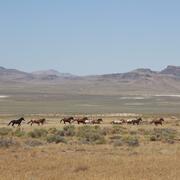
Science for management of America’s iconic wild horses and burros
Wild horses and burros are iconic wildlife of the western USA as well as a complicated management issue on tribal, state, and federal lands. Due to their history as domesticated animals, these wild equids – also called “free-roaming” or “feral” equids – can reproduce quickly, and have few natural predators, allowing their populations to grow rapidly if not managed. When populations are too large...

Climate Adaptation Technical Services (CATS)
CASC Climate Adaptation Technical Services (CATS) is a new, multi-year pilot effort to respond to management needs on climate adaptation. The program provides partners with tailored climate adaptation science, advice, and training to help them rapidly incorporate climate adaptation science into planning and decision making. Overview The CATS team seeks to learn, through iterative...

Webinar: The RAD (Resist-Accept-Direct) Climate Adaptation Framework
Join this webinar to learn more about the Resist-Accept-Direct (RAD) framework, a decision-making tool that helps resource managers make informed strategies for responding to ecological changes resulting from climate change!
'Climate-Smart' Keystone Native Plants for Restoration in a Changing Climate
Project Overview Climate change threatens keystone plant communities and insects that make up the base of functional food webs, but restoration practitioners struggle to factor climate considerations into restoration projects for a number of practical reasons. Researchers supported by this National CASC project will create a trait-based plant vulnerability assessment to guide restoration

A Guide to Modeling Low Flows and Intermittent Streams in the Pacific Northwest
As droughts become more frequent, there is a growing need to understand how drought impacts streamflow permanence. Intermittent streams, or streams that go dry at some point during the year, are found in all ecoregions and represent over half of the global stream network length. As stream intermittence increases, there will be implications for both aquatic and terrestrial wildlife...
Diverse Knowledge Systems (DKS) for Climate Adaptation Fellowship
The Diverse Knowledge Systems for Climate Adaptation Fellowship supports graduate students for one year as they use their diverse experiences, viewpoints, value systems, and cultural knowledge to strengthen their climate adaptation efforts. There are many ways of exploring and understanding the natural world. Tribal Nations and Indigenous peoples have cultural identities developed...

Filling the Knowledge Gaps: Extreme Weather Driven Changes in Streamflow Patterns and their Impacts on Fish in Hawaiian Streams
Freshwater is a critical driver for island ecosystems and essential part of the water cycle in tropical islands, which is threaten by climate change. Changes in streamflow patterns may impact streams, estuarine, and coastal habitats. In Hawai‘i, these habitats support five native stream fish species. To examine how changes in streamflow have impacted habitat quality for these native...

Future of Aquatic Flows: A Data-driven Framework to Inform Projections of Aquatic Flows in the Northeast
As climate change is impacting water resources and aquatic ecosystems, there is a great need for natural resource managers to assess adaptation measures in a holistic manner. This can be done by integrating model predictions of climate, hydrology, and ecosystems with observational data to better refine estimates of conditions on-the-ground; however, it can be challenging to combine these...

Future of Aquatic Flows: Endangered streams: Understanding misalignments between aquatic flows and management strategies to inform adaptation efforts
Stream flow is directly tied to climate, and numerous studies provide substantial evidence that climate change is a threat to future aquatic water flow processes. In the southwestern United States, mountain snow is a primary water source for streams and rivers. However, climate change is threatening the region's mountain snow, leading to reduced snowpack, earlier snowmelt, and more...

Future of Aquatic Flows: Exploring Changes in Rain-On-Snow Events and Their Influence on Future Streamflows, Stream Temperatures, and Management Priorities in the Great Lakes Basin
Rain-on-snow events occur when warm rain falls on an existing snowpack, causing rapid snowmelt that can lead to damaging floods, reduced spring and summer streamflow, and altered stream temperatures, with ecological, social, and economic consequences. Rain-on-snow events can result in a loss of riverine biodiversity, decreases in fisheries production, and degradation of stream habitat...

Future of Aquatic Flows: Impacts of Cryospheric Change on Aquatic Flows and Freshwater Habitat Quality for Fish and Communities
High latitude northern ecosystems are currently warming twice as fast as the global average. Over the last several decades, this has caused dramatic losses of frozen area in the Arctic and sub-Arctic. However, it is unclear how melting coastal mountain glaciers, thawing permafrost, and declines in snowpack will affect the quality of freshwater habitat for culturally and economically...

Future of Aquatic Flows: Towards a National Synthesis of Streamflow Regimes Under a Changing Climate
In ecosystems characterized by flowing water, such as rivers and streams, the dynamics of how the water moves - how deep it is, how fast it flows, how often it floods - have direct effects on the underlying ecological communities. Yet increasingly, climate extremes like droughts and floods are disrupting fragile stream ecosystems by specifically changing their internal aquatic flows...